5 Auto Repair Ad Examples That Fill the Bays
Five auto repair ad examples that win trust and book service — an honest-mechanic UGC ad, a clean-shop hero, a warning-light before/after, a testimonial, and an oil-change offer.
Auto repair ads that fill bays all defuse the same fear before they sell anything: am I about to get upsold on work I don’t need? Certifications, bay count, and “family owned since 1987” don’t register until that suspicion is handled. The five fictional ads below cover the five angles that convert wary drivers — honesty, a credible shop, the diagnostic transformation, reputation, and a maintenance offer — each in a visibly different format.
Key takeaways
- Drivers screen for honesty, not skill — they can’t judge your wrenching, so an ad that promises no upsell beats “quality service” every time.
- Maintenance offers acquire; trust retains: a cheap oil change gets them in the bay, honest service brings them back for the big jobs.
- Show the proof a driver can verify — the old part, a written estimate, a real review count — not abstract competence claims.
- Five distinct concepts reach five different driver mindsets; one recycled “winner” caps your lead flow under Meta’s current delivery.
What makes a great auto repair ad
The buyer is a driver who suspects every shop is angling to pad the bill. They cannot evaluate whether the strut really needs replacing, so they evaluate whether you seem honest. That suspicion is the wall every auto repair ad has to get over first.
The proof that matters is concrete and checkable — a mechanic who explains things, a shop that shows you the worn part, a written estimate before a wrench turns, and reviews from your actual town. Glossy stock photos of a smiling tech with a clipboard read as a chain, and drivers burned by chains are exactly who you’re courting. One honest promise per ad, made verifiable, is what separates the best static ads from filler.
The economics favor the repeat relationship. Local-service CPMs often land in the $10–$25 range, and a service booking usually costs less than a competitive auto-repair-keyword click on search. Because a trusted customer returns several times a year and brings the high-margin repairs with them, a shop can afford to acquire on a thin first visit — the oil change is the handshake, not the profit.
| Ad | Format | Angle | Funnel stage | Best for |
|---|---|---|---|---|
| No-upsell UGC | UGC | Trust / honesty | Cold | General repair shops |
| Clean-bay hero | Service hero | Credibility / value | Cold/warm | Dealer-alternative positioning |
| Lights-off split | Before/after | Transformation | Warm | Diagnostics & check-engine work |
| Showed-the-part testimonial | Testimonial | Trust / proof | Warm | Shops with strong reviews |
| $39 oil-change offer | Offer | Price / acquisition | Cold/warm | New-customer pipelines |
1. The no-upsell UGC ad
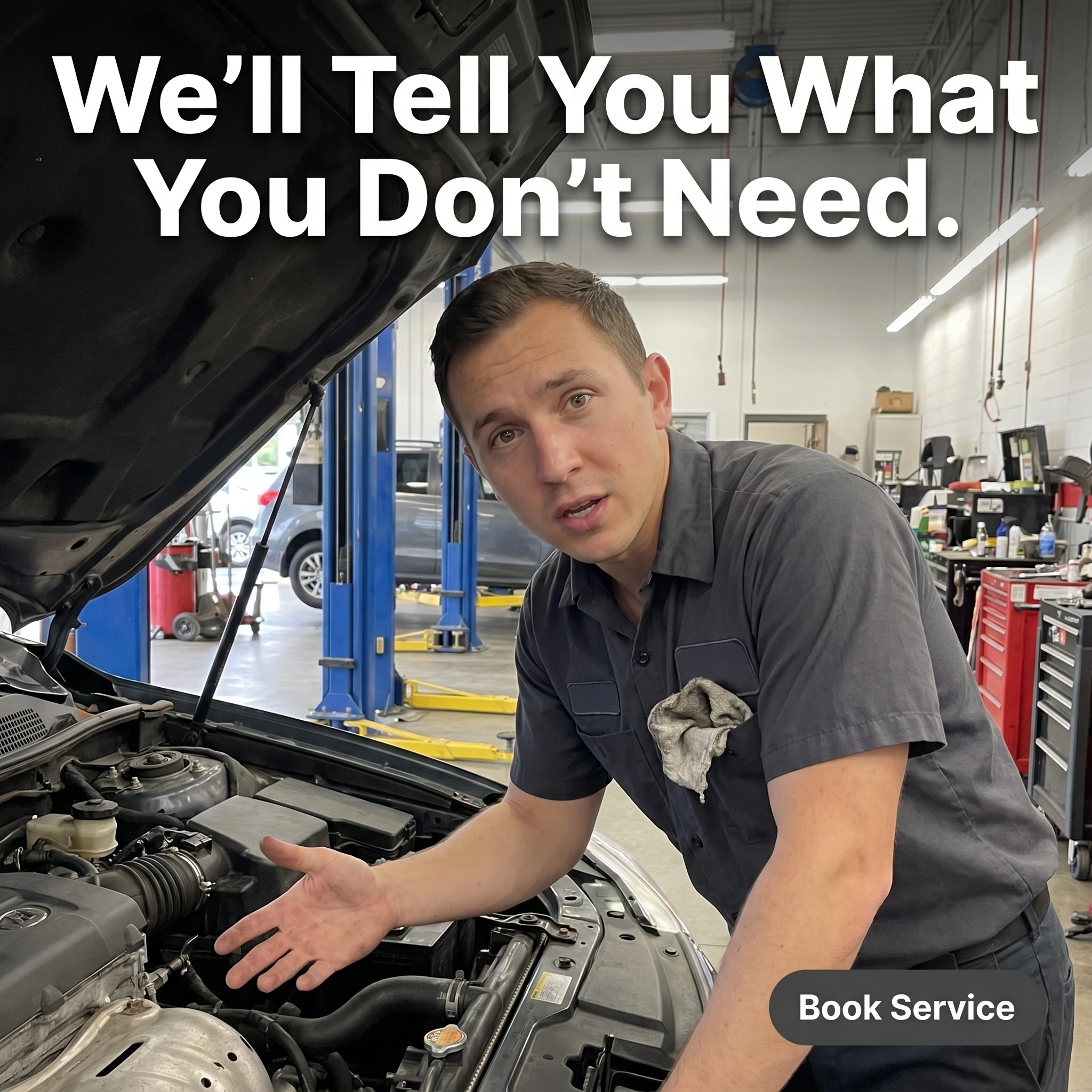
The format & angle. A Trueline Auto mechanic leaning under an open hood, explaining something to the camera, shot like a customer filmed it in the bay. Trust, aimed at the upsell fear.
Who it targets. Cold drivers in the service area who need a shop they don’t have to second-guess.
The hook. “We’ll Tell You What You Don’t Need.” It flips the script — most shops sell what you do need; promising the opposite signals a different kind of place.
Why it works. The candid bay shot is proof of transparency, not a claim of it — open hood, real grease, a mechanic mid-explanation. Naming the thing drivers fear and promising to spare them it is disarming precisely because no one expects a shop to say it out loud. The unpolished frame reads as the local independent people trust over the dealer, and that earns the save and cheaper reach.
Steal it. Film or photograph a mechanic mid-explanation on a real job. Headline the honest promise your best customers already praise you for — no upsell, written estimates, “we’ll show you” — not your years in business.
2. The clean-bay hero ad
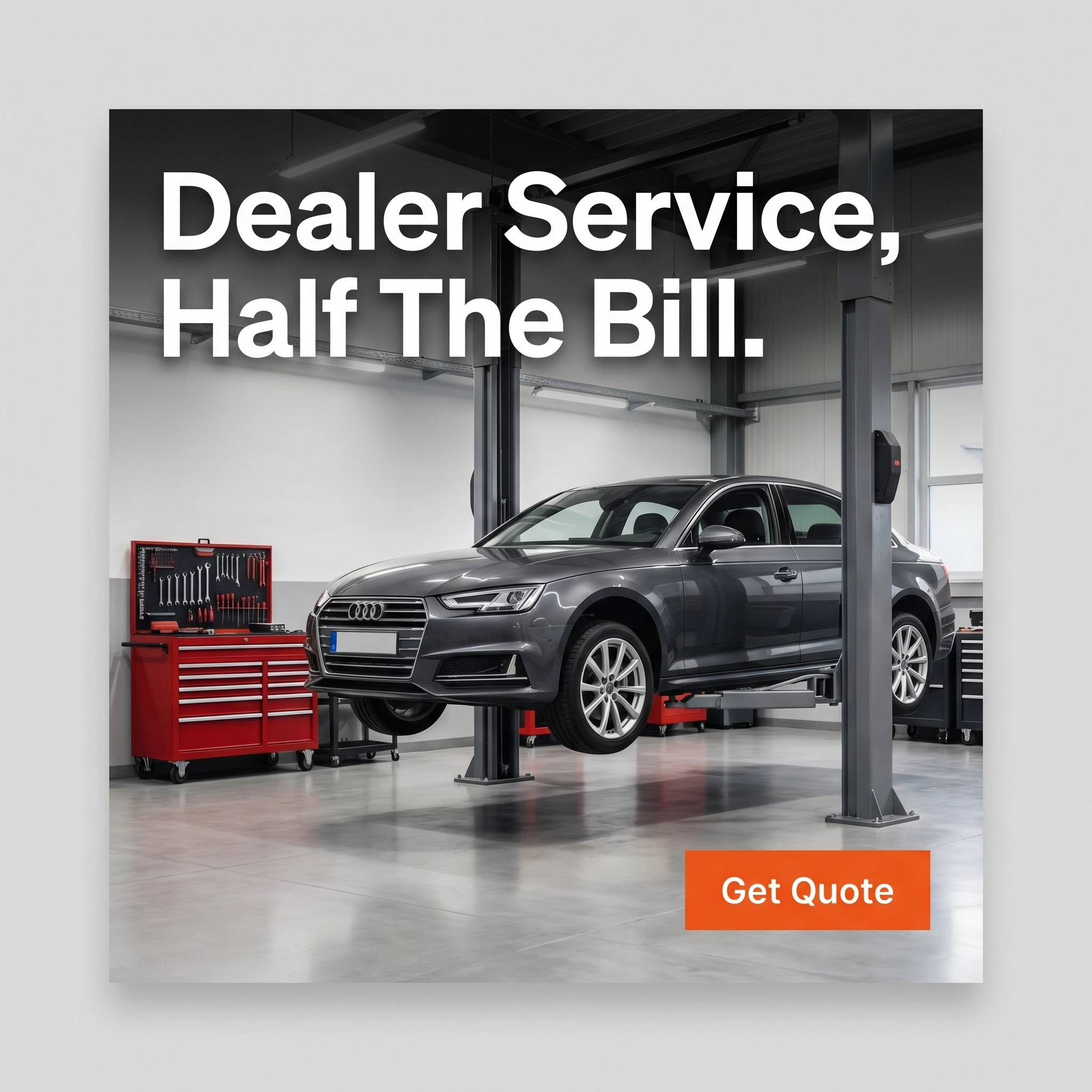
The format & angle. Meridian Motors’ hero shot: a spotless, well-lit service bay, a car on the lift, tools squared away, no people. Credibility and value, positioned against the dealership.
Who it targets. Cold and warm drivers tired of dealer prices but worried an independent can’t match the quality.
The hook. “Dealer Service, Half The Bill.” It names the exact trade-off the buyer is weighing and resolves it in their favor.
Why it works. The clean, organized bay does the heavy lifting — drivers equate a tidy shop with careful work, so the photo pre-answers the quality doubt that keeps people overpaying at the dealer. The headline then makes the value case explicit. Order in the frame is the proof; the price comparison is the pitch.
Steal it. Photograph your cleanest, best-lit bay with a car on the lift, no clutter. Headline the dealer-versus-independent trade-off your customers actually voice, and let the tidy shop carry the credibility.
3. The lights-off split ad
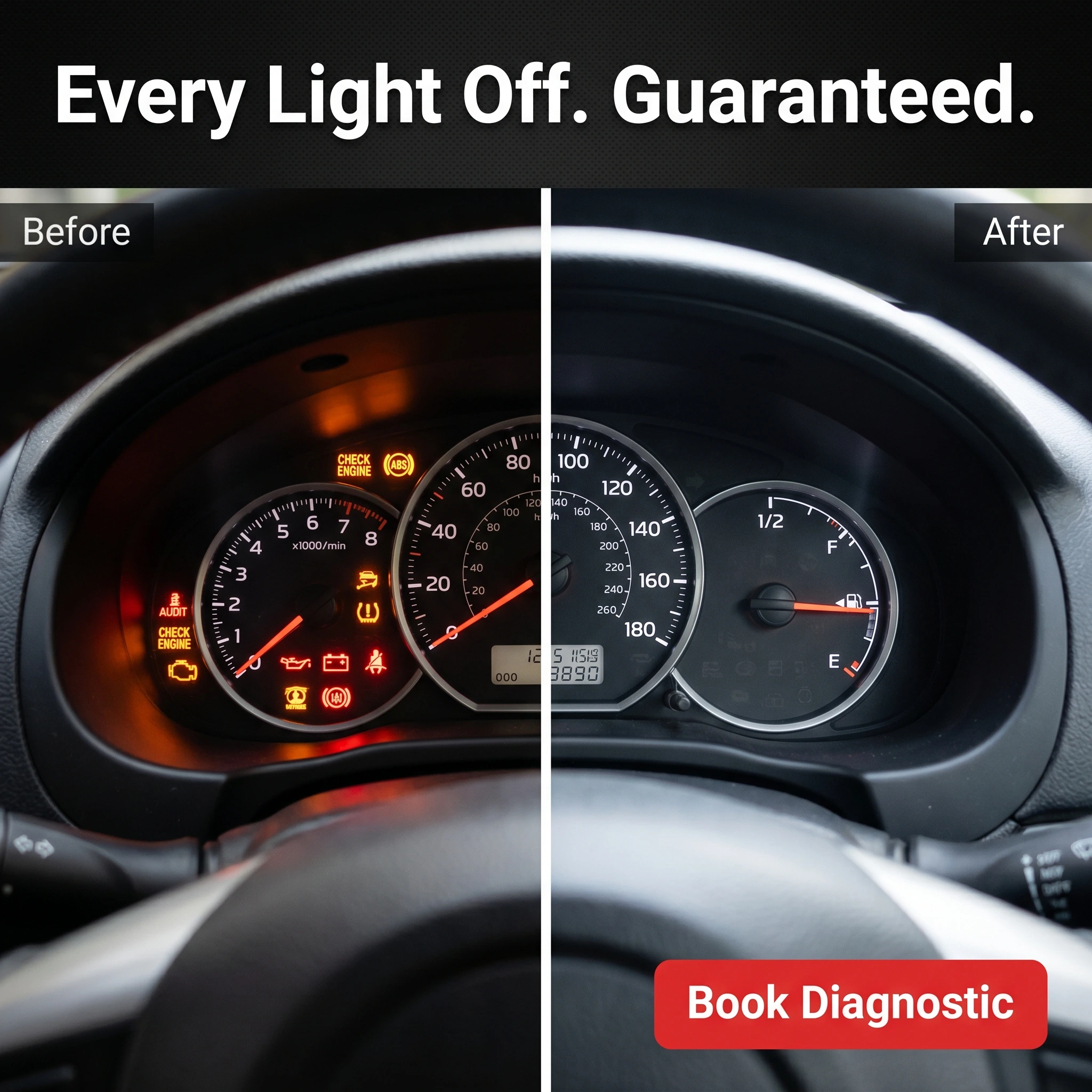
The format & angle. Redline Auto Care’s diagnostic transformation: a dashboard lit up with warning lights on the left; the same dash, every light off, on the right. The shop’s natural before/after.
Who it targets. Warm drivers staring at a check-engine or ABS light, anxious about what it’ll cost.
The hook. “Every Light Off. Guaranteed.” The visual is the proof; the guarantee answers the fear that the light comes back next week.
Why it works. A dashboard full of warning lights is a universal stressor, and showing it resolved is instant, legible relief — no automotive knowledge required to read it. The before/after format, usually reserved for cosmetic trades, works here because the dashboard is the customer’s emotional dashboard. Adding “Guaranteed” addresses the specific dread that the fix won’t hold.
Steal it. Photograph a real cluster of warning lights and the same dash cleared after the repair, same angle. Pair it with whatever guarantee you can honestly stand behind. The contrast does the persuading.
4. The showed-the-part testimonial ad
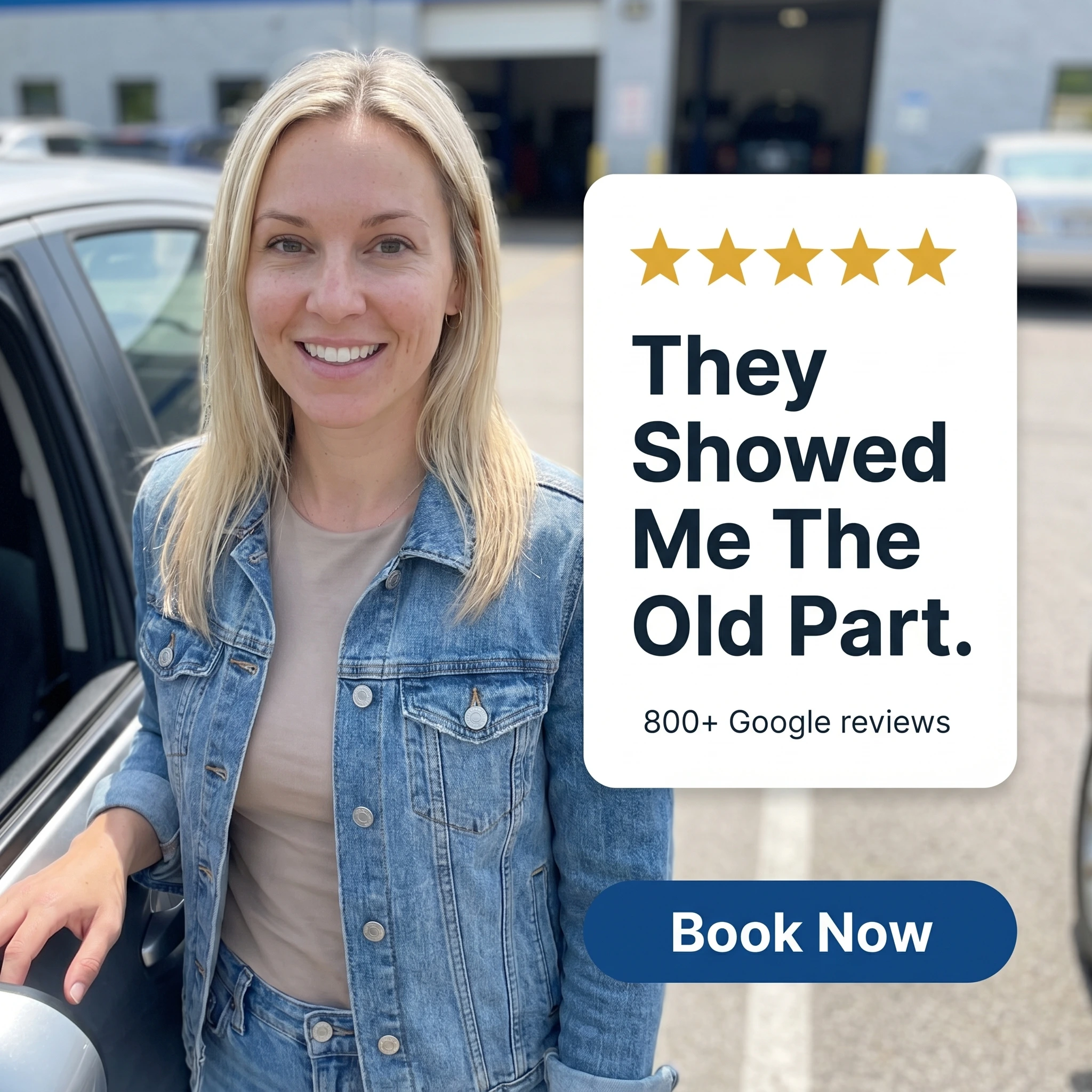
The format & angle. Honest Axle: a satisfied driver beside her car and a quote card, five stars, “800+ Google reviews.” Trust, told through a small, telling detail.
Who it targets. Warm audiences — drivers comparing two or three local shops before committing.
The hook. “They Showed Me The Old Part.” A review fragment that proves transparency with a single concrete action.
Why it works. At the comparison stage, drivers aren’t grading torque specs; they’re collecting honesty stories. “Showed me the old part” is sticky because it’s a tiny, specific act that signals a shop with nothing to hide — far more persuasive than “honest and fair.” The visible review count turns one story into a pattern, and the customer photo grounds it. This recycles your reviews into paid reach.
Steal it. Search reviews for “showed me,” “explained,” “honest,” “didn’t push.” Build the card around the most specific line and display your live review count beneath it.
5. The $39 oil-change offer ad

The format & angle. Garage 12’s acquisition push: big type, one price, a bold red-and-black background, no photo. Price and a foot in the door.
Who it targets. Cold and warm drivers due for routine maintenance — the lowest-stakes reason to try a new shop.
The hook. “$39 Synthetic Oil Change.” The price is the entire message; specificity (“synthetic”) signals it’s a real deal, not a bait number.
Why it works. The oil change is the classic foot-in-the-door for auto repair: it costs the shop little, gets the car on the lift, and surfaces the legitimately needed repairs that build the relationship. The typography-only format reads as a genuine local special rather than an agency campaign, and a concrete price filters for ready buyers. The real return is the second visit, not the $39.
Steal it. Price an oil change low enough to draw first-timers but real enough to be credible, and treat the visit as the start of a relationship, not a transaction. Then rotate the creative before ad fatigue erodes it.
Put all five on the lift
An honesty promise, a credible shop, a diagnostic transformation, a trust story, and a maintenance offer — five auto repair ads aimed at five different driver moments. Since the Andromeda upgrade widened how many ads Meta weighs per auction, the accounts that earn cheap delivery are the ones feeding it real range — five separate ideas, not one idea in five fonts — so each driver meets the angle that fits them. The cross-trade local-service patterns hold up too — the home services ad examples breakdown covers the broader playbook, and to choose the right placements and ratios see Facebook ad aspect ratios by placement.
Run the offer and UGC concepts to acquire new drivers, then retarget with the testimonial and hero creative to convert one-time oil changes into the repeat relationships that carry the high-margin work. The work that stalls most shops is producing five-plus distinct concepts on a schedule — and Zendux takes it off your plate, generating on-brand static variants with AI and bulk-launching them across ad sets faster than a tech can rack a tire.