Tree Service Ad Examples: 5 Ads That Book Crews
Tree service ad examples that book crews lead with safety — a hazard-tree UGC ad, a crane-removal hero, an overgrown-yard before/after, a licensed-and-insured testimonial, and an off-season trimming offer.
Tree service ads that actually book crews answer the homeowner’s quiet fear first: that tree could fall on my house, and the wrong company will make it worse. Price is secondary; the buyer is screening for safety, proof of insurance, and a crew that can drop a sixty-foot oak without flattening the fence. Five invented tree service ads show the angles that earn calls — risk relief, expertise at scale, the overgrown-to-safe transformation, licensed-and-insured trust, and an off-season offer — each in a visibly different format.
Key takeaways
- Safety is the headline, not the footnote — the homeowner’s first question is liability and damage, so license and insurance are the strongest trust signals you own.
- Meta wins the plannable, high-ticket work — dead and leaning trees that homeowners stew over for months — while the limb-on-the-roof emergency goes to search.
- Show controlled power: a clean crane or rigging job proves you can take down something big without taking down anything else.
- Run all five, not one on repeat — the storm-rattled owner, the big-removal shopper, and the off-season pruner are buyers one recycled ad can’t reach under Meta’s delivery.
What makes a great tree service ad
The buyer is a homeowner staring at a problem they cannot solve themselves and cannot afford to get wrong. A dead ash leaning toward the bedroom. A storm-split limb hung up over the driveway. A row of overgrown pines shading out the whole backyard. The common thread is risk — to the house, to the family, to the power line — and the fear that an uninsured outfit with a chainsaw turns a $4,000 removal into a $40,000 insurance claim.
That is why the proof that matters is different from most home trades. Reviews help, but the load-bearing trust signal is licensed, insured, and certified — ideally an ISA Certified Arborist credential and visible proof your crew rigs heavy wood down in controlled pieces. Homeowners have heard the horror stories: the tree that came down on the roof it was supposed to save, the “guy with a truck” who vanished mid-job. Your creative has to answer that fear before it asks for the call. Pin each ad to a single fear and let the photo prove it — the focus that separates the best static ads from a yard sign blown up to billboard size.
The economics favor patience. A removal that clears four or five figures lets you pay a healthy cost-per-consult and still profit — and Meta impressions stay cheap next to what removal keywords fetch per click on search. The catch is timing: most tree work is deferred, so Meta is the trusted name when the deferral tips into a decision. That makes a steady licensed-and-insured presence more valuable than a burst of emergency ads, since the limb-on-the-roof crowd is already on Google. Pressure washing companies play a faster, cheaper game — the pressure washing ad examples breakdown shows the opposite end of the outdoor-service spectrum.
| Ad | Format | Angle | Funnel stage | Best for |
|---|---|---|---|---|
| Leaning-tree UGC | UGC | Urgency / risk relief | Cold/warm | Storm-response & hazard removals |
| Crane-removal hero | Service hero | Expertise / scale | Cold | High-ticket removal revenue |
| Overgrown-yard split | Before/after | Us-vs-the-old-way | Warm | Aging-property markets |
| Licensed-and-insured testimonial | Testimonial | Trust / credibility | Warm | Crews with strong reviews |
| Off-season trimming offer | Offer | Price / seasonal | Cold/warm | Dormant-season booking pushes |
1. The leaning-tree UGC ad
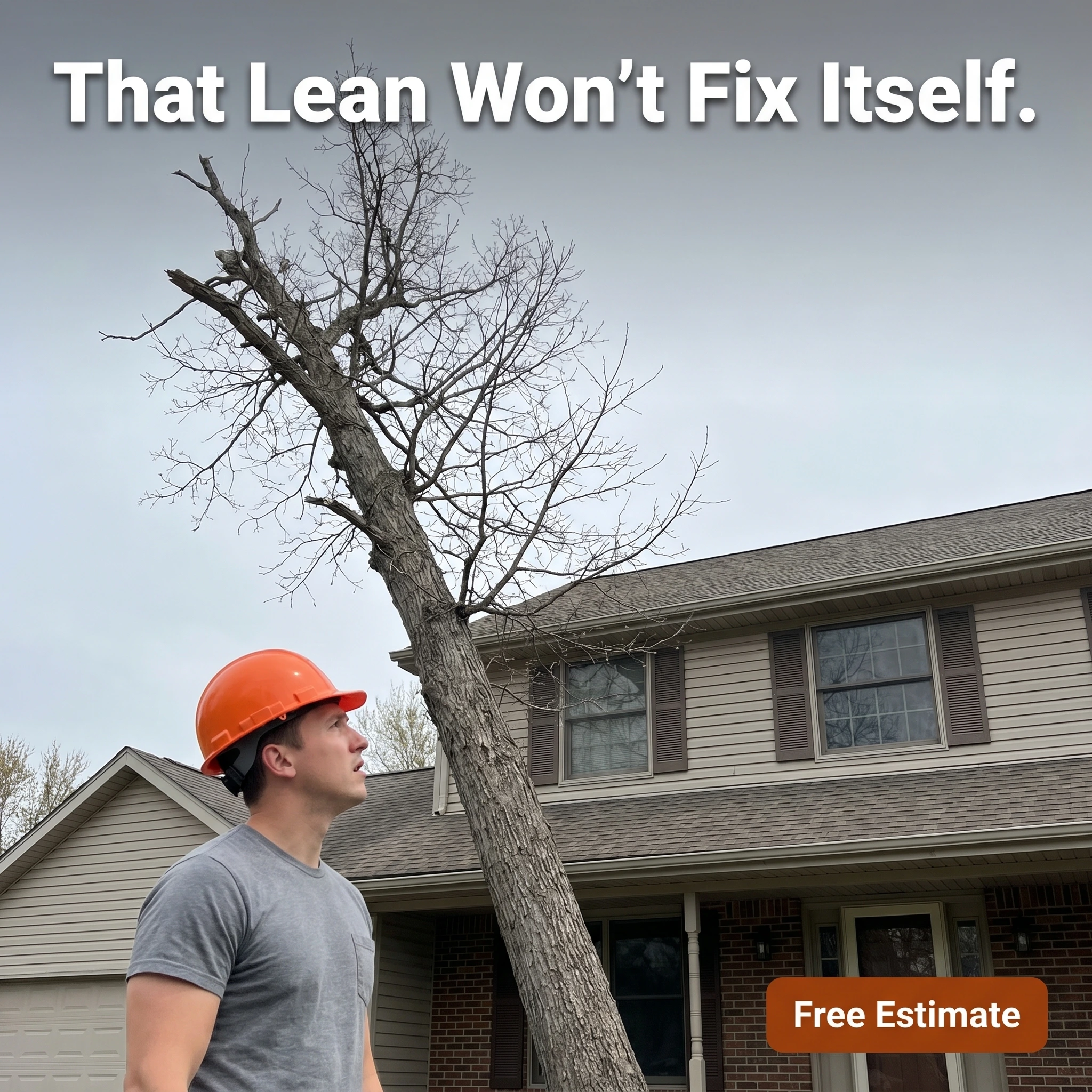
The format & angle. A Canopy & Co. arborist in a hard hat standing at the base of a big dead oak that leans visibly toward a two-story house, shot like a worried homeowner grabbed the photo from the deck. Urgency and risk relief, no theatrics.
Who it targets. Cold and warm homeowners with a tree they already side-eye — not in crisis tonight, but uneasy every time the wind picks up.
The hook. “That Lean Won’t Fix Itself.” It names the exact thing the homeowner has been telling themselves to ignore, and quietly removes the excuse to keep waiting.
Why it works. The candid frame is proof of presence, not a stock promise — a real arborist, a real lean, a real house in the background. In a category where the buyer’s core fear is procrastinating until the tree decides for them, naming the lean converts low-grade dread into a reason to get an estimate now. The unpolished phone-photo look reads as a local crew that shows up, not a national lead broker.
Steal it. Next time a crew quotes a hazard tree, have the arborist photographed at its base looking up (homeowner’s permission, phone camera, house in frame). Write the headline as the blunt thing the homeowner won’t say out loud — the lean, the dead crown, the crack — and let the picture carry the threat.
2. The crane-removal hero ad
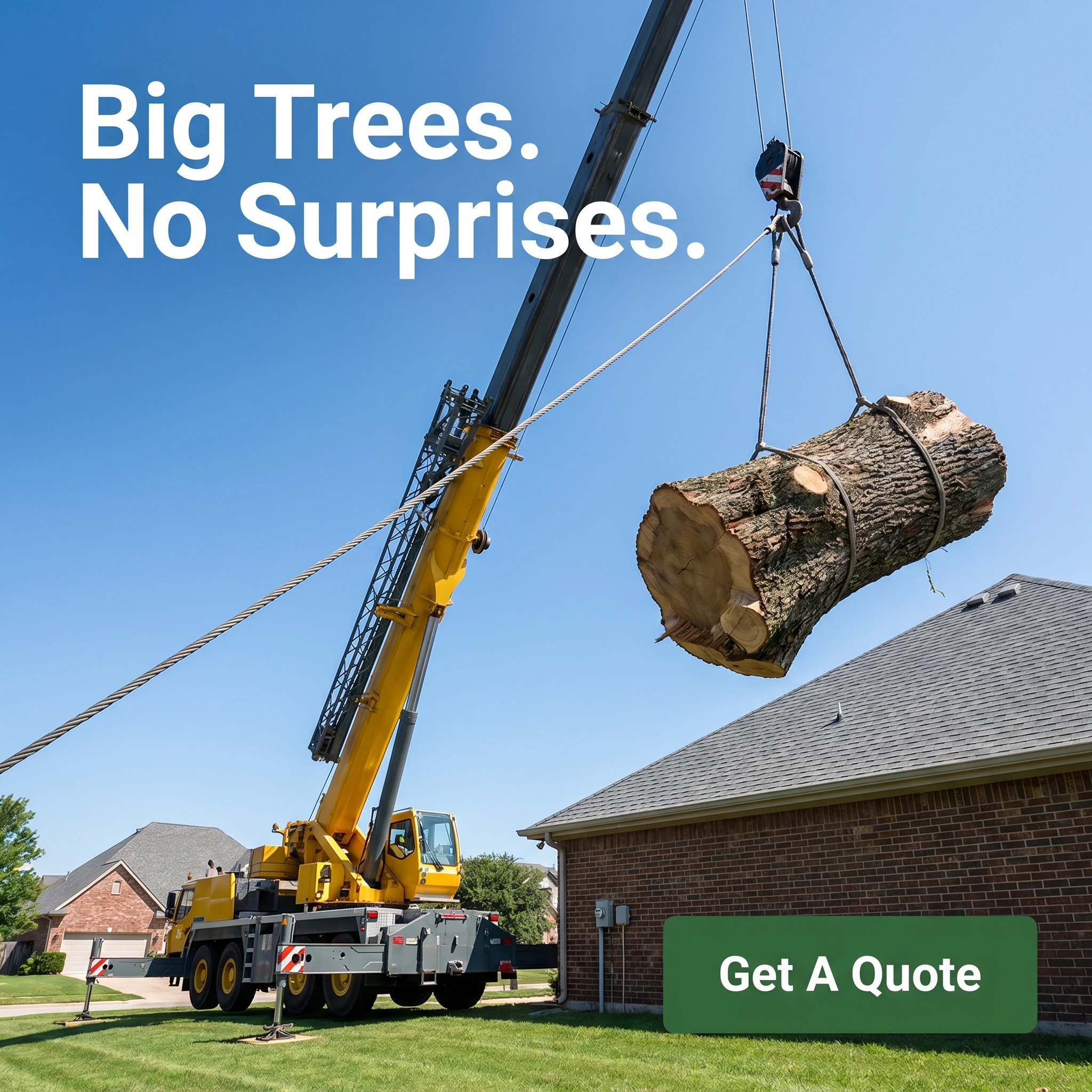
The format & angle. Timberline Tree Care’s signature shot: a crane hoisting a massive cut section of trunk up and away over a tidy suburban roofline, rigging taut, everything under control. Expertise and scale — proof you can handle the job most outfits can’t.
Who it targets. Cold homeowners with a large, complicated tree — the close-to-the-house, over-the-power-line removal that scares off the cheap competition.
The hook. “Big Trees. No Surprises.” Four words that promise the thing a homeowner with a huge tree actually wants: no fence crushed, no roof clipped, no surprise change order.
Why it works. A crane in the frame is instant credibility — it signals capitalization, training, and the judgment to take heavy wood down in controlled pieces instead of dropping it and hoping. Removal buyers aren’t shopping for the lowest bid on a big tree; they’re shopping for the crew least likely to damage the house. The “No Surprises” line answers the second fear — the runaway invoice — without a single price on the image.
Steal it. Photograph your most impressive crane or rigging job mid-lift, framed so the house and the suspended wood are both visible. Headline the control you deliver, not the equipment spec — the homeowner cares that nothing goes wrong, not the crane’s tonnage.
3. The overgrown-yard split ad
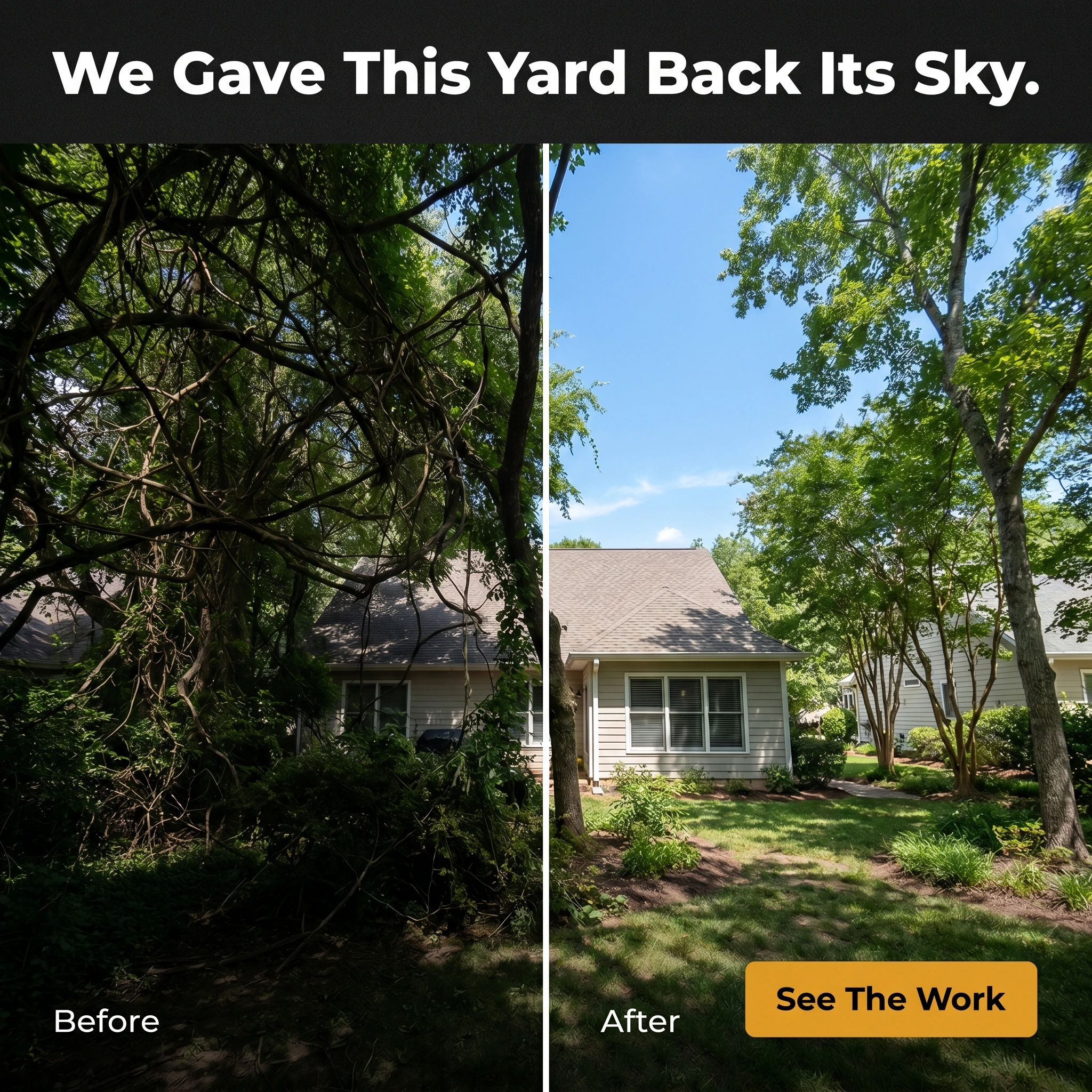
The format & angle. Highbough Tree Service’s transformation: left half a backyard smothered under tangled, overgrown limbs in gloom; right half the same yard after crown-thinning and removals, open and sunlit, the house finally visible. The us-vs-the-old-way contrast the trade owns.
Who it targets. Warm homeowners on older, tree-heavy lots — the “we haven’t touched these in fifteen years” property that has slowly gone dark.
The hook. “We Gave This Yard Back Its Sky.” It reframes tree work as a gain — light, space, a usable yard — rather than the grim chore of cutting things down.
Why it works. Overgrowth creeps up so gradually that homeowners stop seeing it; the split frame makes the before look like the liability it became — blocked light, leaning deadwood, a roof under constant debris. The right side pre-sells craftsmanship too: clean cuts, a tidy cleanup, no ruts in the lawn. This format turns a vague “we should deal with those trees someday” into a concrete picture of the payoff.
Steal it. Shoot every big trimming or removal job from the same spot before and after — make it a crew habit. Lead with what the homeowner gains (light, view, a safe yard), and keep the after-frame spotless, because the cleanup is half of what they’re buying.
4. The licensed-and-insured testimonial ad

The format & angle. Bough & Branch: a homeowner standing in front of her house beside a quote card, five stars, “480+ verified reviews,” with a small “Licensed & Insured” badge. Trust and credibility, told through the fear it resolves.
Who it targets. Warm audiences — estimate-requesters and site visitors comparing two or three local crews before committing to a four-figure removal.
The hook. “Fully Insured. Not A Scratch On The House.” A review fragment that speaks directly to the homeowner’s nightmare and reports it didn’t happen.
Why it works. No homeowner can grade an arborist’s rigging from a photo, so they grade the downside instead. A review tying proof of insurance to a clean outcome (“not a scratch”) sticks far harder than “great service, friendly crew.” The visible review count turns one homeowner’s relief into a pattern, and the insured badge carries weight a low bid never could — turning reviews you spent years earning into reach.
Steal it. Comb your reviews for the coverage words — “insured,” “careful,” “no damage,” “cleaned up” — pull the one that best names the fear it laid to rest, and set it on a card with your live review count and a license-and-insured line below. Proof of coverage is the most persuasive thing in a tree ad.
5. The off-season trimming offer ad
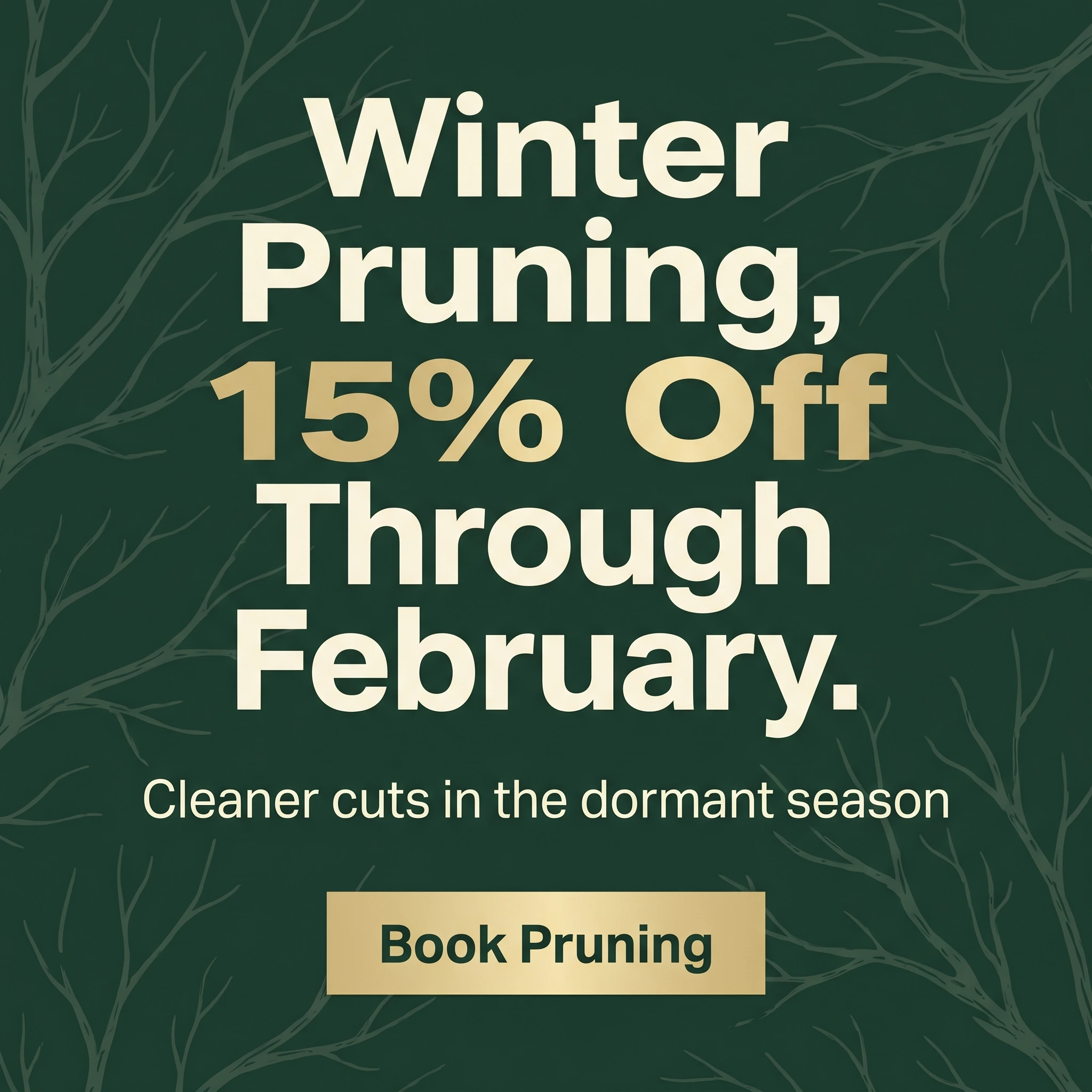
The format & angle. Rootwise Tree Co.’s dormant-season push: bold type, one discount, one deadline, a deep evergreen background with a faint bare-branch motif. Price and seasonality, no photo.
Who it targets. Cold and warm homeowners in late fall and winter, when pruning cuts heal cleaner, deciduous structure is visible, and crews have open capacity to fill.
The hook. “Winter Pruning, 15% Off Through February.” The discount anchors it; the named month makes the deadline real and checkable.
Why it works. Off-season pruning is the trade’s smartest foot-in-the-door: it fills the slow months, it’s genuinely better for most trees, and the pruning visit surfaces the hazard trees and removals that become next season’s high-ticket jobs. Text-only, it looks like a small shop’s seasonal deal rather than a franchise campaign, and the dated deadline outperforms “limited time” because the homeowner can put it on the calendar. The season does the targeting for you.
Steal it. Pick an honest discount on dormant-season pruning, cap your slots so the deadline means something, and run it through late fall and winter — then rotate the creative before ad fatigue erodes it. Use the pruning visit to flag the removals you’ll book in spring.
Put the whole crew to work
A hazard warning, a crane removal, a yard reclaimed, an insured testimonial, and a seasonal deal — five tree service ads aimed at five different homeowner moments. Since the Andromeda overhaul, Meta’s auction weighs far more candidate ads per impression, and that headroom rewards accounts that hand it real variety. Copies of one winner waste it; five honest angles let it sort the worried-tree owner, the big-removal shopper, and the off-season pruner apart.
Set a deliberate rhythm: hazard and storm-response creative through storm season, the licensed-and-insured testimonial live all year, the crane hero and overgrown-yard split running steady to capture the planners, and the pruning offer in the dormant window. When a winner comes back for another season, relaunch it from the same post ID so its banked comments and reactions stay attached instead of resetting to zero. Other outdoor trades face the same cadence; the landscaping ad examples and broader home services ad examples breakdowns cover the cross-trade patterns.
Drawing up that many concepts each season is the bottleneck Zendux clears: it generates static ad variants in your crew’s branding, bulk-launched across ad sets faster than a morning crew meeting.
Book more removals with better creative →
Want to generate winning tree service ads? Start using Zendux AI