5 Water Damage Restoration Ad Examples That Win Calls
Five water damage restoration ad examples built for emergencies and insurance — a fast-response UGC ad, a mold-prevention hero, a dry-out before/after, an insurance testimonial, and a free-inspection offer.
Water damage restoration ad examples that win the call work a hard truth most agencies ignore: the 2 a.m. flooding emergency goes to Google, so Meta’s job is to own the relationship before and after it. A homeowner watching water rise is searching, not scrolling — but the ads below build the name recognition that decides who they search for, geo-target the neighborhoods a freeze just hit, and answer the insurance and mold questions that get people to call early. Below are five examples covering the angles that earn that call: speed, mold prevention, the dry-out, insurance trust, and a free-inspection offer — each in a visibly different format.
Key takeaways
- Meta plays the run-up, not the moment — the live emergency goes to search; ads build the familiarity that wins that search, then re-engage neighborhoods after a storm.
- Speed is the whole pitch: standing water grows mold in 24–48 hours, so a same-day response guarantee is a real, falsifiable hook.
- “We bill your insurance directly” removes the biggest hesitation — homeowners stall on cost, and naming the deductible-only reality unsticks the call.
- Trust is built with proof: IICRC certification, response-time guarantees, and dry-out before/afters answer the fear of letting strangers into a flooded home.
- A range of creative outperforms one repeated ad: the calm homeowner, the freshly flooded block, and the caller dreading the insurance fight each need a different message one recycled creative can’t carry.
What makes a great water damage restoration ad
The buyer is a homeowner in panic — a burst pipe, a flooded basement, a sewage backup, water through the ceiling during a storm. They want one thing: someone competent on the phone, fast. That urgency is the strategic catch. When the disaster is live, the homeowner types “water damage near me” into Google and calls whoever ranks; the Meta feed is not where a crisis gets solved. Pretending otherwise wastes restoration budgets, so be honest about what paid social actually does here.
Meta does three things search can’t. It builds familiarity before the emergency, so when the pipe bursts your name surfaces first — recognition is what converts a panicked search into your phone ringing instead of a competitor’s. It geo-targets after an event: a freeze or storm floods specific neighborhoods, and a tight ad in those ZIP codes the next morning catches homeowners just discovering the damage. And it educates — insurance, the mold timeline, what to do first — which gets people to call early, when mitigation is cheaper and the claim is smaller.
The proof that converts is trust under pressure. Three things carry it: a response-time guarantee (speed is the entire value proposition when mold starts in 24 to 48 hours), “we bill your insurance directly” (cost is the hesitation that delays the call), and IICRC certification plus dry-out before/afters (homeowners letting strangers into a flooded home need to know they’re qualified). Pick one promise per ad — response time, insurance billing, or certification — and prove it rather than listing all three; that restraint is what makes the best static ads land. Plumbers face an adjacent emergency-versus-planned split, and the plumbing ad examples breakdown pairs well with this one.
| Ad | Format | Angle | Funnel stage | Best for |
|---|---|---|---|---|
| 47-minute response UGC | UGC | Speed / urgency | Cold/warm | Brand familiarity + post-event reach |
| Stop-the-mold hero | Service hero | Pain / fear relief | Cold/warm | Educating before the emergency |
| Flooded-to-dry split | Before/after | Us-vs-the-damage | Warm | Proving capability and outcome |
| Insurance-handled testimonial | Testimonial | Trust / credibility | Warm | Claims-anxious homeowners |
| Free-inspection offer | Offer | Price / value | Cold/warm | Low-friction first contact |
1. The 47-minute response UGC ad
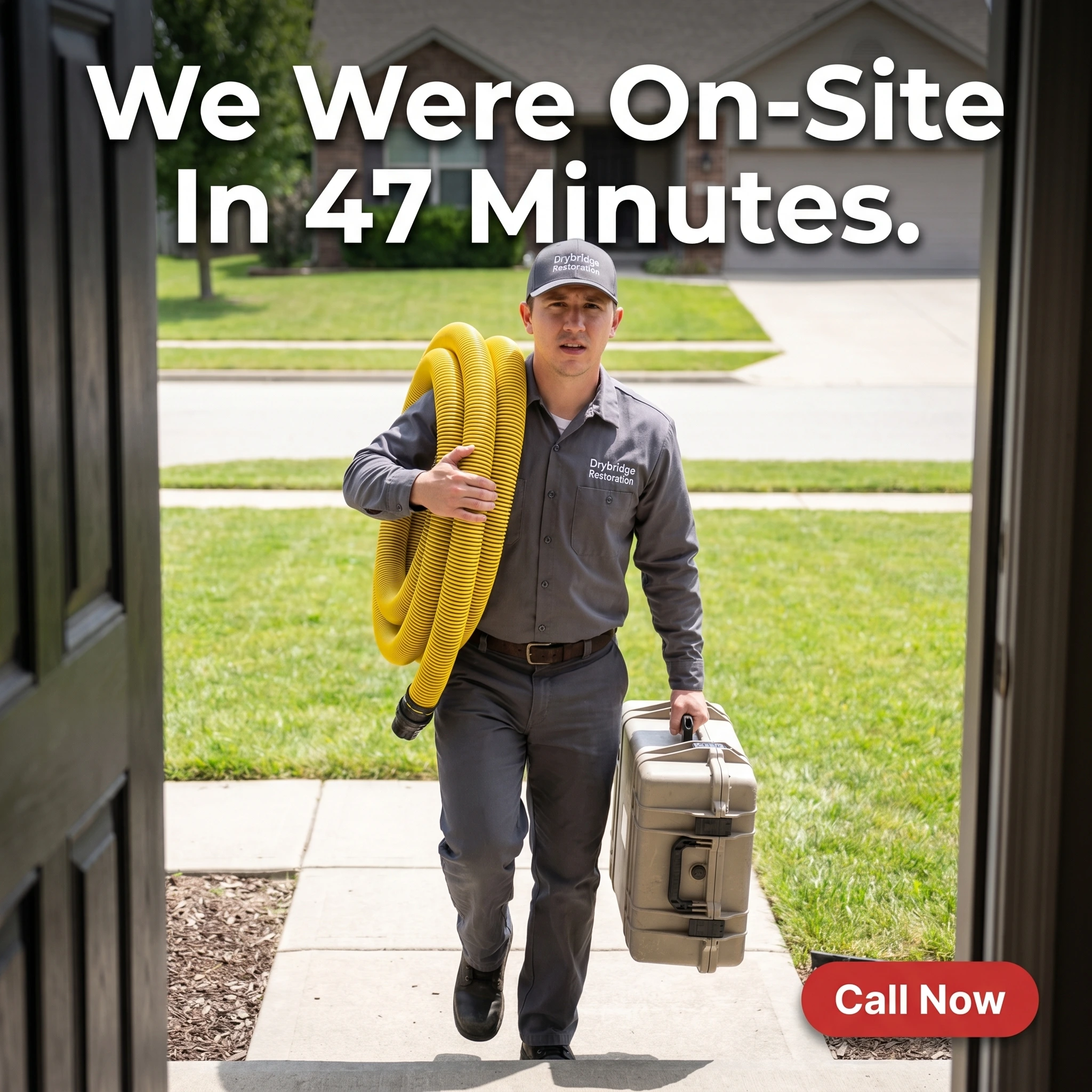
The format & angle. A Drybridge Restoration technician striding up a front walk with a coiled hose and extraction gear, shot like the homeowner grabbed a phone photo when help arrived. Speed, made human.
Who it targets. Cold and warm homeowners in the service area — not in crisis yet, but filing away who shows up fast. Broad for familiarity; tighten the radius after a storm.
The hook. “We Were On-Site In 47 Minutes.” A specific number beats “fast, 24/7 response” because it’s checkable — 47 minutes is a story, “fast” is a claim.
Why it works. In an emergency trade, the buyer’s deepest fear is calling and waiting — water rising while nobody comes. A candid arrival shot is proof of response, not a promise: gear in hand, on the porch, already here. The oddly specific minute count reads as a real dispatch record rather than marketing — which is what makes a homeowner remember the name when their own ceiling drips. UGC also earns the cheap reach and familiarity that win the eventual search.
Steal it. Photograph a tech arriving on a real call — gear in hand, walking to the door, phone camera. Headline your true average response time as a specific number, not a round one.
2. The stop-the-mold hero ad
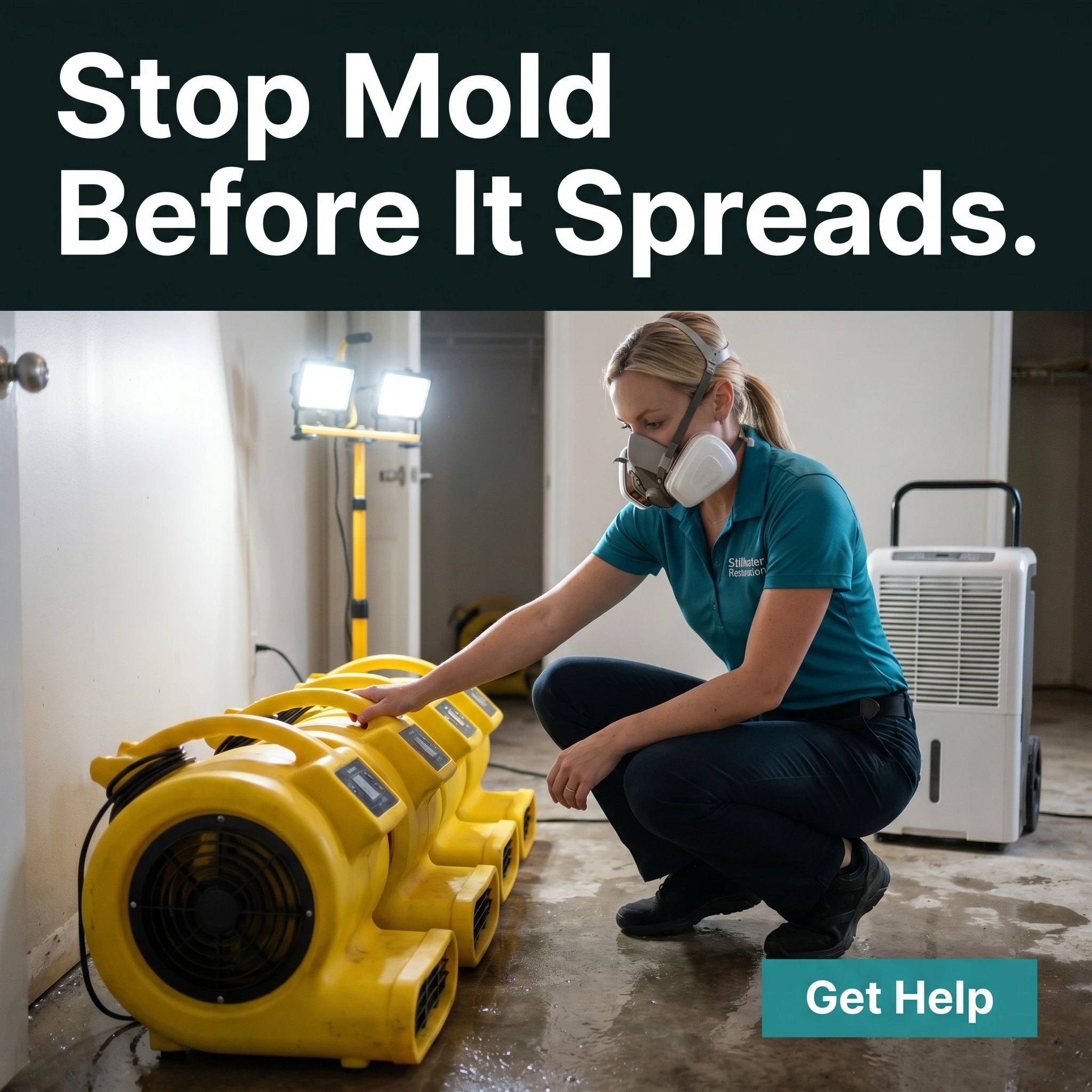
The format & angle. Stillwater Restoration’s on-the-job hero: a technician in a branded uniform and respirator setting up air movers and a dehumidifier in a damp room, clean and competent under work lighting. Pain and fear relief — the threat named and handled.
Who it targets. Cold and warm homeowners being educated before disaster — the ones who don’t yet know that water sitting two days becomes a mold problem. Top-of-funnel teaching that pays off later.
The hook. “Stop Mold Before It Spreads.” It reframes water damage from a wet-floor nuisance into a ticking clock — the truth, and the reason to call within hours.
Why it works. Most homeowners underestimate water damage until it’s mold on the drywall, and this ad sells the invisible stakes. Naming mold turns “I’ll deal with it tomorrow” into “I should call now,” because the fear is concrete and time-bound. The drying equipment quietly answers the competence question — a trained crew with the right gear, not a wet-vac and a fan. As a demand-gen Meta ad, it plants the urgency that converts the next time water appears.
Steal it. Photograph your crew mid-dry-out — air movers staged, dehumidifier running, a tech in PPE. Headline the threat you prevent (mold, not “water mitigation”), and let the equipment prove you can stop it.
3. The flooded-to-dry split ad
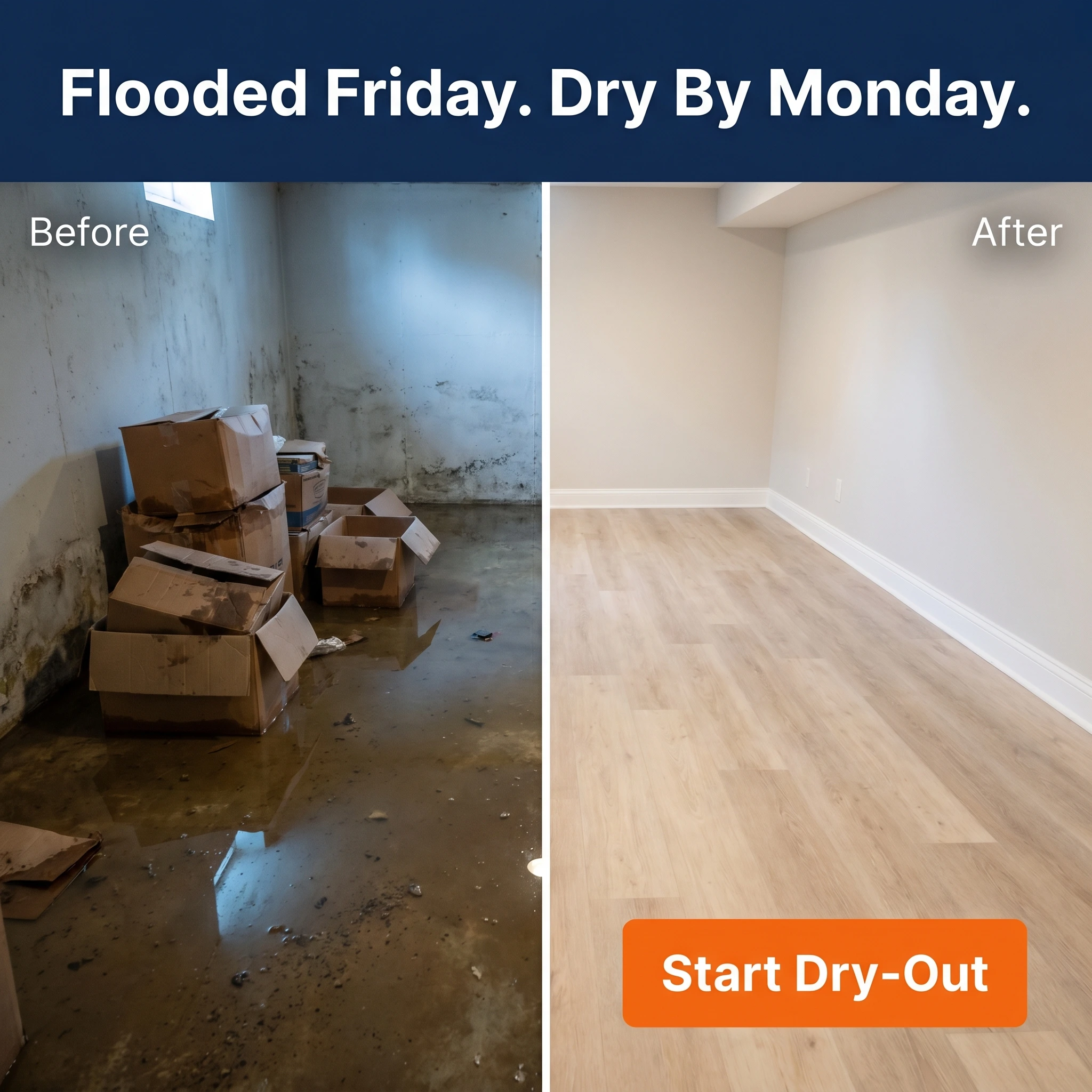
The format & angle. Puredry Restoration’s transformation: an inch of standing water across a ruined basement on the left; the same room extracted, dried, and restored on the right. The before/after this trade earns on every job.
Who it targets. Warm homeowners weighing whether a soaked room is salvageable or a teardown — the audience that fears the worst at the sight of standing water.
The hook. “Flooded Friday. Dry By Monday.” Two dates compress the whole pitch: the speed, the outcome, a normal house by the start of the week.
Why it works. A homeowner staring at a flooded room assumes catastrophe and a months-long rebuild. The split frame replaces that dread with evidence: this is recoverable, and fast. The day-to-day timeline (“Friday… Monday”) makes the speed tangible the way “rapid restoration” never could. It also pre-sells thoroughness — a dry, restored room signals proper extraction, not a mop-up that leaves moisture behind the walls. The flooded before supplies its own urgency.
Steal it. Document every job from the same spot — standing water on arrival, the dry room at completion. Run the most dramatic pairing with a real two- or three-day timeline; specificity is what makes the speed believable.
4. The insurance-handled testimonial ad

The format & angle. Afterflood Restoration: a relieved homeowner at his kitchen table beside a quote card, five stars, “IICRC-certified · 540+ reviews.” Trust, told through the part homeowners dread most — the claim.
Who it targets. Warm audiences comparing two or three companies after the crisis passes, when the question shifts from “who’s fast” to “who won’t leave me fighting my insurer.”
The hook. “They Handled The Whole Insurance Claim.” A review fragment answering the second-biggest fear after the water itself: the paperwork, the deductible, the adjuster.
Why it works. Once the water’s stopped, the homeowner’s anxiety moves to money and bureaucracy. A testimonial that names a handled insurance claim hits that fear directly, and it’s stickier than “professional and courteous” because it describes a specific relief. The IICRC line beside the stars stacks certification onto social proof — qualified and trusted — the exact pair a homeowner letting strangers into a damaged house screens for. The review count alongside lifts one account into a track record — what a rattled homeowner screens for — channeling the trust you earned one job at a time into the feed.
Steal it. Scan your reviews for ones that mention the claim — “handled my adjuster,” “I only owed the deductible” — put the most reassuring quote on the card, with your certification badge and review total beside the stars.
5. The free-inspection offer ad

The format & angle. Cascade Restoration Co.’s low-friction offer: bold type, two short promises, and a 24/7 line on a deep navy-to-slate background. Value and reassurance, no photo.
Who it targets. Cold and warm homeowners who suspect a problem — a musty smell, a ceiling stain, a slow leak — but haven’t called for fear of the cost of finding out.
The hook. “Free Inspection. We Bill Your Insurance.” Two sentences remove the two reasons people delay: the cost of looking and the cost of fixing.
Why it works. Cost uncertainty is what keeps a homeowner staring at a stain for a week. A free inspection makes the first step risk-free, and “we bill your insurance” reframes the repair from an out-of-pocket shock to a deductible. Together they convert a vague worry into a booked visit. The typography-led layout reads as a local company’s offer rather than an agency campaign, and the 24/7 line doubles as reassurance that the emergency case is covered too.
Steal it. Lead with your two no-risk promises — free inspection, direct insurance billing — keep a 24/7 line visible, and pair it with strong ad copy and headlines so the offer reads as clearly in the primary text as on the image.
Build the name before the pipe bursts
Speed, the mold clock, a dry-out, the insurance relief, and a no-risk offer — five water damage ads aimed at five moments in an emergency that mostly plays out on Google. Since the Andromeda overhaul, Meta’s auction weighs far more creative per impression, and it favors accounts that feed it real range over redraws of one idea. The cross-trade home services ad examples breakdown covers the patterns these angles share with other property niches.
Run it as a two-speed system. Keep familiarity creative — the response UGC, the mold hero, the insurance testimonial — always on at a steady budget so your name is the one a panicked homeowner already half-trusts. Then keep a geo-targeted flight ready to switch on the morning after a freeze or storm, narrowed to the hit ZIP codes and led by speed and the dry-out before/after. When a winner comes off the bench for the next storm, copy it using the existing post ID so its banked engagement stays attached — a fresh post forfeits every reaction and comment.
Building five-plus different concepts and reworking them for every storm is what stops most restoration shops cold — the job Zendux takes off your plate: it generates static ad variants in your branding and fires them across ad sets the moment the forecast turns.
Win more emergency calls with better creative →
Want to generate winning restoration ads? Start using Zendux AI