Fire Damage Restoration Ad Examples: 5 That Get Calls
Five fire damage restoration ad examples that turn a homeowner's worst day into a booked job — fast-response UGC, a restored-home hero, and a soot before/after.
A homeowner standing in a smoke-stained kitchen isn’t weighing your equipment list — they need to know you’ll show up fast and handle the insurance. That’s the job the fire damage restoration ad examples below are built for. Square footage and years in business are noise at the feed level; speed and a handled claim are everything. The five fictional ads that follow cover the angles that move this trade — emergency speed, a restored-home promise, the soot-to-spotless transformation, a peer’s relief, and a free assessment — each in a visibly different format.
Key takeaways
- Search gets the active emergency; Meta wins the referral and the repeat property — advertise to stay top-of-mind and to reach landlords, property managers, and adjusters.
- Speed and insurance are the two real fears. An ad that names one and answers it outperforms generic “fire and smoke restoration” copy.
- Before/after is fully allowed here because it’s property, not personal health — and it’s the most persuasive format in the category.
- Five distinct concepts reach five different mindsets and referral sources; one recycled “winner” caps your lead flow under Meta’s current delivery.
What the best fire damage restoration ad examples share
The buyer is in shock, on the phone with their insurer, and choosing between strangers who will tear out drywall and tell them what survived. Trust is the whole transaction, and it gets decided in a half-second of feed scrolling weeks before — or seconds after — disaster.
Three principles follow. First, respond to the fear, not the feature: soot spreads, smoke odor sets, and water from the fire hose breeds mold, so a homeowner needs to believe you’ll move before the damage compounds. Second, own the insurance burden, because the second wave of panic is the claim — naming direct billing or claims support removes the objection that stalls the call. Third, show the outcome, since restoration is an act of faith until someone sees a kitchen that looks like the fire never touched it.
The economics reward patience. Restoration is high-ticket and insurance-funded, so a single won job pays for months of awareness spend. Local-service CPMs often land in the $10–$25 range, and the goal isn’t a cheap click — it’s being the name a property manager already recognizes when the sprinklers go off at 2 a.m. Keep one promise per ad and make it checkable, the discipline behind the best static ads.
| Ad | Format | Angle | Funnel stage | Best for |
|---|---|---|---|---|
| 60-minute response UGC | UGC | Speed / emergency | Cold | Companies with 24/7 dispatch |
| Restored-home hero | Service hero | Dream outcome | Cold/warm | Full-rebuild restoration firms |
| Soot-to-spotless split | Before/after | Transformation | Warm | Smoke and soot specialists |
| Insurance-fight testimonial | Testimonial | Trust / social proof | Warm | Firms that manage the claim |
| Free 24/7 assessment offer | Offer | Value / access | Cold/warm | Lead-gen and mitigation-first shops |
1. The 60-minute response UGC ad
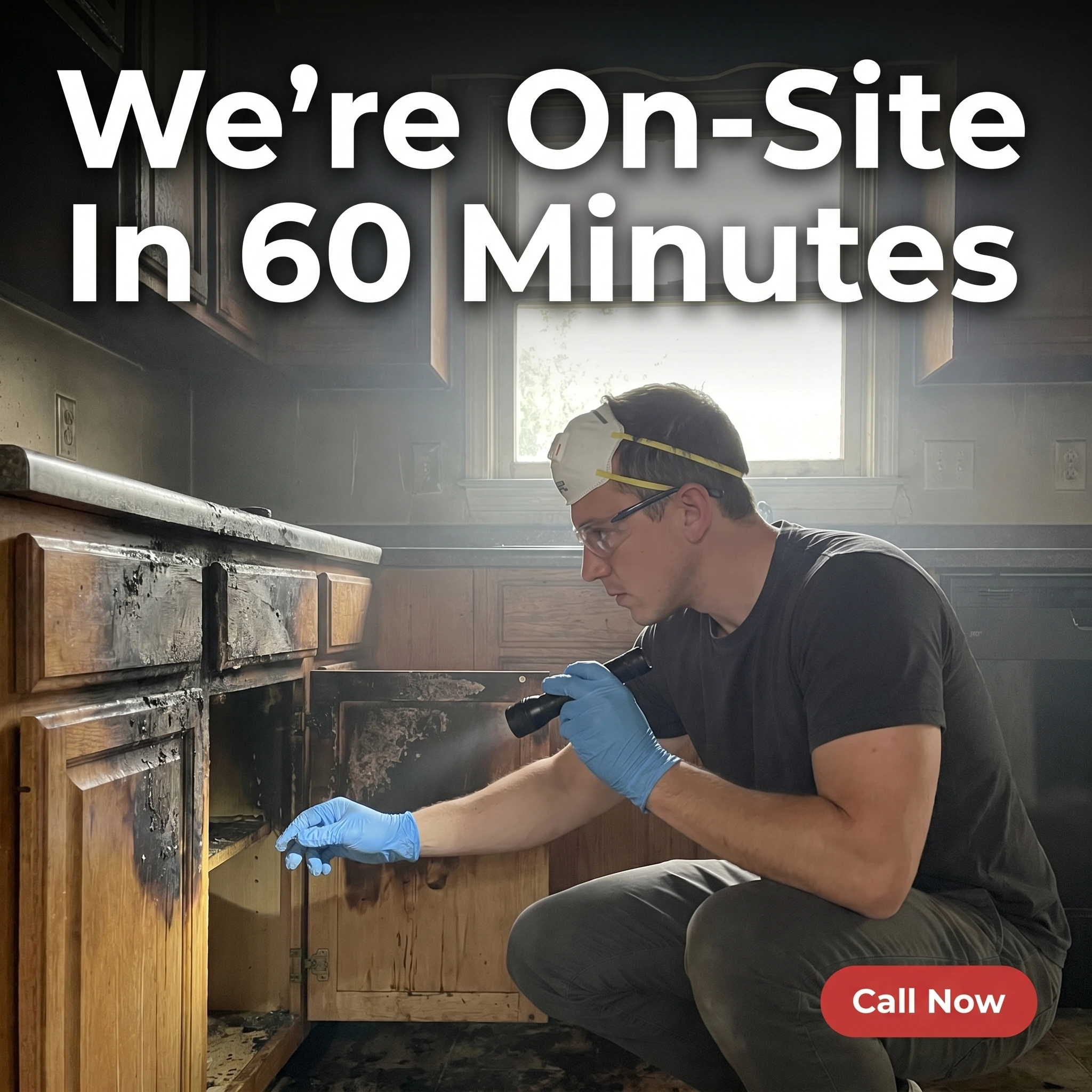
The format & angle. A Ridgeline Restoration tech in a respirator and gloves crouched by a soot-blackened kitchen cabinet, shot like a crew member grabbed it on a phone. Speed, aimed at the fear that the damage is still getting worse.
Who it targets. Cold homeowners and property managers in the service area — people who haven’t needed you yet but will recognize the name when they do.
The hook. “We’re On-Site In 60 Minutes.” A concrete time, not a vague “fast, reliable service.” It answers the only question that matters in the first hour.
Why it works. The candid, slightly grim frame reads as a real responder, not a national franchise call center that subcontracts the actual work. In a category where every minute lets soot etch deeper, a falsifiable response promise does more than any badge. The unpolished shot also earns the cheaper reach that native-looking creative gets in the feed.
Steal it. Have a tech photograph a real mitigation arrival — gear on, on the way in — with the property owner’s okay. Headline the response time you can actually defend in your service radius, then prove it on the call.
2. The restored-home hero ad

The format & angle. Meridian Restoration Group’s hero shot: a sunlit, fully rebuilt living room — fresh paint, clean trim, not a trace of smoke — styled like a real estate listing. The dream outcome, with no clutter.
Who it targets. Cold and warm homeowners who can’t yet picture their gutted house ever looking normal again.
The hook. “Like The Fire Never Happened.” It sells the only result the customer actually wants — erasure, not repair.
Why it works. Restoration is sold on faith, and faith needs a picture. A clean, aspirational finished room answers the unspoken dread (“will my home ever feel like home again?”) that a photo of equipment never will. Showing the end state, not the process, keeps the ad about the customer’s relief instead of your gear.
Steal it. Shoot your best completed restoration in good light, styled like a listing photo. Headline the emotional outcome — back to normal — not the scope of work.
3. The soot-to-spotless split ad
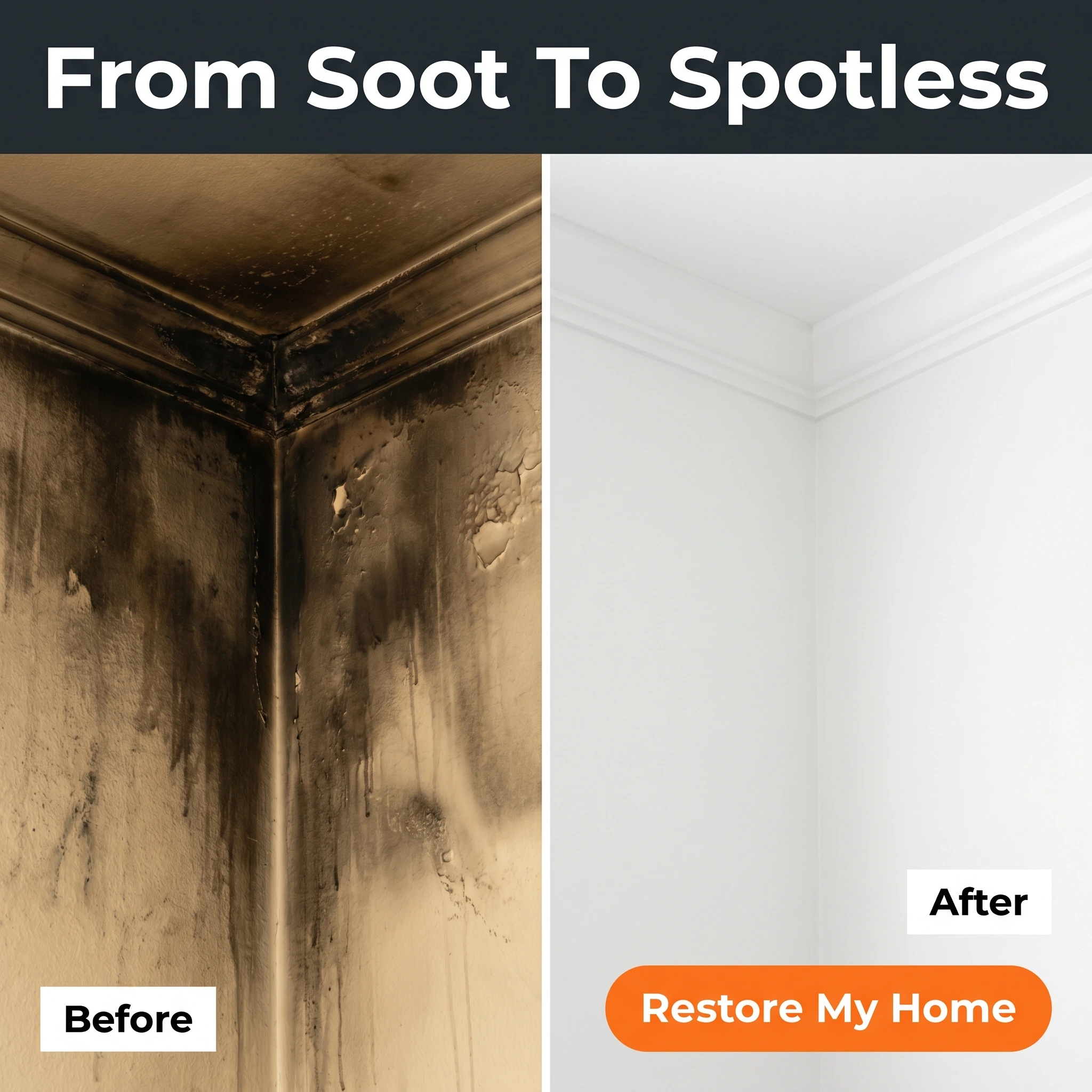
The format & angle. Trueline Restoration’s transformation: a smoke-blackened wall and scorched ceiling on the left, the same corner restored to clean white on the right. The category’s signature before/after.
Who it targets. Warm homeowners comparing two or three restoration firms, deciding who can actually undo the damage.
The hook. “From Soot To Spotless.” The contrast is the argument; the headline just names it.
Why it works. Smoke and soot damage looks permanent to a homeowner, so visible proof that it isn’t is the most persuasive thing you can show. This is also the one niche where the before/after carries no policy risk — it’s property, not a body, so Meta’s personal-health rules don’t apply. The split makes the case before a word is read and holds up at thumbnail size.
Steal it. Document one wall or room before remediation and after, same camera spot, with written permission. Build a rotating library of honest transformations — every soot job is a future ad.
4. The insurance-fight testimonial ad

The format & angle. Hollis Fire & Smoke: a relieved homeowner standing in front of her restored house beside a review card — five stars, “800+ homes restored.” Trust, told through the part everyone dreads.
Who it targets. Warm audiences comparing firms — and quietly worried about the claims process as much as the repair.
The hook. “They Handled My Insurance Fight.” A review fragment aimed at the second fear, the one that arrives after the smoke clears.
Why it works. By the comparison stage, the homeowner isn’t grading your equipment; they’re collecting reassurance. A quote about the insurance being handled is sticky because nearly everyone has heard a claims-denial horror story. The restored count turns one anecdote into a track record, which is the real decision input, and it recycles your hardest-won asset — reviews — into paid reach.
Steal it. Search your reviews for “insurance,” “claim,” “adjuster,” and “stress.” Build the card around the strongest one and put your homes-restored count beneath it. Rotate the creative before ad fatigue erodes it.
5. The free 24/7 assessment offer ad

The format & angle. ClearSky Restoration’s lead-gen push: bold type on a deep charcoal background, one offer, the financial fear removed. Value and access, no photo.
Who it targets. Cold and warm homeowners and property managers who suspect they have hidden smoke or water damage but haven’t committed to a call.
The hook. “Free 24/7 Damage Assessment.” The price is zero and the door is always open — the two barriers to picking up the phone, both removed.
Why it works. A free assessment is a low-commitment first step into a high-stakes purchase, which is exactly what a hesitant homeowner needs. The “direct insurance billing” support line does double duty — it’s a value claim and a trust signal, because it preempts the out-of-pocket fear. The typography-only layout reads as a straightforward local service, not a campaign.
Steal it. Lead with your genuinely free first step and name the money fear you remove — direct billing, no upfront cost, claim help. Keep the image text to the offer and one supporting line; no phone numbers or fine print on the creative itself.
Dispatch all five, not one favorite
A fast-response promise, a restored-home vision, a soot transformation, an insurance-fight review, and a free assessment — five ads aimed at five moments, from the homeowner who’ll need you next month to the property manager who refers you. Meta rewards that spread. Its Andromeda retrieval engine sifts far more candidate ads per auction than the old system did, so five genuinely different concepts get matched to five different moments, while five tweaks of one idea just crowd the same slot. Other property trades face the same dynamic — the home services ad examples breakdown covers the cross-trade patterns, and if you also chase storm work, the roofing ad examples post pairs naturally with this one.
Spinning up five-plus genuinely different concepts on a steady schedule is the hard part, and it’s the part Zendux automates: describe your brand once, generate a batch of on-brand static variants, and push them live across your ad sets in a single pass.