5 Travel Agency Ad Examples That Book More Trips
Five travel agency ad examples that turn dreamers into booked clients — a done-for-you UGC ad, a destination hero, a DIY-vs-agent split, a honeymoon review, and an early-bird offer.
Travel agency ads convert when they sell the relief of not planning the trip yourself — the dream vacation with none of the 47-tab research spiral. The person scrolling isn’t short on wanderlust; they’re short on time and sure they’ll book the wrong hotel. The ad that promises an expert will handle the flights, the transfers, and the what-ifs beats one more pretty beach photo. Below are five fictional travel agency ad examples, each running a different angle in a different layout: a done-for-you airport moment, a destination hero, a DIY-versus-agent split, a honeymoon review, and an early-bird offer.
Key takeaways
- Sell the planning, not just the place — the destination is the easy part; travelers pay an agency to remove the research, the risk, and the second-guessing.
- Match the angle to the trip — honeymoons sell on trust, multi-stop tours on logistics, shoulder-season getaways on price and a deadline.
- Specifics beat adjectives — a named region, a real itinerary detail, or a price band converts better than “unforgettable experiences.”
- Your warmest audience already clicked — retarget people who viewed a destination but didn’t inquire with a dated offer.
What makes a great travel agency ad
The buyer is daydreaming and stuck at the same time. They can picture the trip, but the gap between the daydream and a paid itinerary is full of decisions — which island, which week, is this neighborhood safe, will the connection be tight. An agency’s real product is removing that gap, so the ad has to name the relief, not just flash the view.
Trust is the currency, because the customer is handing over money and their one big trip of the year. Concrete signals carry it: a real itinerary detail, a named resort tier, visible review counts, a human advisor in frame. Vague luxury language reads as a stock-photo trap and gets scrolled past.
Then the ad needs a job that fits the trip. A honeymoon inquiry responds to reassurance; a family spring-break trip responds to “we handle the chaos”; a shoulder-season deal responds to a price and a date. Running one ad for all of them wastes delivery — which is why a spread of distinct angles works, the same logic behind strong Meta advertising examples organized by industry and goal. Deciding how many to run at once is its own question, covered in how many ad creatives to test per week. The five concepts below cover the angles that move bookings.
| Ad | Format | Angle | Funnel stage | Best for |
|---|---|---|---|---|
| Boarding-pass UGC | UGC | Done-for-you convenience | Cold | Busy professionals |
| Overwater-villa hero | Hero | Dream outcome | Cold | Honeymoon & milestone trips |
| Tabs-vs-itinerary split | Comparison | Us-vs-the-DIY-way | Warm | Overwhelmed self-planners |
| Honeymoon testimonial | Testimonial | Trust/credibility | Warm | Once-in-a-lifetime trips |
| Early-bird offer | Offer | Price/urgency | Cold/warm | Deal-driven planners |
1. The boarding-pass UGC ad
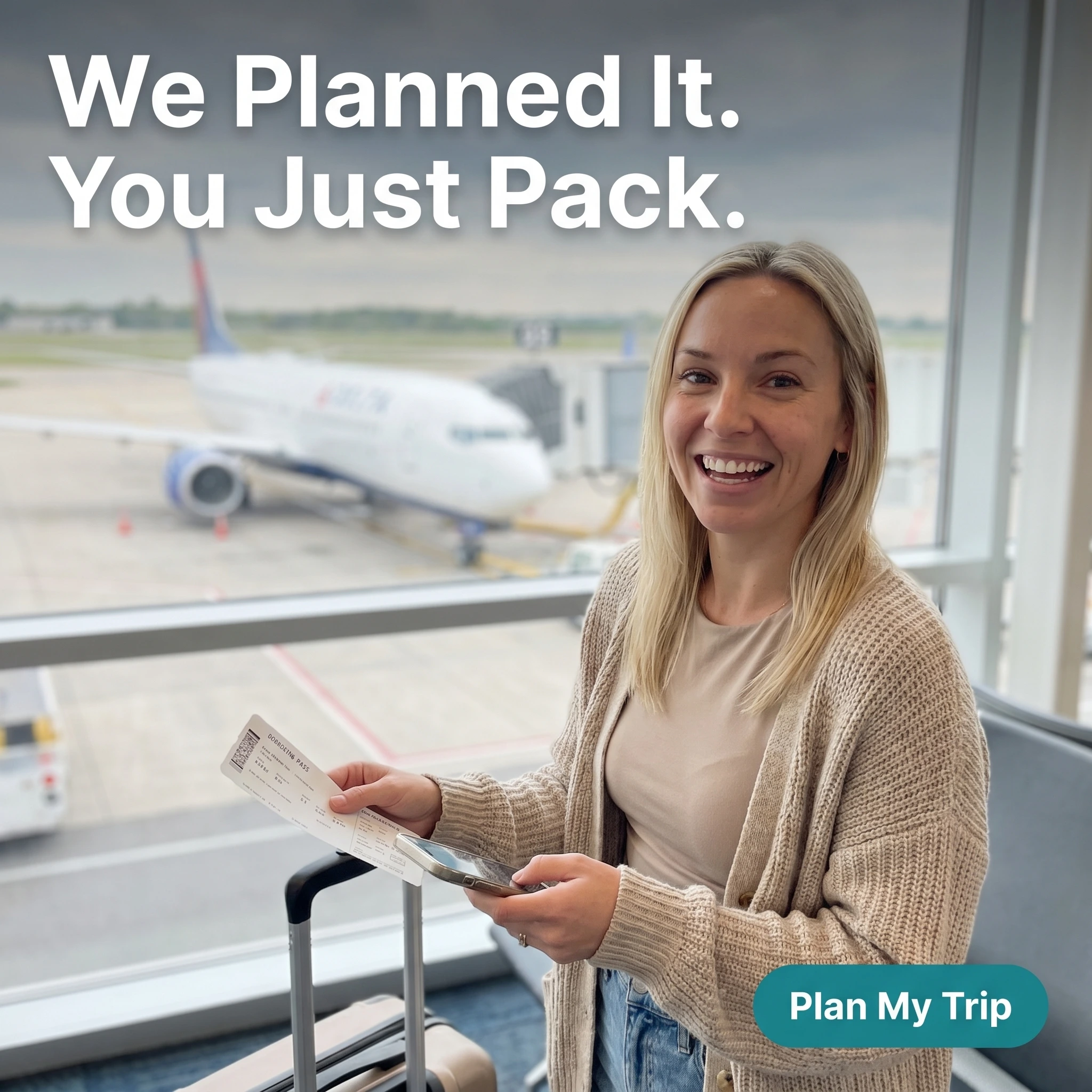
The format & angle. A Wander Atlas client at the departure gate, boarding pass and phone in hand, carry-on at her feet, shot like a friend snapped it before the flight. Done-for-you convenience over postcard polish.
Who it targets. Cold, time-poor professionals who want the trip but dread building it — the people who keep a “someday” list and never book.
The hook. “We Planned It. You Just Pack.” It draws the line between the agency’s job and the traveler’s, and the traveler’s job is the easy, fun one.
Why it works. A candid airport photo reads as a real person who already crossed the finish line, not a brand promising one — social proof and outcome in a single frame. The headline sells the emotional payoff travelers actually want, zero logistics, which lands harder than any destination name for someone overwhelmed before they start.
Steal it. Shoot a real client (or a stand-in) at a gate, phone-camera style, and headline the division of labor: you handle the planning, they handle the packing. Send the click to a short inquiry form, not a 40-field quote request.
2. The overwater-villa hero ad

The format & angle. Meridian Voyages’ single aspirational frame: an overwater villa on a turquoise lagoon at golden hour, deck ladder dipping into clear water, no people, nothing competing. Pure dream outcome.
Who it targets. Cold scrollers in the daydream phase — honeymoon and milestone-trip planners who need the want before the plan.
The hook. “This Could Be Your November.” A specific near month turns a fantasy into something on the calendar, which beats a vague “escape to paradise.”
Why it works. A clean, richly lit hero is appetite for travel — the saturated blues do the selling, and naming a month makes the daydream feel bookable instead of theoretical. It’s a top-of-funnel magnet built to earn the cheap click and the retargeting cookie, then hand the warm audience to the trust and offer ads.
Steal it. Use one stunning, high-resolution destination shot with no clutter and a near-term month in the headline. Treat it as a prospecting ad — its job is the click and the audience build, not the booking.
3. The tabs-vs-itinerary split ad

The format & angle. Pathline Travel’s split: a laptop drowning in flight and hotel tabs on the left, a clean printed day-by-day itinerary on the right. Us-versus-the-DIY-way.
Who it targets. Warm self-planners who’ve started researching, hit the overwhelm wall, and are open to handing it off.
The hook. “47 Tabs Or One Itinerary?” It names the exact pain — comparison paralysis — and offers the antidote in the same breath.
Why it works. Anyone who’s tried to plan a complex trip recognizes the left side instantly; tab chaos is universal. Contrasting it with one tidy document makes the agency’s value visual instead of asserted, and reframes the price as buying back hours and certainty. This is a retargeting workhorse for people who clicked a destination but stalled.
Steal it. Screenshot the real research mess beside a clean sample itinerary you’d actually deliver. Keep the headline to the one-line trade — chaos for clarity — and aim it at warm traffic that already engaged.
4. The honeymoon testimonial ad

The format & angle. Northbound Travel Co. pairs a relaxed client at a sunset beach bar with a review card — five stars and a no-hedge quote. Trust and credibility.
Who it targets. Warm couples comparing a few agencies for the one trip they can’t afford to get wrong.
The hook. “Best Honeymoon Decision We Made.” Framed as a decision, it speaks to the buyer’s real fear: picking the wrong planner.
Why it works. High-stakes, once-in-a-lifetime trips are bought on trust, and trust transfers best from another customer. A real face plus a specific, confident quote answers the unspoken question — can I hand my honeymoon to these people — better than any “award-winning” badge. The “planned in one call” subline quietly sells the low-effort process too.
Steal it. Pull your most quotable five-star review, build a card around it with a real client photo, and keep the wording verbatim — the slightly raw phrasing is what makes it read as real. Point it at engaged audiences and lookalikes of past bookers.
5. The early-bird offer ad
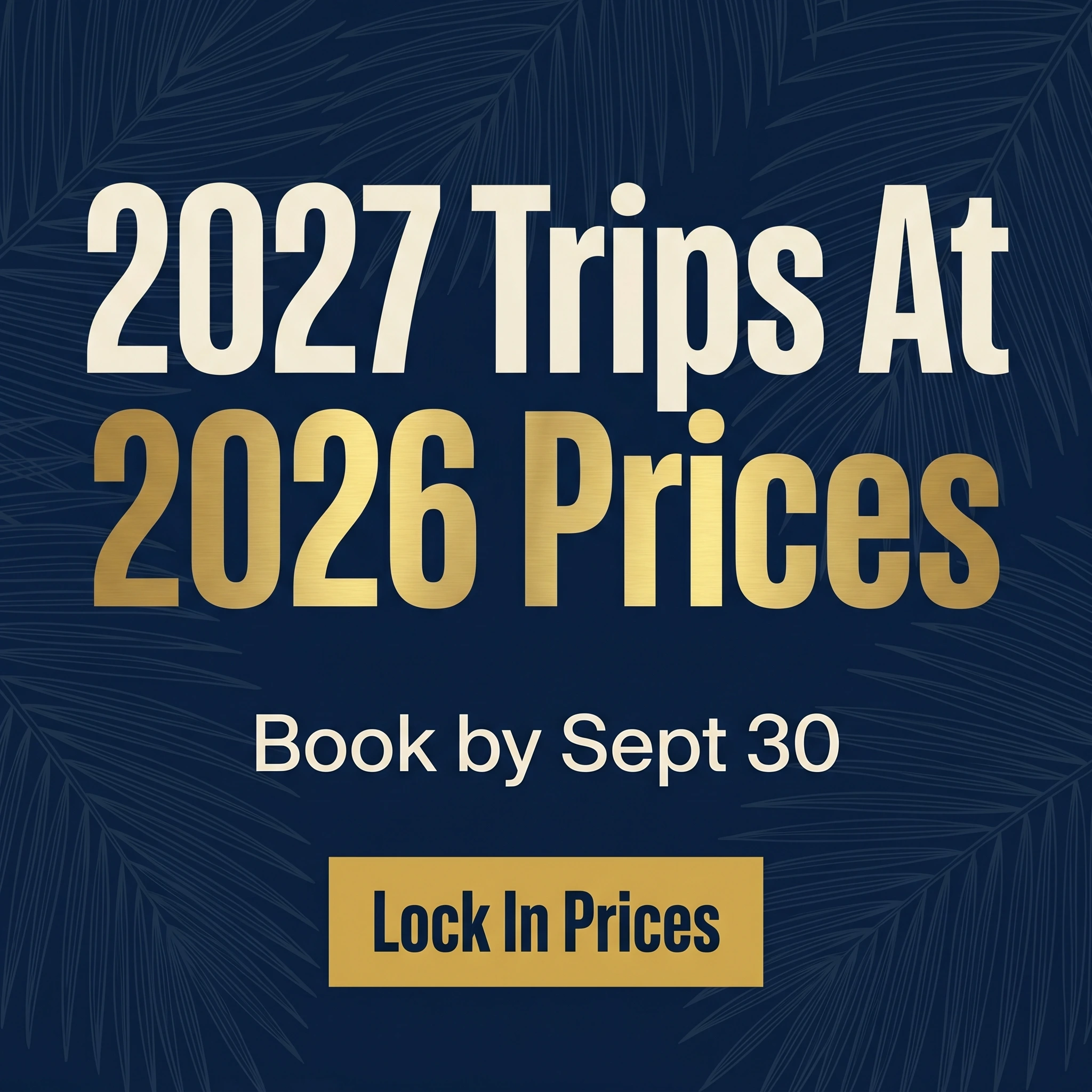
The format & angle. Saltair Getaways’ deadline play: typography-led, the price promise dominant on deep navy, no photo competing with the message. Price and urgency.
Who it targets. Cold and warm planners who are price-aware and need a reason to act now instead of “later.”
The hook. “2027 Trips At 2026 Prices.” A concrete value claim with a built-in clock — book now, pay today’s rate for next year’s trip.
Why it works. Travel decisions stall for months, so the job here is converting intent that already exists. The year-over-year framing — next year’s trip at this year’s price — manufactures honest urgency without a fake countdown, and the “Book by Sept 30” subline gives the deadline teeth. Stripped to type, it reads as a real rate rather than a brand campaign, and closes the planners the dreamy hero and the testimonial warmed up.
Steal it. Make the price promise and the deadline the two biggest elements, skip the stock imagery, and schedule it to retarget everyone who engaged with your destination ads in the prior 30 days.
Run the whole trip, not one postcard
Convenience, a dream, a pointed comparison, a rave, and a deadline — five different reasons the same traveler finally books. One beach photo can only reach the sliver of the audience that beach happens to suit; five distinct angles let Meta’s Andromeda-era delivery hand each traveler the one that fits — the honeymooner gets the testimonial, the deal-hunter gets the offer.
Treat the set like an itinerary. The hero and UGC prospect and build audiences, the comparison and testimonial convert the researchers, and the offer closes on a deadline. Swap destinations and prices each season so a small, well-targeted audience never sees the same frame long enough to tune it out.
Building that many on-brand creatives by hand is where a small agency stalls. Zendux drafts static ad variants with AI and pushes them live across every ad set at once, so a full slate of angles is ready before the booking window opens. For neighboring playbooks, the hotel ad examples and Airbnb ad examples breakdowns pair well with this one.