5 Fitness Ad Examples Built to Stop the Scroll
Five fitness ad examples that pass Meta's health policies and still convert — gym UGC, a studio hero, a plan callout, a testimonial, and a trial offer.
The fitness ad examples that convert in 2026 sell identity and logistics, not body transformations — partly because that’s what gets people to join, and partly because Meta’s personal-health policies restrict before/after imagery and “fix your flaw” framing outright. The five fictional ads below are fully policy-safe and cover five distinct angles: the early-morning identity, the community, the realistic plan, the member’s word, and the low-risk trial.
Key takeaways
- Body-transformation creative is a policy trap — Meta restricts before/afters and flaw-framing in health niches; results-adjacent formats convert without the rejection risk.
- Logistics are the real objections: time, schedule, price, and contracts decide sign-ups more than motivation does.
- Identity hooks (“done training by 6:45 AM”) recruit better than aspiration hooks, because joiners picture their own week.
- Five distinct angles give Meta’s auction five different member profiles to find — a single “best ad” caps your lead flow.
What makes a great fitness ad
The buyer isn’t the fitness enthusiast — they’re already a member somewhere. The growth audience is the person who wants to be a person who works out, and they’re triggered by recognition: someone with their schedule, their hesitations, their Monday dread, visibly making it work. The proof that matters is social and experiential — real members, real schedules, real prices — not physiques.
There’s also a compliance frame around everything in this niche. Meta’s personal-health policies restrict body-focused before/afters and any creative implying the viewer is inadequate. So the classic before/after slot in this lineup is swapped for a plan-callout format — a transformation of the week, not the body. For how other restricted-niche advertisers handle this, the industry breakdowns in Meta advertising examples by industry are worth a read.
Timing and audience size shape the plan too. January and September are the niche’s demand spikes — and also when every gym in town floods the auction and CPMs jump, so accounts that advertise steadily through the off months buy recognition at a discount and cash it in during the rushes. A gym’s realistic radius audience is also small — often under 100,000 people in total — which means frequency builds within a few weeks of steady spend. The five-concept rotation below doubles as frequency management: it keeps one image from meeting the same audience until both give up.
| Ad | Format | Angle | Funnel stage | Best for |
|---|---|---|---|---|
| 6:45 AM gym UGC | UGC | Convenience/identity | Cold | Gyms near commuter neighborhoods |
| Empty-studio hero | Hero | Belonging/status | Cold | Boutique class studios |
| Three-workouts plan callout | Stat callout (swapped before/after) | Us-vs-all-or-nothing | Cold/warm | Apps & coaching programs |
| Monday-lover testimonial | Testimonial | Trust/experience | Warm | Studios with strong reviews |
| $14 trial offer | Offer | Price/low risk | Warm/retargeting | Membership conversion pushes |
1. The 6:45 AM gym UGC ad

The format & angle. A sweaty, flash-lit mirror-adjacent phone photo from Ironquarter Gym: one member, post-workout, gym still dark outside. Convenience as identity.
Who it targets. Cold local traffic — working parents and commuters who’ve concluded they “don’t have time,” which is the dominant non-joiner belief.
The hook. “Done Training By 6:45 AM.” Not start — done. The timestamp is the entire argument.
Why it works. The ad sells a schedule, and the schedule sells an identity: the person who has already trained while everyone else hits snooze. UGC styling makes it read as a member’s brag rather than the gym’s claim, which is who the audience actually believes. Nothing about bodies, nothing about flaws — pure policy-safe logistics with an aspirational edge.
Steal it. Ask a real early-bird member to take their post-workout phone photo this week, and headline the time they walk out the door. Run it within a few miles of the gym, broad demographics.
2. The empty-studio hero ad

The format & angle. Cadence Cycle Club’s signature room: rows of bikes under moody violet light, shot like an album cover, no people. Belonging, sold through atmosphere.
Who it targets. Cold and warm boutique-fitness shoppers — people choosing between studios on vibe as much as workout.
The hook. “Find Your 6 AM Crew.” The product is the people; the photo is the stage they’re missing from.
Why it works. Boutique studios aren’t selling exercise — gyms are cheaper for that — they’re selling a third place. The cinematic empty room creates an open loop (this fills up at 6 AM, and you’re not in it) that a crowded class photo wouldn’t, while sidestepping every body-image policy issue at once. The high-production look also signals price point honestly, pre-qualifying the click.
Steal it. Shoot your space at its most atmospheric — lights on, room empty, one strong color — and write a headline about the people, not the equipment.
3. The three-workouts plan callout ad

The format & angle. Repsync, a training app: a typography-led callout with a simple weekly plan visible beneath. This slot is normally a before/after — swapped here because body-transformation splits violate Meta’s personal-health policies. The transformation shown is the week, not a body.
Who it targets. Cold and warm restarters — people burned by all-or-nothing programs who assume fitness requires six days a week.
The hook. “Three 30-Minute Workouts. That’s It.” Permission, framed as a plan.
Why it works. The biggest competitor in fitness isn’t another gym — it’s the prospect’s belief that the price of entry is their whole life. Underpromising is the pattern interrupt: every other ad escalates, this one de-escalates. The visible Mon/Wed/Fri plan makes the claim concrete, and the format is bulletproof from a policy standpoint because no body appears at all.
Steal it. State the minimum honest dose of your program as the headline and show the actual weekly schedule. Cut every motivational adjective from the draft — the restraint is the message.
4. The Monday-lover testimonial ad

The format & angle. Northpine Strength Co.: a member photo on the gym floor beside a quote card, five stars, “480+ reviews.” Trust, told through feeling rather than physique.
Who it targets. Warm traffic — people who clicked, visited the schedule page, and stalled at the door-fear stage.
The hook. “I Actually Look Forward To Mondays” — an emotional outcome, which is both more persuasive and more compliant than a physical one.
Why it works. The unspoken blocker for new gym members is social: will I fit in, will I be judged. A relaxed, ordinary-looking member — not a competitor type — answers it visually, and the quote reframes results as how life feels, which Meta’s policies smile on and prospects actually want. The review count converts one person’s feeling into a pattern.
Steal it. Collect quotes about feelings and routines, not measurements. Photograph the member in your actual space mid-rest, not mid-PR — approachability is the casting brief.
5. The $14 trial offer ad
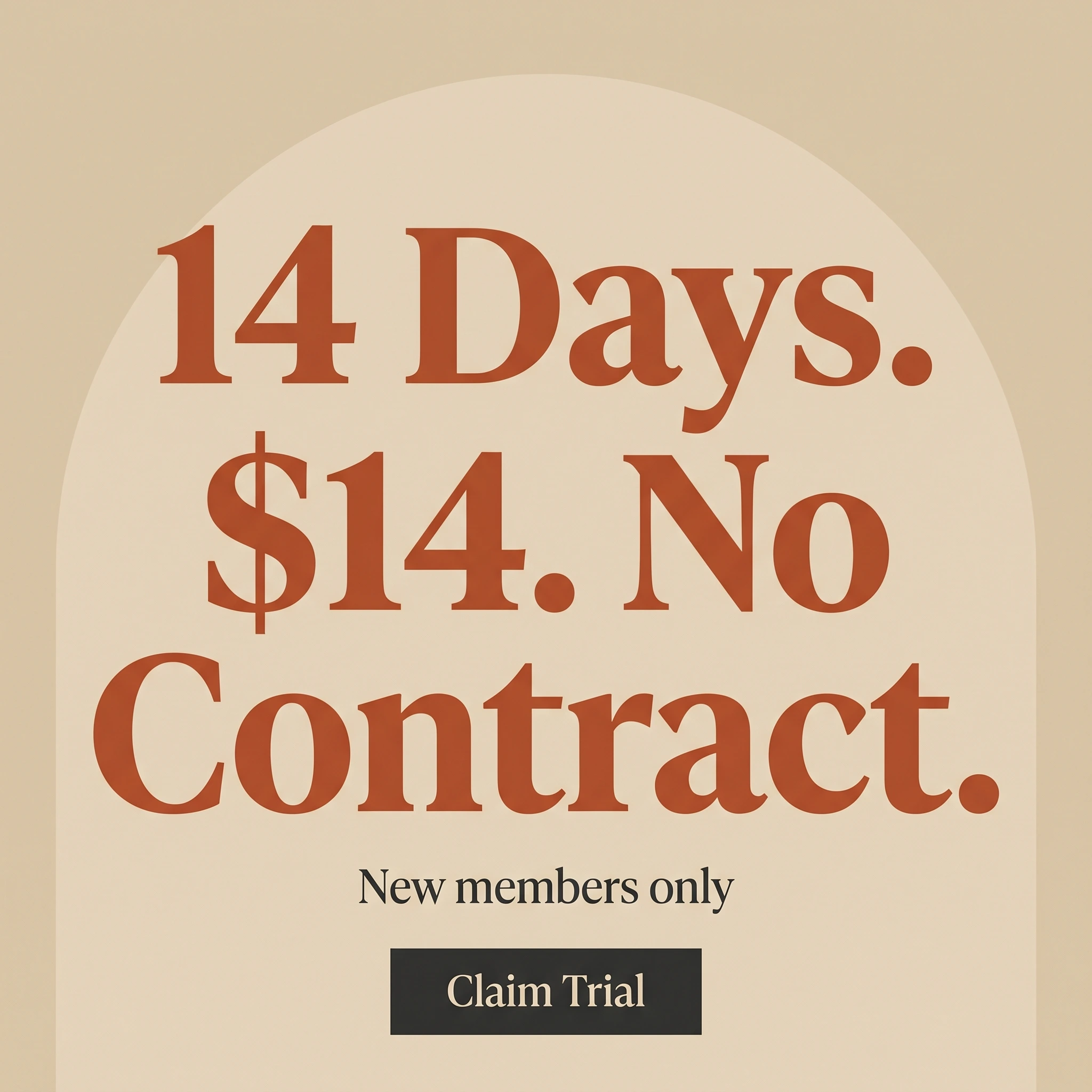
The format & angle. Halcyon Pilates: an offer ad in big confident type on warm neutrals. Price, risk-reversal, and a number that’s almost a joke.
Who it targets. Warm and retargeting audiences — schedule-page visitors and past trial-expirers who needed one less reason to say no.
The hook. “14 Days. $14. No Contract.” Three objections — cost, commitment, contract — executed in six words.
Why it works. Trial offers move the fence-sitting middle of a warm audience, and the symmetry of 14/$14 makes the deal memorable enough to act on later, which most offers aren’t. “No contract” does the heaviest lifting: contract fear is the industry’s inherited reputation problem, and naming it dissolves it. Typography-only keeps the focus on the deal and ships in an afternoon.
Steal it. Price a capped trial with a number that pairs with its duration, kill the contract requirement for it, and show this ad only to people who’ve already met your brand.
From five ads to a weekly habit
A timestamp, an empty room, a permission slip, a feeling, and a deal — five fitness ads with zero overlap in look or claim. Meta’s delivery works in your favor here: since the Andromeda retrieval upgrade, the auction evaluates enough creative to hand each concept its own slice of your local audience, where near-duplicates would have fought over one. The studios growing on paid social right now ship new creative concepts weekly, not quarterly.
The practical sequence for a studio: launch all five this month, watch which angle books actual intro visits rather than clicks, then build next month’s batch as three variants of the winner plus two new angles. Keep the trial offer always-on for warm traffic and rotate everything else. And track cost per booked intro visit rather than cost per lead — the gap between those two numbers is where most studio ad budgets quietly leak.
Zendux makes that cadence realistic for a gym without a marketing team — AI-generated static ad variants in your branding, bulk-launched across ad sets before the morning classes end.
Launch your five fitness angles →
Want to generate winning fitness ads? Start using Zendux AI