Construction Ad Examples: 5 Ads That Win Bids
Five construction ad examples that win homeowner trust and bids — a reliability UGC ad, a finished-build hero, a renovation before/after, an on-budget testimonial, and a free-consult offer.
Construction ads that win bids do something the trade is rarely associated with: they prove reliability before they prove craftsmanship. A beautiful finished build earns the click; on-time, on-budget, finished-when-promised proof earns the signed contract. The five fictional ads that follow — a reliability UGC ad, a finished-build hero, a renovation before/after, an on-budget testimonial, and a free-consult offer — each take a different format and a different angle.
Key takeaways
- Reliability is the real sell: homeowners fear the no-show and the overrun more than they doubt your craft — lead with proof you finish.
- Before/after is the trade’s killer format — renovation work is uniquely visual, and a transformation proves capability faster than any claim.
- Capture leads early with low-friction offers — construction is a long, considered purchase, so a free consult enters the consideration set before competitors do.
- Run five distinct angles so Meta can match each to the right homeowner instead of bidding your own near-duplicates against each other.
What makes a great construction ad
The buyer — a homeowner planning an addition, a remodel, or a custom build — is making a high-stakes, infrequent purchase with real horror stories attached. Everyone knows someone whose contractor vanished mid-project or blew the budget by 40 percent. That fear, more than any doubt about skill, is what stalls the decision. The ad’s first job is to defuse it.
Search captures the rare urgent need; Meta owns the long planning window where the homeowner is forming a shortlist. Because the cycle runs weeks to months, the smart play is low-friction lead capture early — a free consult or estimate — then consistent retargeting with proof. This is the same demand-generation logic behind the broader home services ad examples playbook, scaled up to a bigger, slower purchase.
The proof that matters is visual and specific: a real finished project, a real crew, a transformation shot from the same angle. Before/after is the category’s strongest format because renovation is inherently visual and the result is self-evident — the discipline that separates the best static ads from generic stock-photo filler. The five concepts below cover the angles that win bids.
| Ad | Format | Angle | Funnel stage | Best for |
|---|---|---|---|---|
| Show-up reliability UGC | UGC | Us-vs-old-way | Cold | Trust-led contractors |
| Finished-build hero | Project hero | Dream outcome | Cold/warm | Custom builds & additions |
| Renovation before/after | Before/after | Transformation | Warm | Remodelers & renovators |
| On-budget testimonial | Testimonial | Credibility/trust | Warm | Reputation-driven firms |
| Free design consult offer | Offer | Low-friction lead | Cold/warm | Early-funnel lead capture |
1. The show-up reliability UGC ad

The format & angle. A Granite Ridge Builders lead on an active job site, clipboard in hand, shot like a project photo a client snapped. Plain and real. Us-versus-the-flaky-contractor-way.
Who it targets. Cold homeowners early in planning who’ve been burned — or warned — about contractors who disappear.
The hook. “We Show Up When We Say.” It names the single biggest grievance homeowners have with the trade and answers it head-on.
Why it works. A candid on-site photo is proof of presence — a real crew, real progress, no staged showroom. In a category where the core fear is abandonment and delay, a plainspoken reliability promise does more than any rendering of a dream kitchen. The unpolished framing signals a working contractor who’s actually on jobs, not a marketing front, which is exactly the reassurance a wary homeowner needs to make first contact.
Steal it. Have a crew lead photographed on a real active site, phone-camera style, with work visibly underway. Headline the reliability promise you can actually keep — showing up, finishing on schedule — in plain words, not “quality you can trust.”
2. The finished-build hero ad
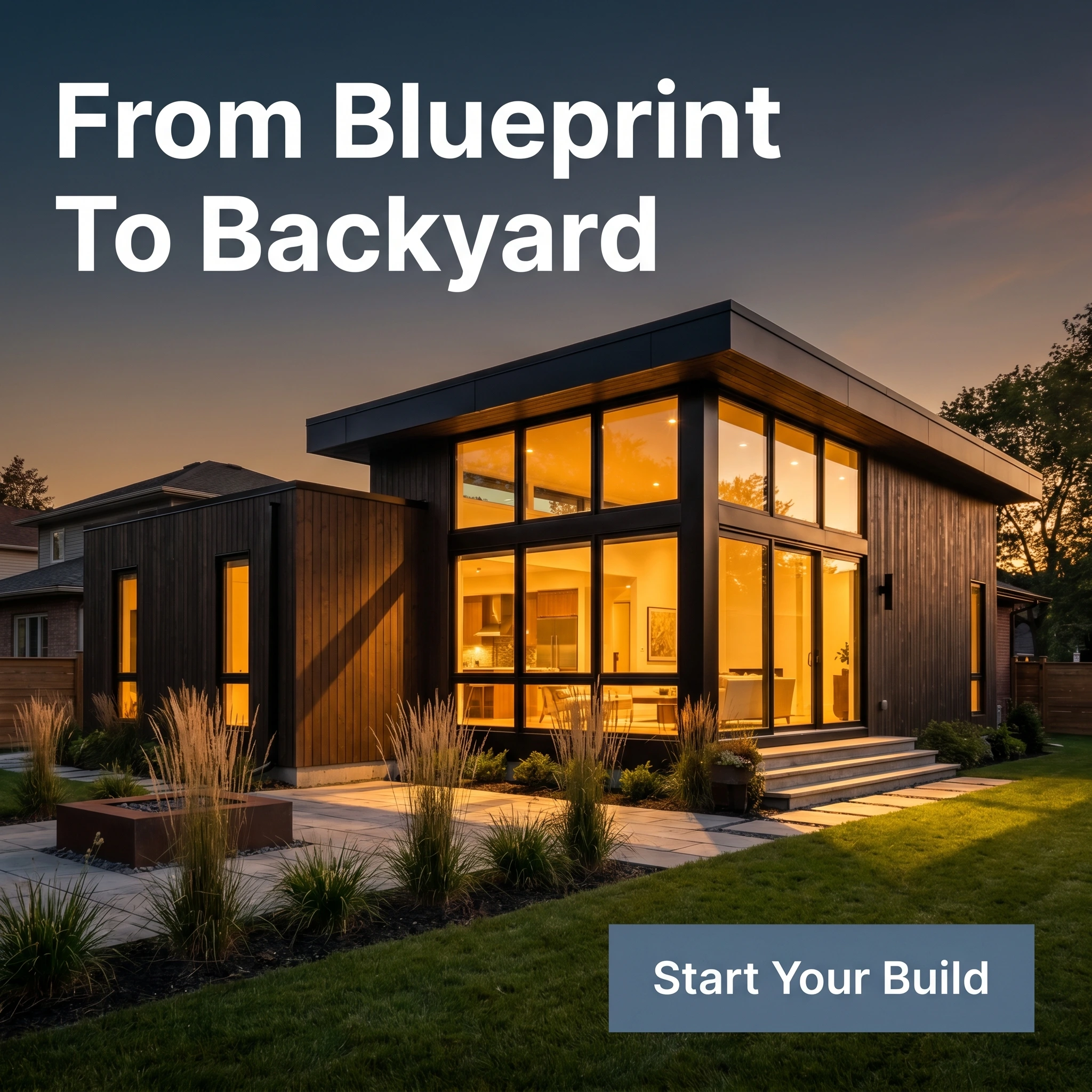
The format & angle. Northcrest Construction’s hero: a finished modern addition photographed at golden hour, clean lines, one focal point, magazine-grade. Dream outcome.
Who it targets. Cold and warm homeowners imagining a bigger or better home — the “we’ve outgrown this house” planner.
The hook. “From Blueprint To Backyard.” It compresses the whole journey into four words and promises the company handles all of it.
Why it works. Considered, expensive projects start as a fantasy, and a clean finished-project hero sells that fantasy as achievable and real — this firm’s actual work, not a stock render. The “blueprint to backyard” line reassures the homeowner that one company owns the whole messy process, which is a relief for anyone dreading coordinating a build. It pulls aspirational planners into the funnel where the proof-heavy ads can convert them.
Steal it. Photograph your cleanest completed build at golden hour, one structure, uncluttered frame. Headline the end-to-end promise, and send the click to a project gallery, not a generic homepage.
3. The renovation before/after ad
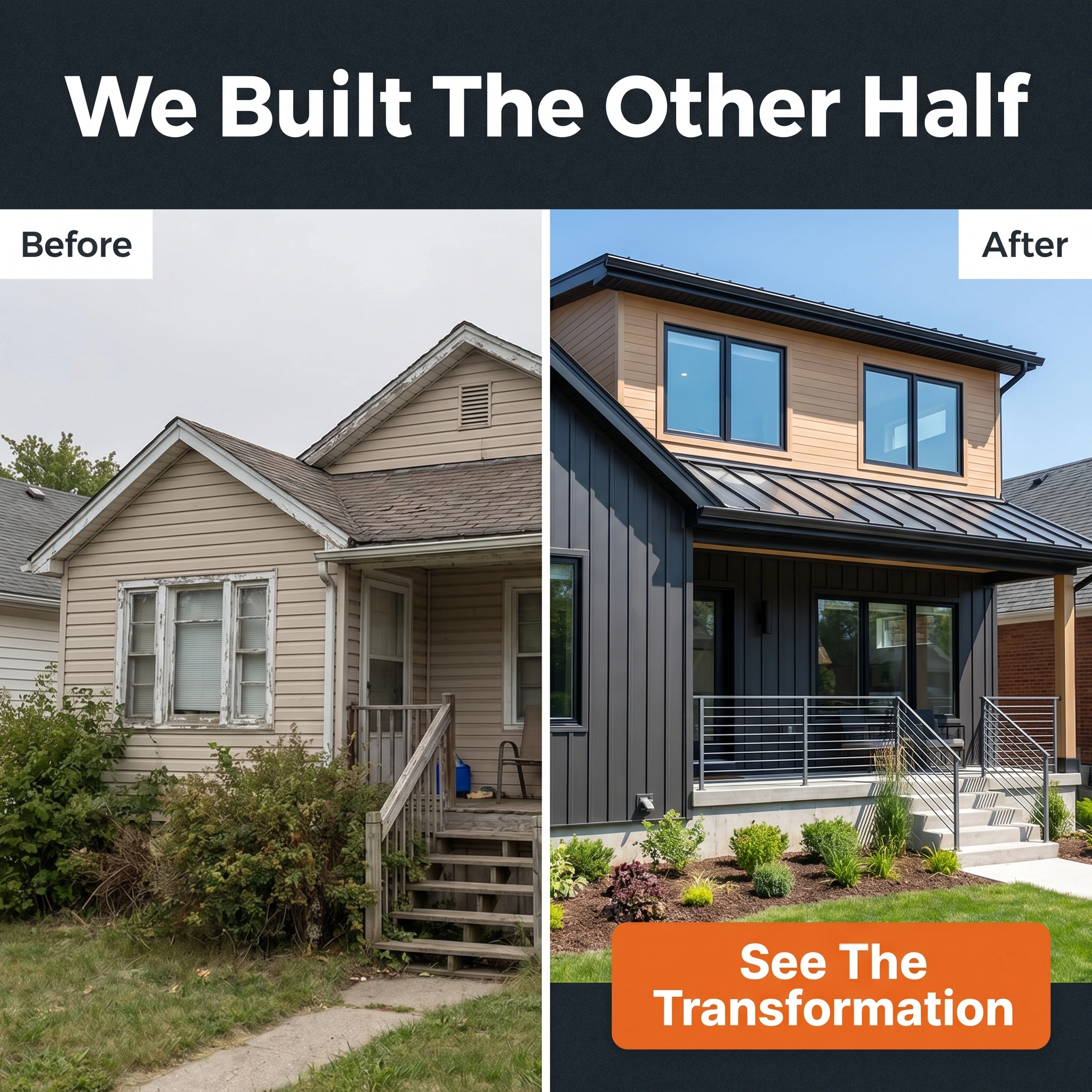
The format & angle. Ironwood Contracting’s split: a dated, cramped original on the left; the renovated, expanded result on the right, same camera position. The trade’s natural before/after.
Who it targets. Warm homeowners with a specific renovation in mind — the people who look at the left half and see their own house.
The hook. “We Built The Other Half.” It frames the transformation as a literal addition and makes the scope of the change instantly readable.
Why it works. Before/after is the most persuasive format in construction because the proof is self-evident — no claim required, the result argues for itself. Matching the camera angle makes the change undeniable and lets the homeowner project their own outdated space onto the left side. It converts deferral into action by making the current state look like the problem it is, the same psychology that drives renovation-heavy roofing ad examples.
Steal it. Shoot every project’s before from a fixed spot and replicate the exact angle after. Use a real, recognizable transformation — the bigger and cleaner the contrast, the less the headline has to do.
4. The on-budget testimonial ad
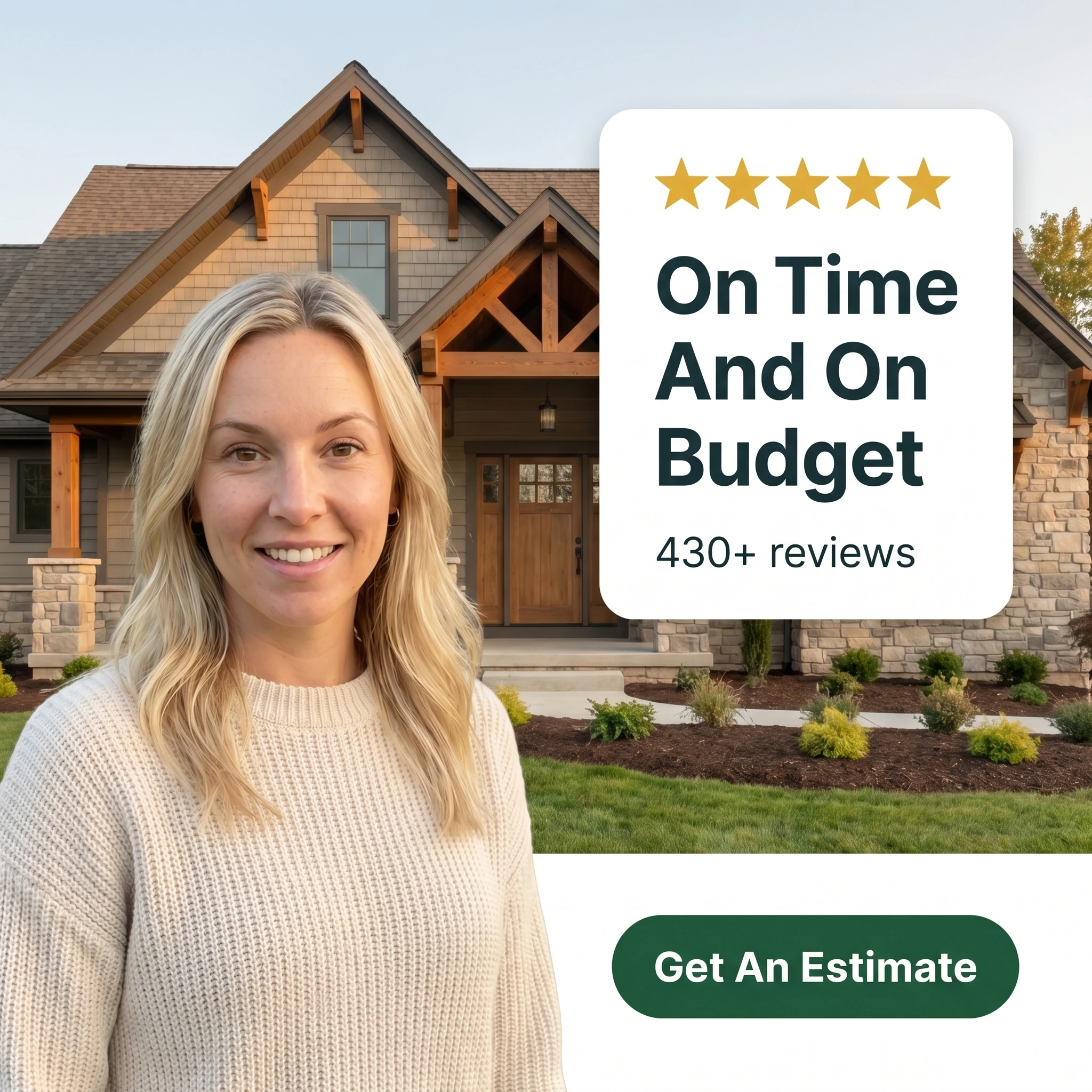
The format & angle. Harborstone Construction pairs a happy homeowner with a review card — five stars, a real review count, and the rarest contractor quote there is. Credibility and trust.
Who it targets. Warm homeowners comparing two or three firms — people sold on the work who now need to trust the process.
The hook. “On Time And On Budget.” Four words that name the two promises homeowners most expect contractors to break.
Why it works. At the comparison stage, homeowners can’t judge structural skill — they judge whether they’ll be respected and not surprised by the invoice. A testimonial about timeline and budget, backed by a visible review count, converts the abstract fear of overruns into “real clients here weren’t burned.” That single proof point about money and schedule often outweighs a prettier portfolio from a firm with no reviews.
Steal it. Search your reviews for budget and timeline language, build the card around the most specific one, and put your live review count beneath it. The plainness of “on time, on budget” is the strength — don’t dress it up.
5. The free design consult offer ad

The format & angle. Trueline Builders’ lead-capture push: typography-led, the free offer dominant, a month deadline, a confident color block — no project photo competing with the message. Low-friction lead generation.
Who it targets. Cold and warm homeowners thinking about a project but not ready to commit to a quote — the early planner who needs a no-risk first step.
The hook. “Free Design Consult This Month.” A zero-cost, zero-pressure entry point with a real deadline to act.
Why it works. Construction’s long cycle means the winner is often whoever enters the consideration set first, and a free consult is the lowest-commitment way in — it asks for a conversation, not a contract. The typography-only format reads as a genuine local offer, and the month deadline adds just enough urgency to move the procrastinator. It captures early-funnel leads the proof-heavy ads can then nurture toward a signed job.
Steal it. Make the free offer the largest element, name the month as the deadline, and route leads to a fast-responding estimator. The consult is the foot in the door — the relationship and the proof close the bid later.
Build the campaign on all five
Reliability, a finished dream, a transformation, a budget-kept review, and a no-risk consult — five proofs spread across a decision that runs weeks or months. Running them together beats reusing one winner for a reason specific to a long sales cycle: the same homeowner should meet different angles over time, not the same ad on repeat, and Meta’s delivery rewards that distinct-creative variety by matching each concept to a different buyer.
Lead cold prospects with the reliability and finished-build ads, retarget site visitors with the before/after and testimonial, and capture the early planner with the free consult. As each project wraps, fold its before/after into the rotation so the proof on screen stays as current as the trucks in the field.
Keeping a gallery’s worth of fresh creative live is the constraint for a busy builder. Zendux produces on-brand static variants with AI and bulk-launches them across ad sets, so a full portfolio is ready before the next bid walk-through.