5 Moving Company Ad Examples That Book Moves
Five moving company ad examples that turn movers from scrollers into booked jobs — a damage-free UGC ad, a speed hero, a packing before/after, a testimonial, and an hourly offer.
Moving company ads that actually book jobs answer the one question every mover is silently asking: will my stuff arrive in one piece, for the price you quoted? Square footage, truck sizes, and years in business are background noise at the feed level. The five fictional ads below cover the five angles that move the needle in this trade — damage-free trust, speed, the packing transformation, reputation, and a clean hourly offer — each in a visibly different format.
Key takeaways
- Meta wins the planned move — leases, home sales, relocations booked weeks out — while same-day emergencies go to search; advertise for the planning window.
- Damage and hidden fees are the two real fears; an ad that names one and answers it outperforms generic “professional movers” copy.
- A flat, honored quote is the strongest claim in the category because every customer has heard a horror story about the opposite.
- Five distinct concepts reach five different mover mindsets; one recycled “winner” caps your lead flow under Meta’s current delivery.
What makes a great moving company ad
The buyer is stressed, on a deadline, and choosing between strangers who will carry everything they own down a flight of stairs. Trust is the entire game. They can’t evaluate your dolly technique, so they screen for signals: a crew that looks careful, a quote that won’t move, and other people’s belongings that survived.
The proof that matters is specific and local — a real crew, a real review count, a finish time you can plan a Tuesday around. Polished national-franchise creative reads as a call center that subcontracts the actual move, which is exactly the experience people are trying to avoid. Keep one promise per ad and make it checkable, the discipline that separates the best static ads from decoration.
The economics favor Meta with a catch. Local-service CPMs often land in the $10–$25 range depending on market, and a quote request typically costs less than a click on the most competitive moving keywords in search. The catch is timing: Meta reaches movers earlier, so speed-to-quote decides everything. Shops that send a same-day estimate book a multiple of those that reply tomorrow.
| Ad | Format | Angle | Funnel stage | Best for |
|---|---|---|---|---|
| Nothing-broke UGC | UGC | Trust / damage-free | Cold | Full-service residential movers |
| Loaded-by-lunch hero | Service hero | Speed / convenience | Cold/warm | Crews competing on turnaround |
| Chaos-to-done split | Before/after | Transformation | Warm | Packing & full-service add-ons |
| Honored-quote testimonial | Testimonial | Trust / no surprises | Warm | Shops with strong reviews |
| $99/hour offer | Offer | Price / value | Cold/warm | Local same-city moves |
1. The nothing-broke UGC ad
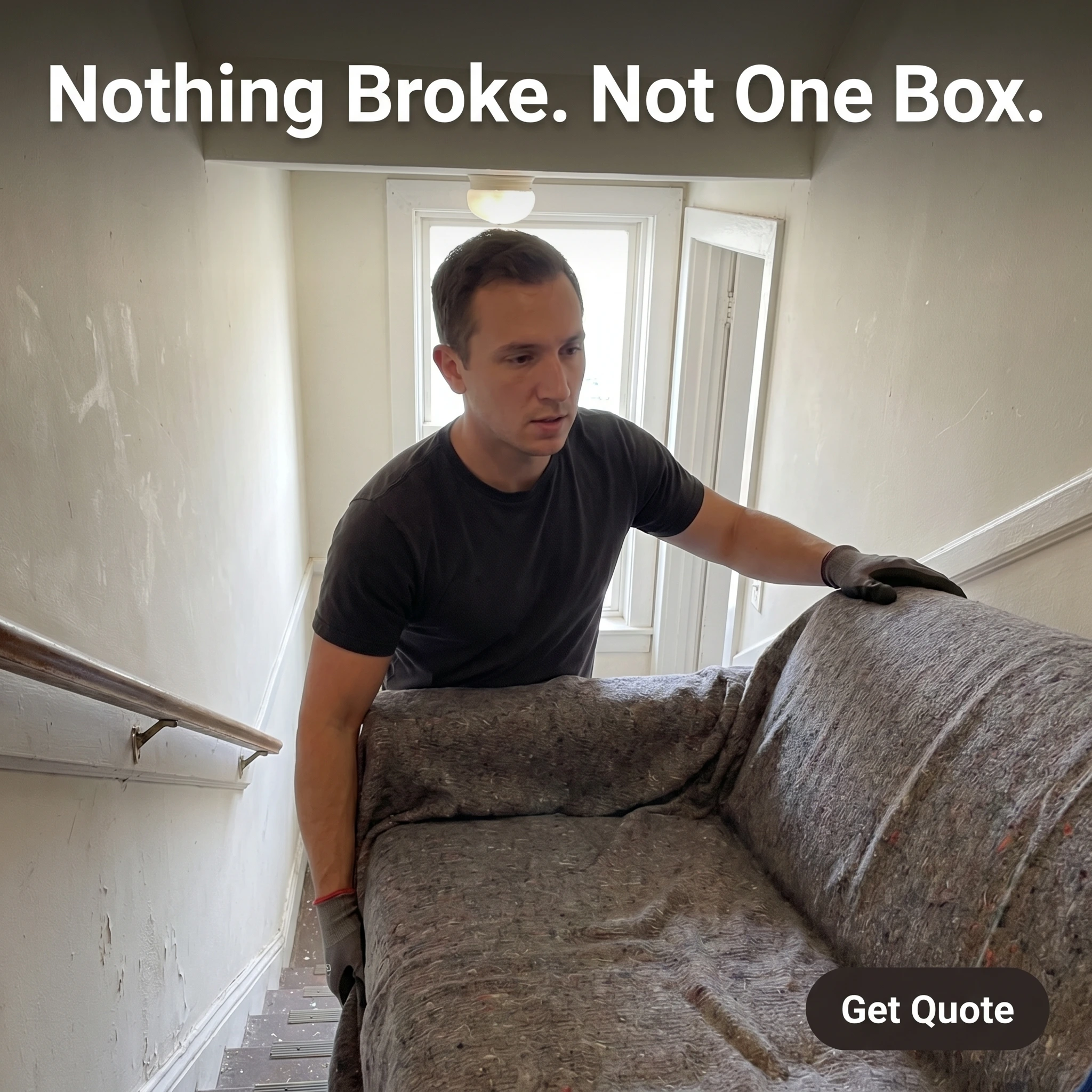
The format & angle. A Northbound Moving Co. crew member easing a blanket-wrapped sofa down an apartment stairwell, shot like a roommate grabbed the photo on the way out. Trust, aimed straight at the damage fear.
Who it targets. Cold movers in the service area who’ve started planning but haven’t shortlisted anyone yet.
The hook. “Nothing Broke. Not One Box.” The flat, slightly defiant claim names the outcome every mover is praying for.
Why it works. The candid stairwell shot is proof of care, not a promise of it — moving blankets, careful hands, a real building. In a category where the core fear is a shattered TV and a shrug, a results-first headline does more than any “fully insured” badge. The unpolished frame also reads as a local crew rather than a faceless broker, which earns the save and the cheaper reach that follows.
Steal it. Have a crew member photograph a real wrapped item mid-carry on your next job (with the customer’s okay, phone camera). Headline the outcome your customers actually exhale about — nothing broken, nothing scratched — not your years in business.
2. The loaded-by-lunch hero ad
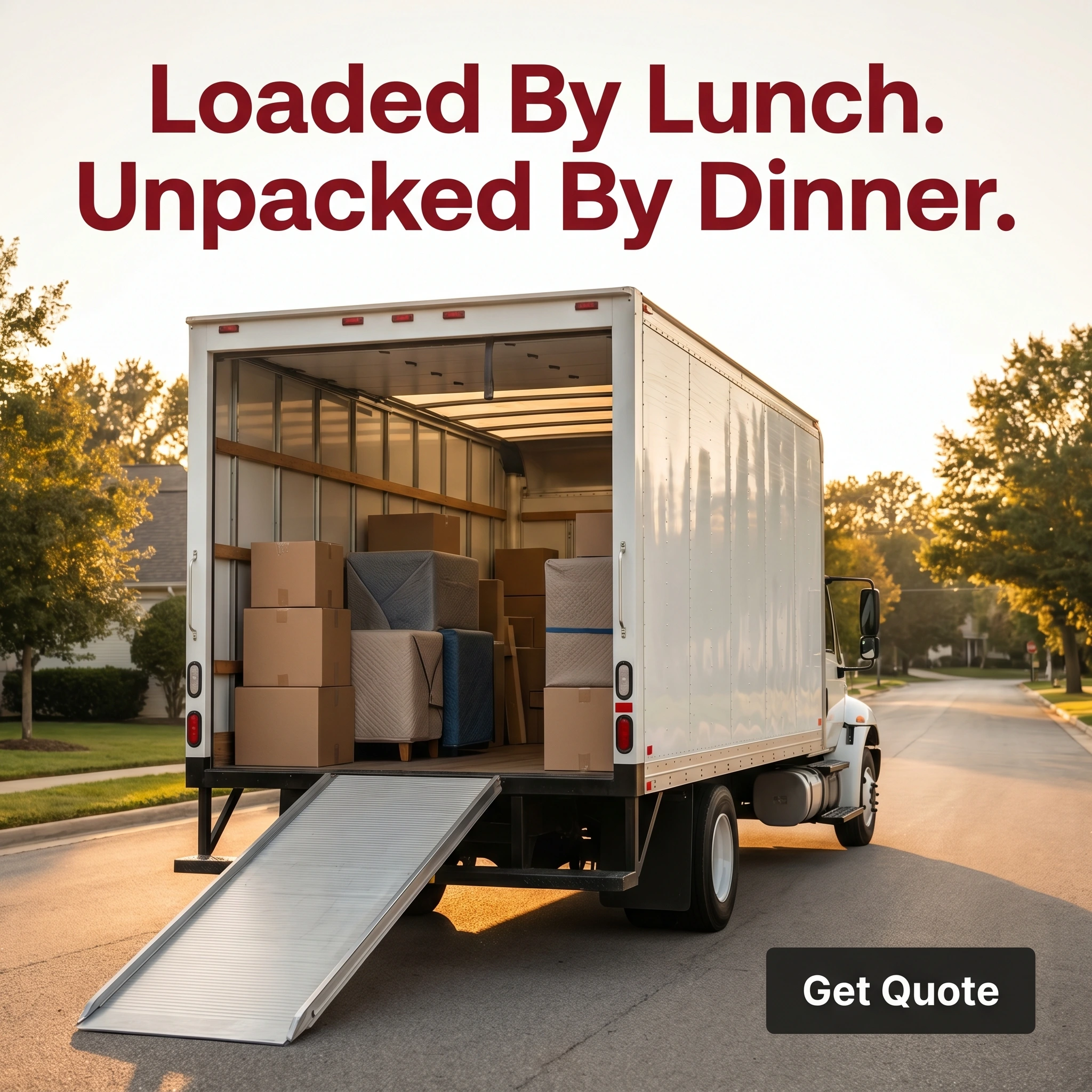
The format & angle. Cardinal Move Crew’s hero shot: a spotless box truck, ramp down, neatly stacked boxes inside, golden-hour light on a quiet street. Speed and convenience, no clutter.
Who it targets. Cold and warm movers dreading a move that eats their whole weekend.
The hook. “Loaded By Lunch. Unpacked By Dinner.” It sells the felt outcome — a move that doesn’t consume the day — in two clean beats.
Why it works. People don’t shop for movers; they shop for a Saturday they get back. Framing the day as a timeline instead of a service reaches the person already exhausted by the thought of it. The pristine, organized truck quietly answers a second worry: that the crew will be chaotic and careless. Order in the frame implies order on the job.
Steal it. Photograph your cleanest truck loaded and squared away, late afternoon light. Headline the rhythm of the day your customers wish for, not your crew size.
3. The chaos-to-done split ad
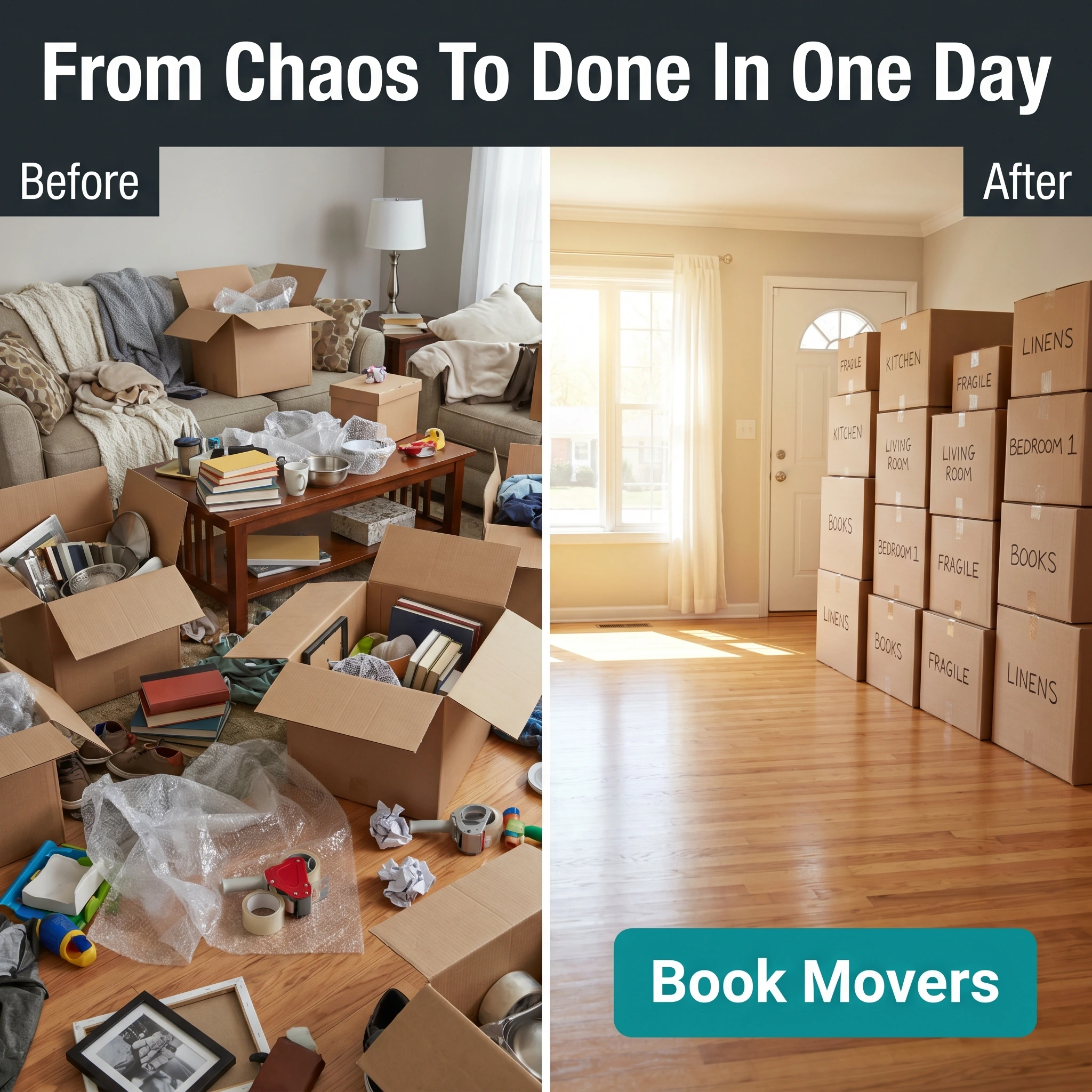
The format & angle. Hearth & Haul’s transformation: a cluttered, half-packed living room on the left; the same room emptied, swept, and a wall of labeled boxes on the right. The packing service’s natural before/after.
Who it targets. Warm movers weighing whether to pay for full-service packing or white-knuckle it themselves.
The hook. “From Chaos To Done In One Day.” The contrast is the argument; the left half is every procrastinator’s living room the week before a move.
Why it works. Packing is the part movers dread most and underestimate most, and this format makes the relief visible. The left frame triggers recognition; the right frame sells the calm. It also upsells the higher-margin packing add-on without a word of pitch — the picture does it. No exaggeration needed; real moves supply their own befores.
Steal it. Shoot one room before you start and after you’ve loaded out, same camera spot. Make it a crew habit on packing jobs and you’ll build a library of honest transformations to rotate.
4. The honored-quote testimonial ad

The format & angle. Two Oaks Moving: a relieved customer standing in a doorway of boxes beside a quote card, five stars, “900+ moves.” Trust, told as the absence of a surprise.
Who it targets. Warm audiences — quote requesters comparing two or three local crews.
The hook. “They Quoted It, They Honored It.” A review fragment that speaks to the second great fear: the bill that doubles on the day.
Why it works. At the comparison stage, movers aren’t grading lifting technique; they’re collecting reliability stories. A quote about the quote being honored is sticky because nearly everyone has heard the opposite tale. The visible move count turns one anecdote into a pattern, which is the real decision input. This format also recycles your hardest-won asset — reviews — into paid reach.
Steal it. Search your reviews for the words “quote,” “price,” “no surprises,” and “on time.” Build the card around the strongest one and put your live move count or review total beneath it.
5. The $99-per-hour offer ad

The format & angle. Pace Movers’ local push: big type, one rate, the fee everyone hates removed, a deep navy background. Price and value, no photo.
Who it targets. Cold and warm movers planning a same-city move where hourly pricing wins.
The hook. “$99/Hour. 2 Movers. No Truck Fee.” The rate anchors it; “No Truck Fee” kills the most common hidden charge in the category.
Why it works. Local moves are a price-sensitive, comparison-shopped purchase, and the typography-only format reads as a straightforward local rate rather than an agency campaign. Naming the removed fee does double duty — it’s both a discount and a trust signal, because it preempts the surprise charge people expect. Transparent pricing is itself a differentiator in a trade famous for the opposite.
Steal it. Lead with your honest hourly rate and explicitly remove the fee customers complain about most — travel time, fuel, stairs. Then rotate the creative before ad fatigue erodes it.
Put all five in the truck
A damage-free promise, a speed pitch, a packing transformation, a review, and a clean rate — five moving ads aimed at five different moments in a stressed person’s month. Meta’s delivery has changed under the hood: the Andromeda retrieval engine now weighs a far larger pool of candidate ads in each auction, so a set of genuinely different concepts out-delivers five tweaks of one idea, each finding the movers primed for it. Other local-service trades face the same dynamics — the home services ad examples breakdown covers the cross-trade patterns, and if you also run end-of-tenancy cleans, the cleaning service ad examples post pairs naturally with this one.
Run the seasonal rhythm deliberately: push speed and offer creative into the summer peak and around month-end lease turnover, then lean on trust and testimonial creative in the slower shoulder months. Spinning up five-plus genuinely different concepts on a recurring schedule is the hard part, and it’s the part Zendux automates — AI-generated static variants in your brand, bulk-launched across ad sets faster than a crew loads a truck.