5 CrossFit Ad Examples That Fill the Box
Five CrossFit ad examples that fill classes on Meta: an intimidation-busting UGC, a box hero, an 'everything scales' shot, a member review, and a free-class offer.
CrossFit ad examples that actually fill classes do one counterintuitive thing: they sell to the scared beginner, not the athlete. The people scrolling past aren’t existing CrossFitters — they’re the curious-but-intimidated, convinced they need to “get in shape first.” The five fictional ads below each dismantle that fear from a different direction, in a different format, so Meta’s auction can route each angle to the people it unsticks. And because this is a personal-health niche, none of them lean on the body transformations Meta’s policies restrict.
Key takeaways
- Intimidation is the real objection — “you don’t need to be fit yet” outconverts any athlete highlight reel.
- Sell community and coaching, not intensity alone. The tribe and the scaling are why beginners stay; raw intensity is why they never start.
- Skip body before/afters. Meta restricts them; “every workout scales to you” reassures and complies at once.
- Five distinct angles — reassurance, intensity, scaling, belonging, and a free first class — give the auction five newcomer types to find.
What makes a great CrossFit ad
A box’s growth doesn’t come from poaching other boxes’ members — it comes from converting people who’ve watched CrossFit from a distance and decided it’s “not for someone like me.” That belief is the entire marketing problem, and most box ads make it worse by showing ripped athletes throwing barbells.
Two principles, plus a constraint.
Make beginners the hero. The person you want to reach is nervous, not elite. Casting an ordinary newcomer — relieved, smiling, mid-scale — tells the audience “this room has people like you.” Athlete footage is impressive and counterproductive.
Sell belonging and coaching over intensity. People try CrossFit for the workout but stay for the community and the coaching. Lead with the thing that retains, not the thing that intimidates. The intensity sells itself once they’re in the door.
The constraint is compliance. Meta’s personal-health policies restrict body-transformation before/afters and flaw-based framing, so the before/after slot here becomes an “everything scales” coaching shot — a message about capability, not appearance. The same intimidation problem shapes nearby niches differently: floor-access gyms compete on logistics (gym ad examples), and the broader fitness ad examples set covers studios and classes. Before spending, it helps to know which static layouts perform.
| Ad | Format | Angle | Funnel stage | Best for |
|---|---|---|---|---|
| First-class-relief UGC | UGC | Pain relief/anti-intimidation | Cold | Boxes chasing total beginners |
| Chalk-and-rig hero | Hero | Status/intensity | Cold/warm | Boxes with a strong athlete base |
| Everything-scales shot | Coaching shot (swapped before/after) | Us-vs-the-old-way | Cold | On-ramp and Foundations programs |
| Community testimonial | Testimonial | Belonging | Warm | Boxes with a tight community |
| Free-class offer | Offer | Price/low risk | Warm/retargeting | Filling intro slots |
1. The first-class-relief UGC ad
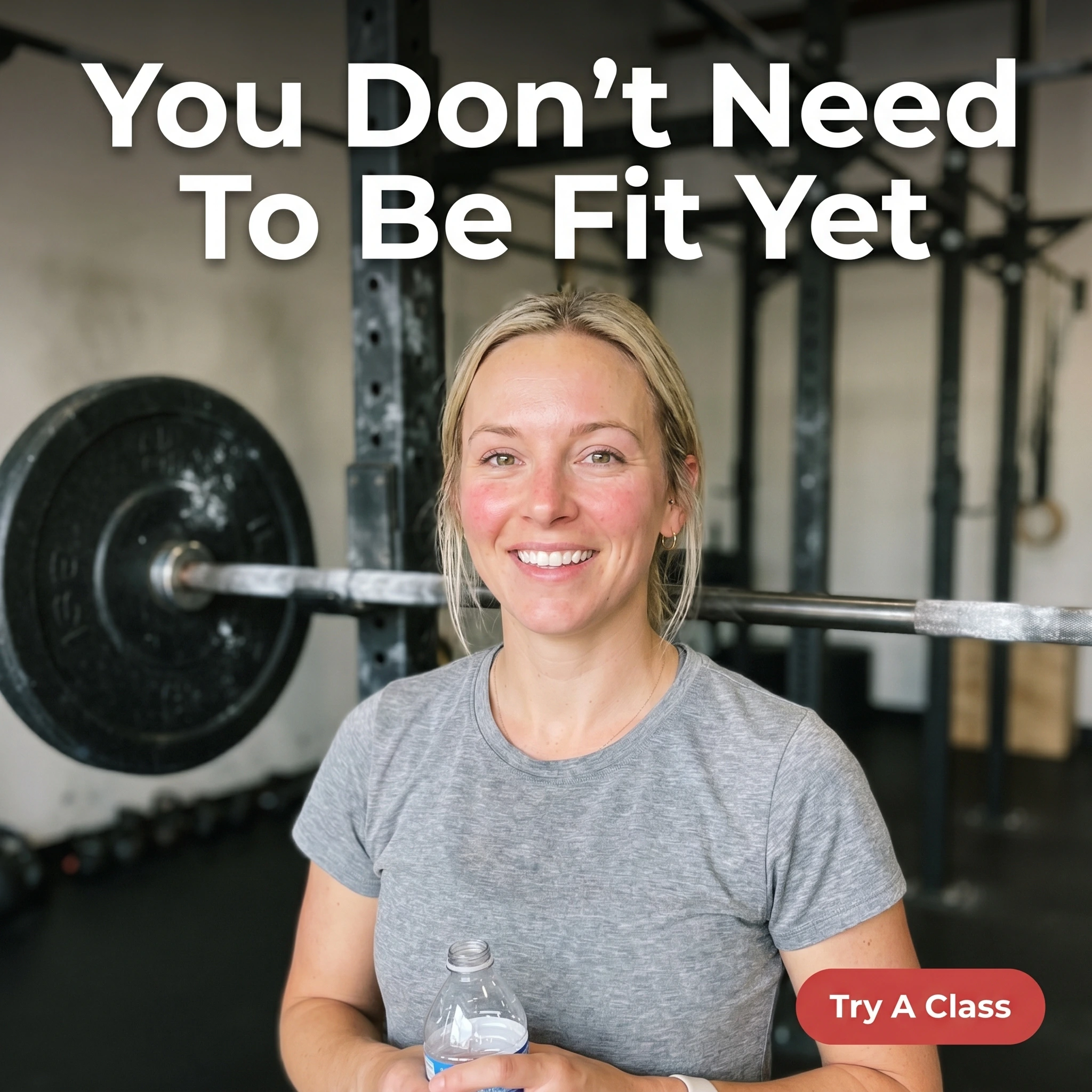
The format & angle. A candid phone shot from Foundry Box: a newcomer, flushed and relieved, smiling after surviving their first class. Pain relief — the pain being the fear, not the workout.
Who it targets. Cold prospects who’ve wanted to try CrossFit for years and keep deciding they’re “not ready.”
The hook. “You Don’t Need To Be Fit Yet.” The single sentence that removes the only real barrier.
Why it works. The whole category is gatekept by a myth — that you need to be fit before you walk in. An ordinary, slightly winded newcomer in the photo disproves it instantly, and the UGC styling makes it read as a real person’s relief, not the box’s claim. No physiques, no flaw-framing — just reassurance.
Steal it. Photograph a real first-timer right after class, genuine relief on their face, and headline the fear you just dissolved. Run it cold and local; this is the ad that grows the funnel.
2. The chalk-and-rig hero ad
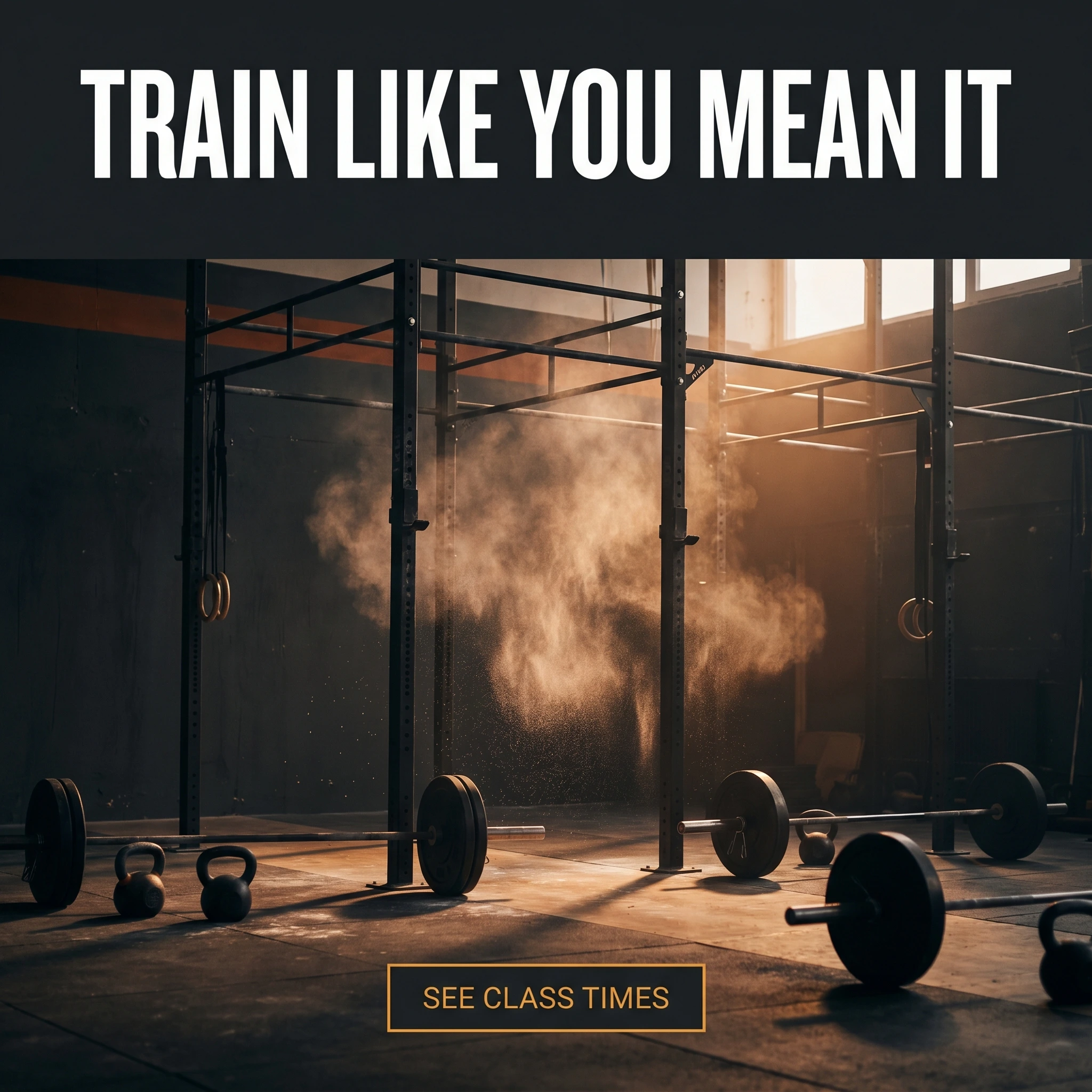
The format & angle. Anvil Athletics’ box, shot like an arena: a black rig, loaded barbells, chalk hanging in a shaft of light, no people. Intensity and identity, sold through atmosphere.
Who it targets. Cold and warm prospects who want the hard thing — ex-athletes and the competitive crowd bored by regular gyms.
The hook. “Train Like You Mean It.” A challenge to the people who respond to challenges.
Why it works. Not everyone needs reassurance; a real slice of the audience is drawn to intensity and self-selects toward it. The empty, cinematic box sells the arena without intimidating through bodies, and the moody styling signals a serious training environment. It’s the deliberate counterweight to the beginner ad — a different person entirely.
Steal it. Shoot your box at its most dramatic — chalk dust, low light, the rig as the hero — with no one in frame. Headline the intensity. Run it as the contrast concept to your beginner ad and let the auction sort them.
3. The everything-scales shot ad
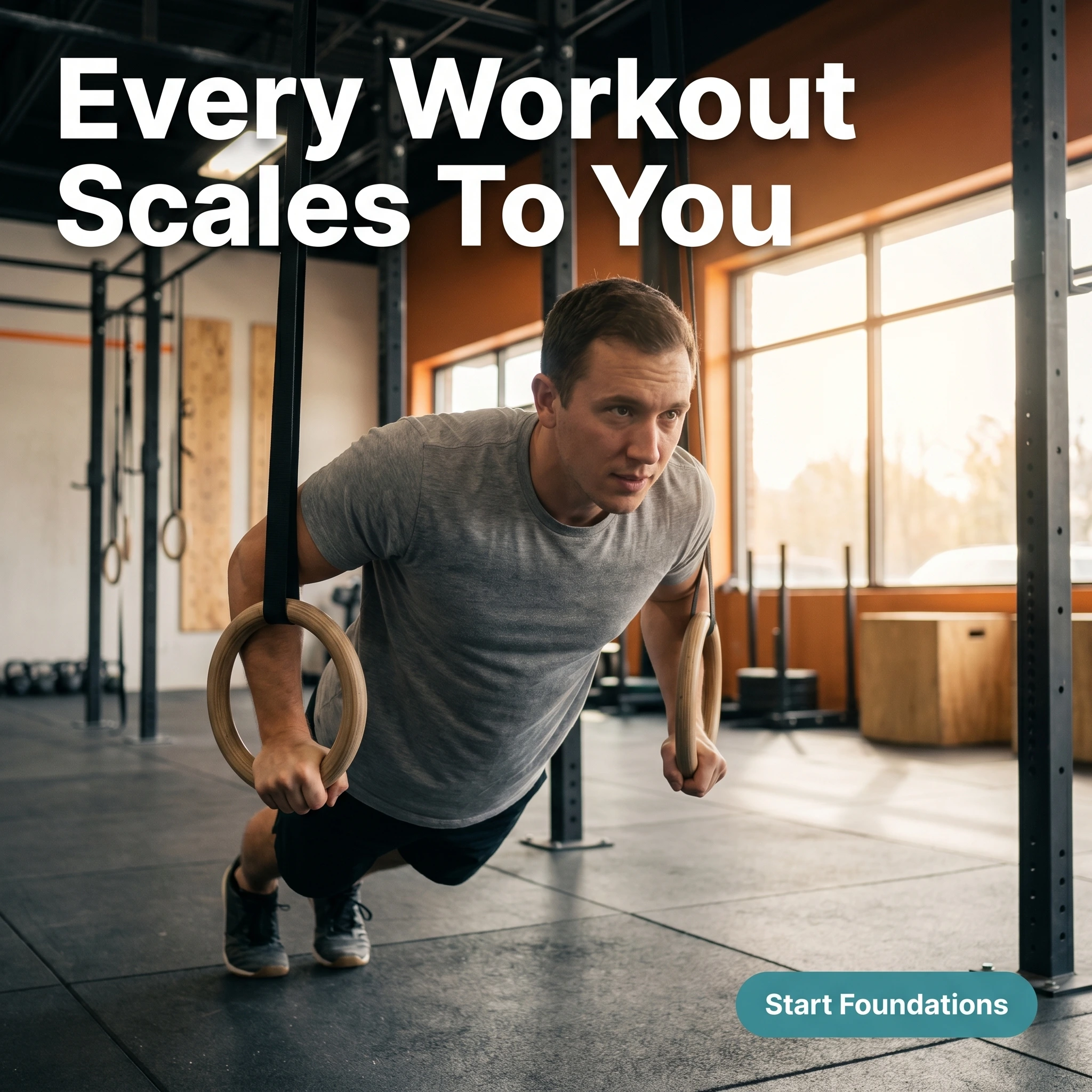
The format & angle. Proving Ground shows one member doing a scaled ring row — feet on the floor, approachable. This slot is normally a before/after, swapped because body-transformation creative violates Meta’s personal-health policies. The message is capability and coaching, not appearance.
Who it targets. Cold prospects who like the idea of CrossFit but assume every movement requires an athlete’s strength.
The hook. “Every Workout Scales To You.” The promise that the workout meets them where they are.
Why it works. Scaling is CrossFit’s best-kept secret and its strongest reassurance — every movement has an entry-level version. Showing a regular person doing the scaled variant makes the abstract concrete: I could do that today. It dismantles the competence fear with proof instead of a slogan, and stays clear of policy by showing effort, not transformation.
Steal it. Photograph the scaled version of an intimidating movement — ring rows for pull-ups, box step-ups for jumps — performed by an ordinary member. Headline the scaling promise; it’s the truest thing you can say to a beginner.
4. The community testimonial ad
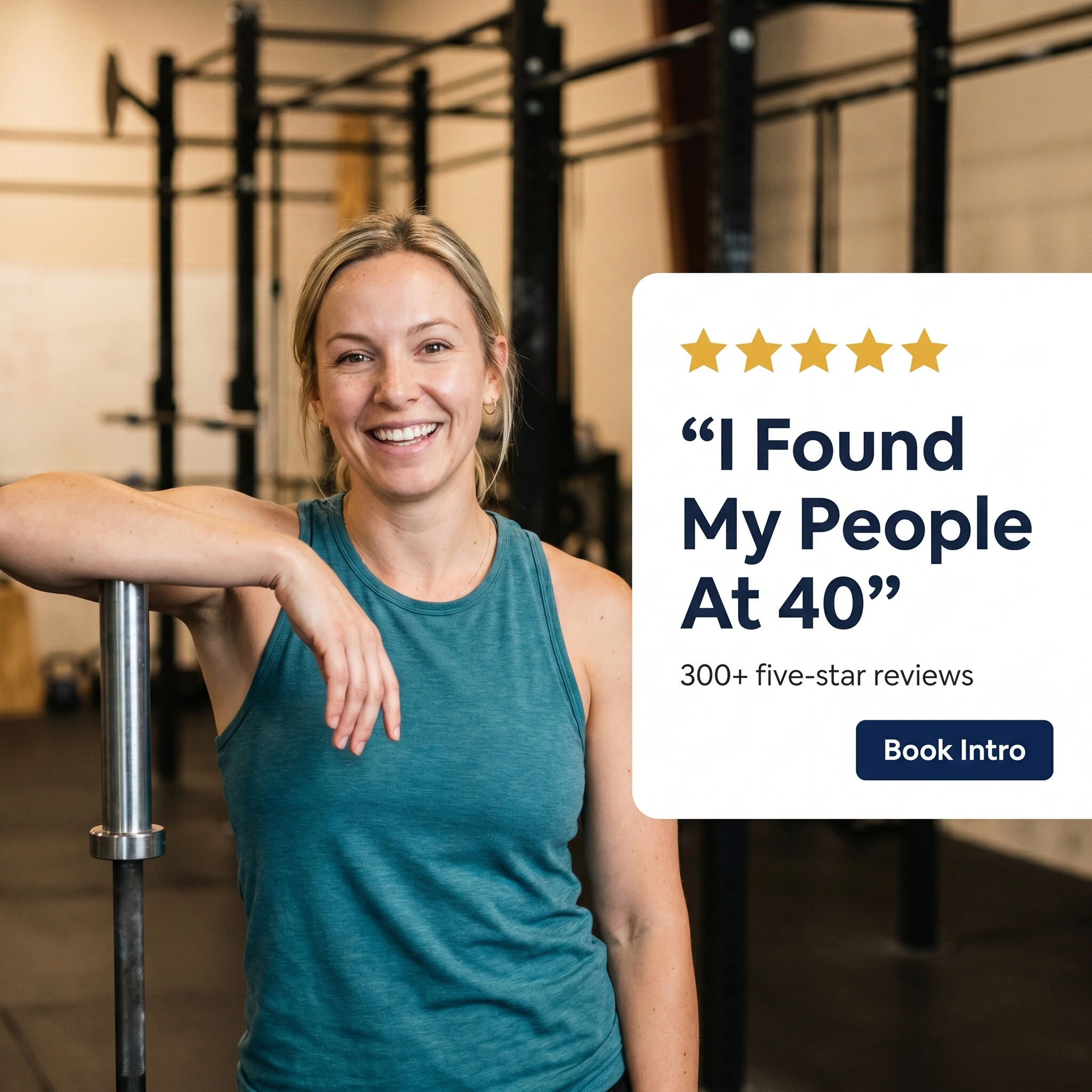
The format & angle. Riverside Box’s testimonial: a happy member leaning on a barbell beside a quote card, five stars, “300+ five-star reviews.” Belonging, in a member’s own words.
Who it targets. Warm prospects — people who clicked or visited the schedule and stalled, wondering if they’d fit in socially.
The hook. “I Found My People At 40.” Community and age-inclusivity in one line.
Why it works. Retention in CrossFit is social, and so is the decision to join. A relatable member — not a 25-year-old competitor — signals that the room has adults with jobs and families, which is who’s actually hesitating. Framing the win as friendship rather than fitness sidesteps body-image policy and hits the real reason people stay.
Steal it. Collect quotes about the people, not the PRs. Cast a member who looks like your target newcomer — older, ordinary, genuinely happy — and put the review count on the card to turn one story into a pattern.
5. The free-class offer ad

The format & angle. Tidewater Strength Co.’s typography offer: a bold headline on slate blue, “no experience needed,” a button. The deal removes the last excuse.
Who it targets. Warm and retargeting audiences — people who’ve met the box and need a zero-risk way in.
The hook. “Your First Class Is Free.” Free, because the barrier was never the money.
Why it works. A free class converts the fence-sitter by making the scary thing free and finite — one class, no commitment. “No experience needed” stacks a reassurance on the offer, answering the competence fear right at the point of decision. Typography-only ships fast and stands out among action shots in the feed.
Steal it. Offer the first class free to warm traffic, put “no experience needed” in the support line, and make booking it one tap. The class sells the membership; the ad just has to get them to show up once.
Pack every class
A relieved beginner, a chalk-lit rig, a scaled movement, a member’s story, and a free class — five box ads with nothing in common but the energy. This is what Meta’s Andromeda retrieval engine changed: by evaluating far more creative per auction, it routes the reassurance angle to the nervous and the intensity angle to the competitive — work that five near-identical ads, all chasing one slice of locals, make impossible.
For a box, the play is to launch all five, watch which angle books intros that become members rather than cheap clicks, then rebuild next month from the winner plus two new angles. Keep the free-class offer always-on for warm traffic and rotate the rest — local audiences are small, so refreshing creative often is what keeps frequency from burning a winner out.
Producing that many distinct concepts is the bottleneck for a coach-run box. Zendux generates on-brand static variants with AI and bulk-launches them across your ad sets, so a single box puts out the creative volume of a franchise.
Want to generate winning CrossFit ads? Start using Zendux AI