Consulting Ad Examples: 5 Ads That Book Calls
Five consulting ad examples that book strategy calls — a founder UGC ad, an authority hero, a case-study stat, a client testimonial, and a free-audit offer.
Consulting ads that book calls win on one move: quantify a specific result, prove it, and offer a low-risk first step — never ask a stranger to buy a contract from a feed. “We help businesses grow” is invisible; “we found $40k in 30 days” books the call. The five fictional ads below cover the five angles that convert decision-makers — a credible expert, authority, a case-study stat, a client’s proof, and a free audit — each in a visibly different format.
Key takeaways
- Quantify the outcome — a dollar figure or percentage beats “drive growth,” because decision-makers buy measurable results and reduced risk.
- Lead with a low-friction step: a free audit or strategy call converts far better than a cold pitch for a high-ticket engagement.
- Proof is the product: a case-study stat or a client testimonial does what a credentials list can’t — it makes the result feel repeatable.
- Five distinct concepts reach five different buyer mindsets; one recycled “winner” caps reach under Meta’s current delivery.
What makes a great consulting ad
The buyer is a business owner or executive weighing whether an outside expert will actually move a number that matters. Consulting is a considered, high-trust, high-ticket purchase, so the feed’s job is not to close — it’s to prove enough value to earn a low-commitment first step. The trigger is a stuck metric: flat revenue, bloated costs, a hiring mess, a plateau.
The proof that matters is quantified and attributable — a real result with a number, a named outcome, a client who’ll vouch. Abstract “strategic solutions” creative reads as a brochure and gets scrolled past. One specific, defensible claim per ad, tied to a clear first step, is what separates the best static ads from filler. Hedge numbers honestly; inflated ROI claims erode the trust the whole sale depends on.
The economics tolerate a higher cost per lead than consumer niches. A booked strategy call may run into the tens or low hundreds of dollars, but the benchmark is cost per acquired client against average contract value. If one in five calls becomes a five-figure engagement, an expensive call is still cheap. Qualify hard so sales time goes to real prospects.
| Ad | Format | Angle | Funnel stage | Best for |
|---|---|---|---|---|
| Found-$40k UGC | UGC | Specific result | Cold | Outcome-led consultancies |
| Execute-it hero | Authority hero | Credibility | Cold/warm | Strategy & advisory firms |
| Case-study stat | Stat callout | Proof | Warm | Results-driven practices |
| Paid-for-itself testimonial | Testimonial | Risk reduction | Warm | Firms with strong references |
| Free-audit offer | Offer | Low-friction start | Cold/warm | Lead generation |
1. The found-$40k UGC ad

The format & angle. A Keelstone Consulting advisor at a whiteboard mid-explanation, shot like a colleague filmed a working session. A specific result, delivered with a human face.
Who it targets. Cold owners and operators whose numbers are stuck and who don’t yet know help exists.
The hook. “We Found $40k In 30 Days.” A concrete dollar figure and a tight timeframe — the two things that make a consulting claim believable.
Why it works. The candid working-session frame signals a real practitioner doing real work, not a polished agency pitch — which lands better with skeptical operators. A specific number with a timeframe is the antidote to vague consulting-speak; it implies a repeatable method, not a one-off. The human face builds the trust a high-ticket service requires. Authenticity earns the save and cheaper reach.
Steal it. Photograph a real advisor mid-work, whiteboard or screen visible, phone-shot. Headline your most defensible quantified result with a timeframe, and be ready to substantiate it on the call. Never inflate the figure.
2. The execute-it hero ad
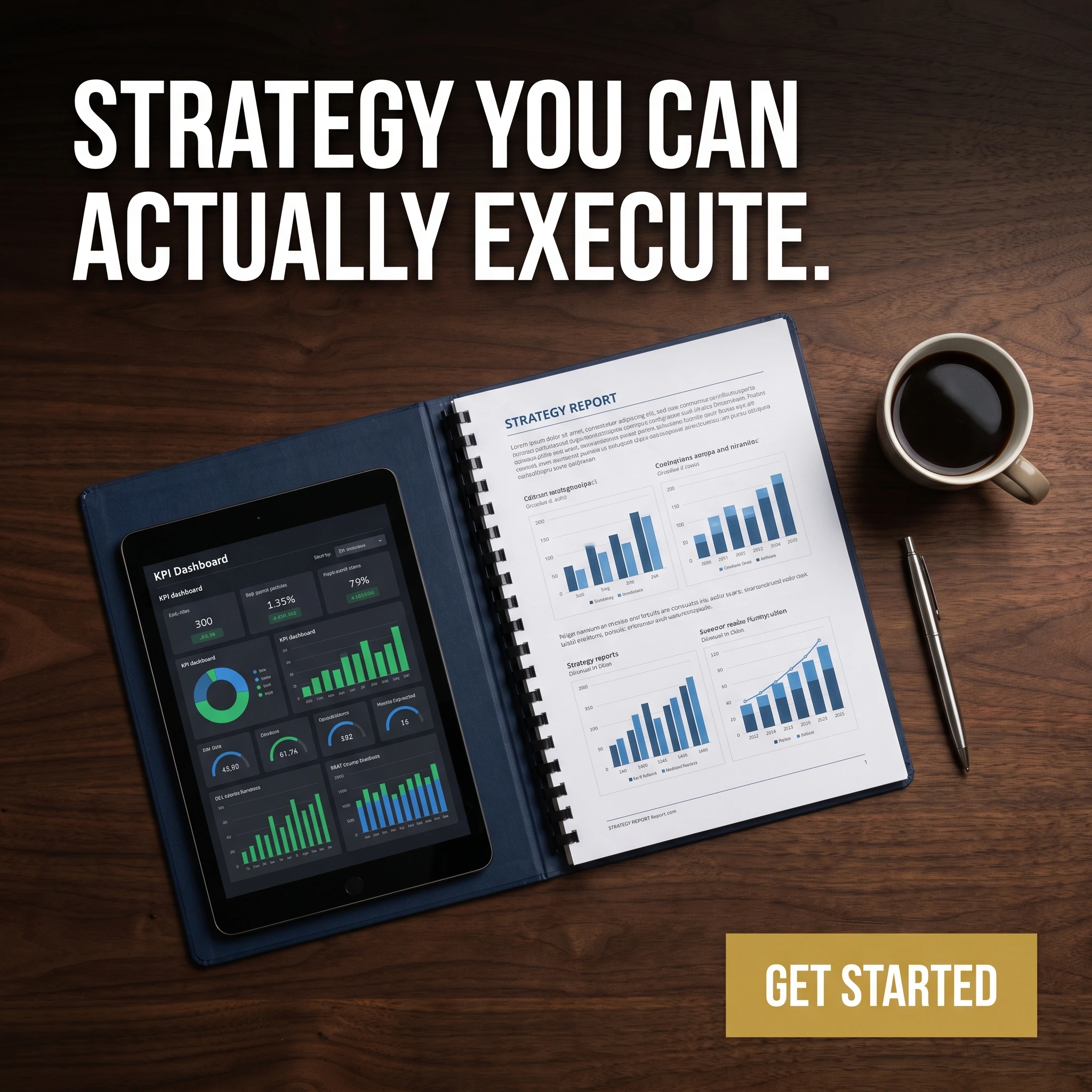
The format & angle. Meridian Advisory’s authority hero: a crisp overhead of a strategy report, a tidy dashboard, a pen — no people. Credibility through tangible deliverables.
Who it targets. Cold and warm decision-makers burned by consultants who delivered slides and disappeared.
The hook. “Strategy You Can Actually Execute.” It names the genre’s biggest failure — unimplementable advice — and promises the opposite.
Why it works. Buyers who’ve hired consultants before carry one specific grievance: a fat deck that never got executed. Showing tangible, practical deliverables — a clear report, a working dashboard — pre-answers that fear visually, and the headline names it directly. The clean, professional composition signals rigor. The deliverable is the proof; the headline is the differentiation.
Steal it. Photograph your actual deliverables looking sharp and practical — a real (redacted) report, a dashboard. Headline the failure mode your prospects complain about in past consultants, and promise execution, not insight.
3. The case-study stat ad
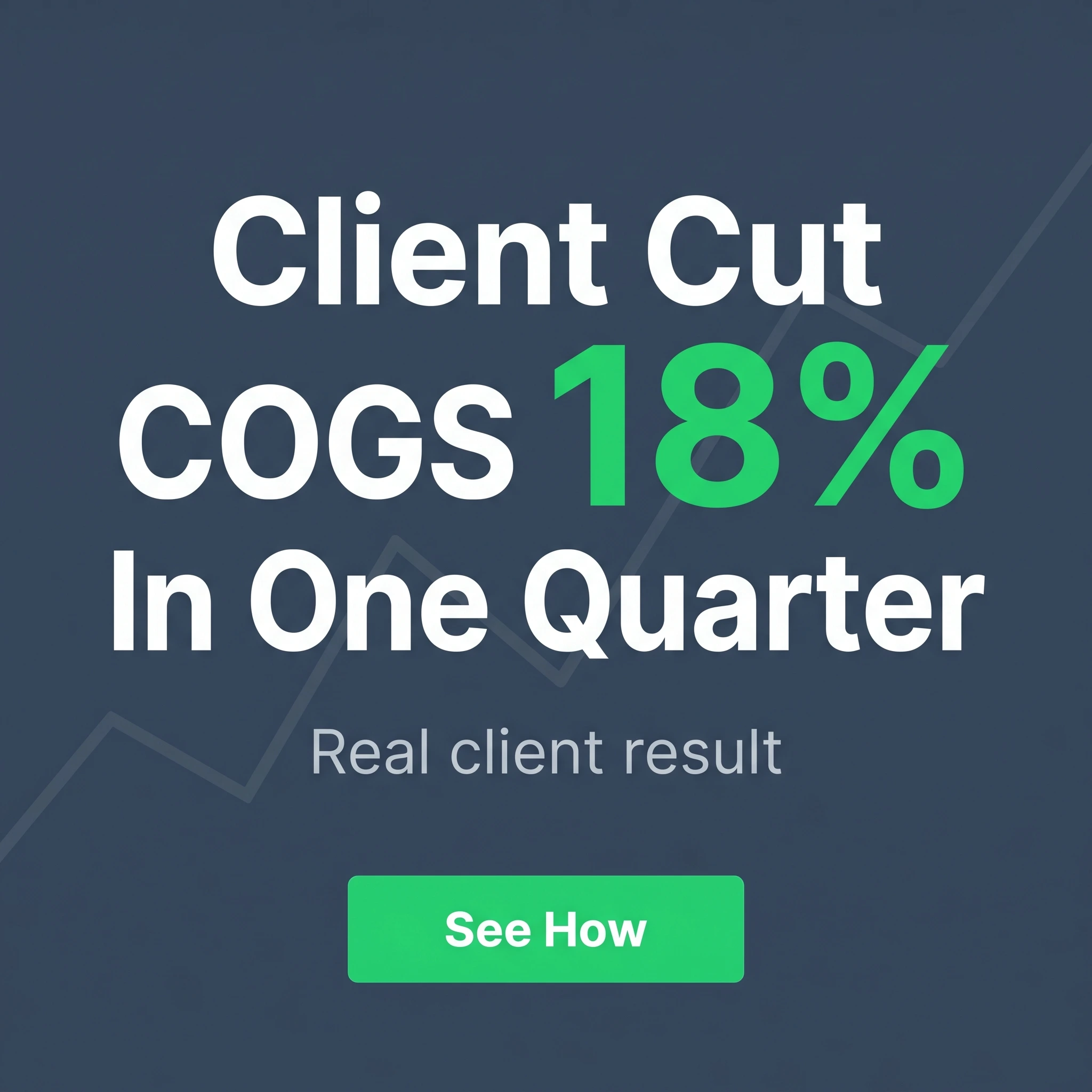
The format & angle. Northpoint Strategy’s proof point: a bold typographic stat on a clean corporate background — no people. This replaces the before/after; for a B2B service, a quantified case-study result is the cleaner proof device.
Who it targets. Warm prospects comparing firms and looking for evidence the approach produces numbers.
The hook. “Client Cut COGS 18% In One Quarter.” A specific metric, a specific magnitude, a specific timeframe — a case study compressed to one line.
Why it works. A single hard number does what a paragraph of positioning can’t: it proves the firm moves the metrics owners care about. Naming the metric (COGS), the magnitude (18%), and the timeframe (one quarter) makes it concrete and checkable on a call. The stat-callout format is built for B2B, where the transformation is financial, not visual. The number is the entire argument.
Steal it. Pull a real, defensible client result and render the number huge over a clean background. Use a metric your buyers obsess over — margin, CAC, churn, cycle time — and be ready to walk through the case study. Keep it honest and attributable.
4. The paid-for-itself testimonial ad
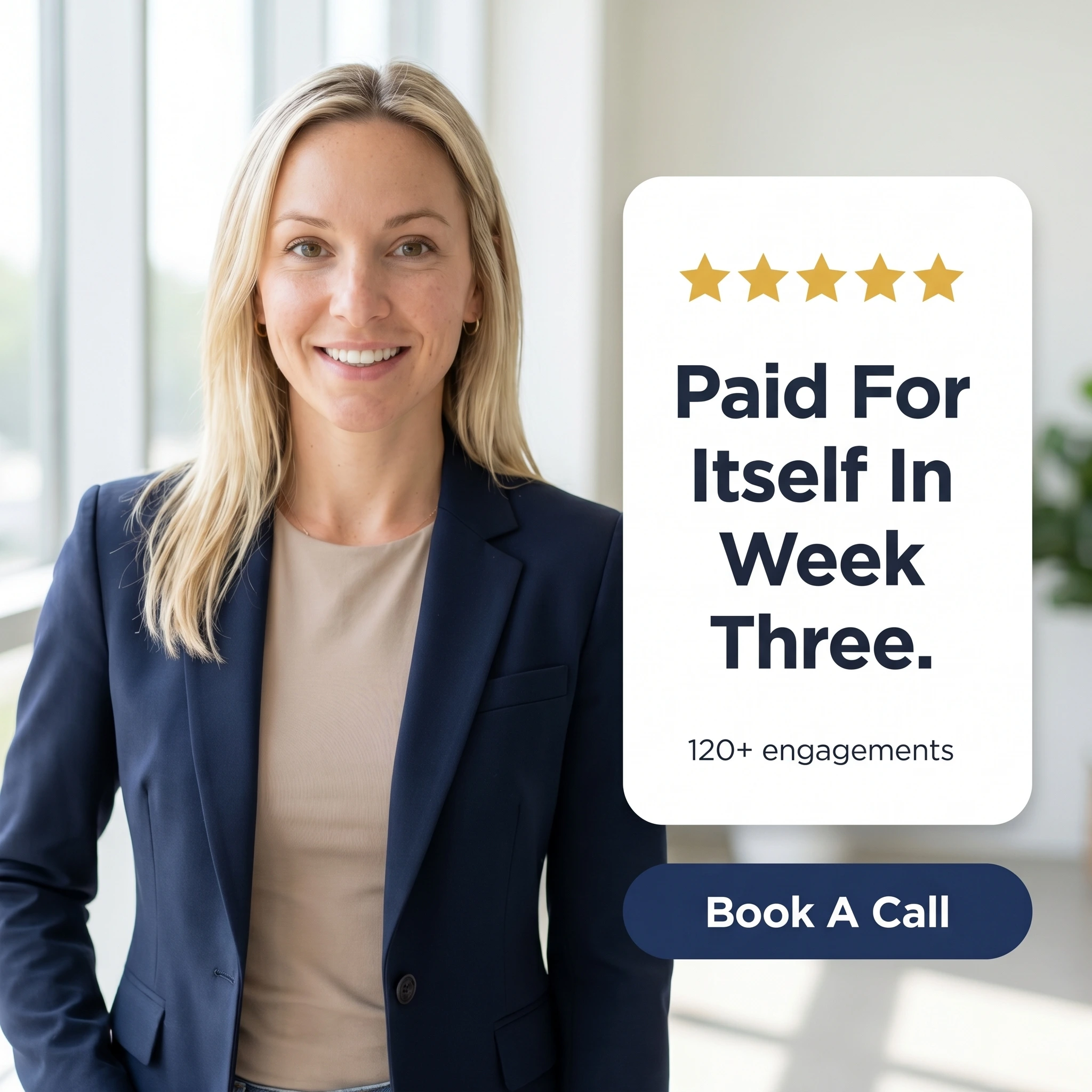
The format & angle. Arc Consulting Group: a composed executive beside a quote card, five stars, “120+ engagements.” Risk reduction, told as a fast payback.
Who it targets. Warm prospects worried the fee won’t return its value.
The hook. “Paid For Itself In Week Three.” A testimonial fragment that answers the core objection — cost — with a payback timeline.
Why it works. The deciding fear in high-ticket consulting is wasted spend, and a client saying the engagement paid for itself fast attacks that fear head-on. A payback timeframe reframes the fee as an investment with a return date, not a cost. The engagement count signals a real practice, and the executive’s photo lends authority. This recycles your references — the most persuasive B2B asset — into reach.
Steal it. Find a client who’ll speak to fast ROI, and headline the payback in their words with a real timeframe. Add an engagement or client count beneath. Secure permission, and keep the claim to what the client will confirm.
5. The free-audit offer ad

The format & angle. Lever & Co.’s lead-gen push: clean type, the free offer dominant, a deep slate background, no photo. A low-friction first step.
Who it targets. Cold and warm decision-makers curious but not ready to commit to a paid engagement.
The hook. “Free 30-Min Growth Audit This Week.” Free removes the barrier; “this week” adds gentle urgency without gimmickry.
Why it works. No one buys a five-figure engagement from a feed ad, so the offer has to be a valuable, low-commitment entry point. A free audit gives the prospect something real and lets the firm demonstrate competence before any pitch — the consulting equivalent of a test drive. The typography-only format reads as a clean professional offer, and the time-bound framing nudges action while a calendar link captures it.
Steal it. Offer a genuinely useful free audit or assessment, scope it tightly (30 minutes), route to a booking calendar, and qualify before the call so your time goes to real prospects. Rotate the creative before ad fatigue erodes it.
Book all five concepts
A quantified result, an authority deliverable, a case-study stat, a fast-payback testimonial, and a free audit — five consulting ads aimed at five points in a skeptical buyer’s deliberation. The Andromeda upgrade expanded how much creative Meta can weigh and personalize per auction, so five distinct angles reach five sets of decision-makers — where five near-duplicates would compete for one. If you also package your expertise as training, the online course ad examples breakdown is a useful sibling, and for structuring the tests themselves see ABO vs. CBO for creative testing.
Lead cold traffic with the UGC and stat concepts, then retarget with the testimonial and free-audit offer to book calls. Turning out five-plus genuinely different concepts on a schedule is the constraint, and Zendux solves it — AI-generated static variants in your branding, bulk-launched across ad sets so your calendar stays full.