5 Online Course Ad Examples That Drive Enrollments
Five online course ad examples that drive enrollments — a student-win UGC ad, a course hero, a no-degree comparison, a career-change testimonial, and a cohort offer.
Online course ads that drive enrollments sell one thing above all: a specific outcome the buyer can picture themselves reaching — and proof that real people like them got there. “Learn a new skill” is invisible in the feed; “booked my first client in six weeks” stops the scroll. The five fictional ads below cover the five angles that convert learners — a student win, the skill itself, the no-degree comparison, a career change, and a cohort deadline — each in a visibly different format.
Key takeaways
- Sell the outcome, not the syllabus — a concrete result (“first client in six weeks”) beats “comprehensive curriculum” every time.
- Proof beats promise: a real student win, a portfolio, or a career change does more than any feature list, because buyers fear it won’t work for them.
- Most courses sell on a two-step funnel — a free workshop or resource captures the lead, then a deadline converts it.
- Five distinct concepts reach five different learner mindsets; one recycled “winner” caps reach under Meta’s current delivery.
What makes a great online course ad
The buyer wants a transformation — a new skill, a career change, a side income — but carries two doubts: will it actually work, and will I finish? The trigger is dissatisfaction (a dead-end job, a wage they’ve outgrown) more than active research, which is why Meta fits: it reaches people in that restless mood before they ever search.
The proof that matters is a real student outcome, shown specifically — a first paycheck, a portfolio, a job title that changed. Polished “transform your life” creative reads as a scam in a category crowded with them. One concrete outcome per ad, backed by believable proof, is what separates the best static ads from hype. Keep numbers honest and hedged; inflated income claims trigger both skepticism and policy scrutiny.
The economics live in the funnel, not the click. Most courses run a two-step model — a free workshop or lead magnet captures the email cheaply, then nurture and a cohort or evergreen deadline drive the enrollment. Judge the channel on cost per enrollment against course price and lifetime value, including cohorts and upsells, not on cost per lead.
| Ad | Format | Angle | Funnel stage | Best for |
|---|---|---|---|---|
| Student-win UGC | UGC | Proof / outcome | Cold | Outcome-driven courses |
| Skill-they-pay-for hero | Product hero | Dream / value | Cold/warm | Skill & career courses |
| No-degree comparison | Comparison | Us-vs-the-old-way | Warm | Career-changer programs |
| Career-change testimonial | Testimonial | Transformation proof | Warm | Job-outcome courses |
| Cohort-deadline offer | Offer | Urgency / scarcity | Warm | Cohort-based programs |
1. The student-win UGC ad

The format & angle. A Craftpath Academy student at a kitchen-table laptop, mid-celebration, shot like she filmed her own win. Proof and outcome — the result, told in the first person.
Who it targets. Cold learners restless in their current situation, scrolling rather than searching.
The hook. “I Booked My First Client In 6 Weeks.” Specific, first-person, and bounded by a believable timeframe.
Why it works. The candid self-shot reads as a real student, not an actor, which is everything in a category thick with scams. A concrete, time-bound outcome (“first client in 6 weeks”) is both aspirational and credible — big enough to want, small enough to believe. The first-person voice invites the viewer to picture themselves in the chair. That authenticity earns the save and the cheaper reach that follows.
Steal it. Feature a real student’s specific early win in their own words, phone-shot, unpolished. Headline the concrete milestone — first client, first sale, first interview — with an honest timeframe, never an inflated income figure.
2. The skill-they-pay-for hero ad
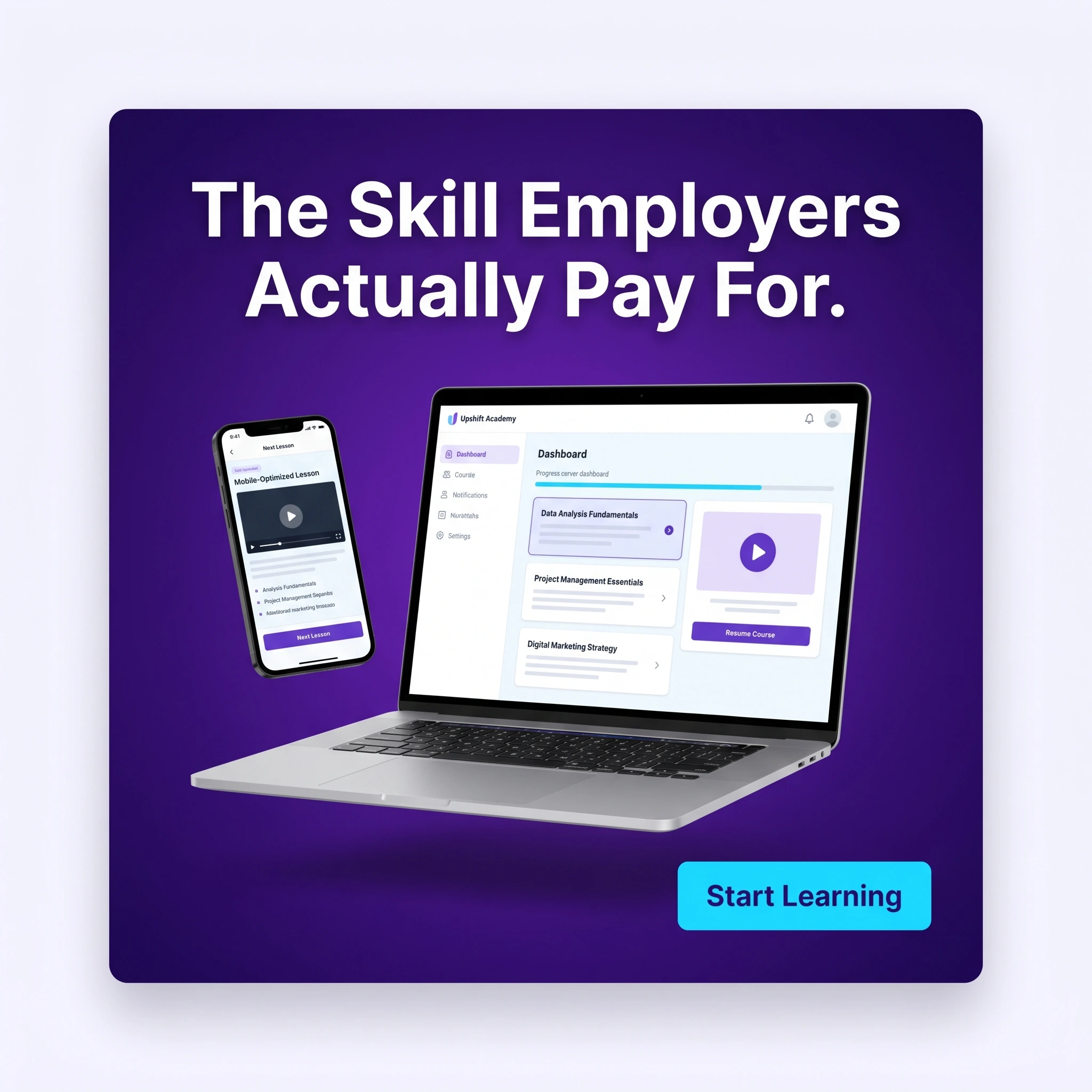
The format & angle. Upshift Academy’s hero shot: a crisp mockup of the course on a laptop and phone against a bold background — no people. Dream outcome and value.
Who it targets. Cold and warm learners weighing whether a course is worth the money and time.
The hook. “The Skill Employers Actually Pay For.” It positions the course as a means to income, not a hobby.
Why it works. The clean device mockup makes an intangible product feel real and professional — buyers can see what they’re getting, which lowers scam anxiety. The headline reframes “learning” as “earning,” the only frame that justifies the price for a career-minded buyer. The single bold focal point reads at thumbnail size. The product looks legitimate; the headline makes it valuable.
Steal it. Show a polished mockup of your actual course on real devices, bold background. Headline the economic payoff — the skill that pays, the role it unlocks — not the topics covered. Save the curriculum for the landing page.
3. The no-degree comparison ad
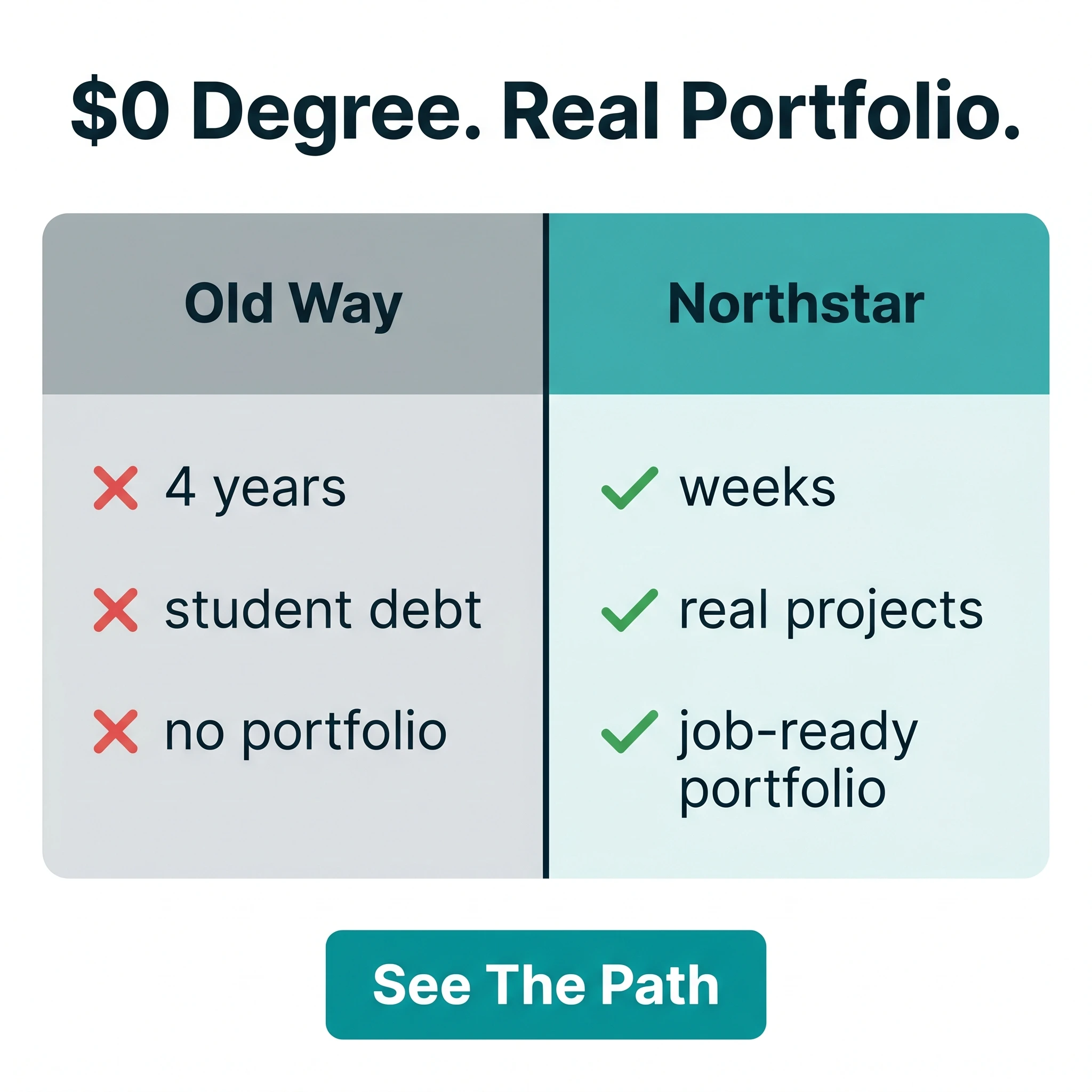
The format & angle. Northstar Skills’ us-versus-the-old-way comparison: two columns contrasting a four-year degree (time, debt) with the course path (weeks, a portfolio) — no people. This replaces the before/after; a side-by-side comparison is the cleaner transformation device for an education product.
Who it targets. Warm career-changers skeptical of the traditional-education path and its cost.
The hook. “$0 Degree. Real Portfolio.” It pits the course against the expensive default and wins on both price and tangible output.
Why it works. The comparison format makes the decision for the viewer by framing it as a choice between an old, costly path and a new, faster one. Career-changers are already disillusioned with the degree-and-debt model, so naming it explicitly validates a feeling they already have. Contrasting “portfolio” against “degree” shifts the value conversation to what employers actually evaluate. The two-column layout is instantly legible.
Steal it. Build a clean two-column graphic contrasting the traditional path against yours on the dimensions buyers care about — time, cost, real output. Keep every claim defensible; the contrast persuades on its own.
4. The career-change testimonial ad

The format & angle. Slate & Co Learning: a confident graduate beside a quote card, five stars, “2,300+ students placed.” Transformation proof, told as a career arc.
Who it targets. Warm audiences who’ve engaged but haven’t enrolled, still wondering if it works for someone like them.
The hook. “From Warehouse To Web Developer.” A before-and-after of a career compressed into four words.
Why it works. At the decision stage, learners need to see someone with their starting point reach the destination. A job-to-job arc is the most persuasive proof a course can show, because it answers “will this work for me” with “it worked for him.” The placement count turns one story into a track record. The graduate’s photo makes it real. This recycles your strongest asset — student outcomes — into paid reach.
Steal it. Find a graduate whose before-job mirrors your audience’s, and headline the leap as a from-to. Add a real, honest placement or completion stat beneath. Get written consent to use the story.
5. The cohort-deadline offer ad

The format & angle. Cohort Club’s enrollment push: bold type, a deadline and a seat count, a deep indigo background, no photo. Urgency and scarcity.
Who it targets. Warm leads who’ve consumed the free content and need a reason to act now.
The hook. “Next Cohort Opens Monday — 40 Seats.” A real date plus a real cap — the two ingredients of credible urgency.
Why it works. Courses are easy to “buy later” forever, and a cohort with a named start date and a seat cap converts deferral into a deadline. Both elements must be true to work: a specific day beats “soon,” and a real seat limit beats “limited spots.” The typography-only format reads as a clean announcement rather than a hype ad, and the scarcity does the closing that proof and nurture set up.
Steal it. Run genuine cohorts with real start dates and honest caps, and put both in the creative. If you sell evergreen, use an authentic rolling deadline — never a fake countdown. Rotate the creative before ad fatigue erodes it.
Enroll all five concepts
A student win, the skill’s value, a no-degree comparison, a career change, and a cohort deadline — five course ads aimed at five points in a learner’s hesitation. Distinct concepts each claim their own slice of delivery; five reworded versions of one promise fight over the same slice. The lever for cheaper enrollments now is real variety, not more variations. If your program is more advisory than instructional, the consulting ad examples breakdown is a useful sibling, and for writing the hooks themselves see how to write Facebook ad copy, headlines, and CTAs at scale.
Lead cold traffic with the UGC and comparison concepts into a free workshop, then retarget with the testimonial and cohort offer to enroll. The limiter is producing five-plus distinct concepts every launch, which Zendux removes by generating on-brand static variants with AI and bulk-launching them across ad sets so every cohort fills.