Marketing Agency Ad Examples: 5 Ads That Book Calls
Five marketing agency ad examples that book sales calls — a pain-point UGC ad, a ROAS stat hero, a DIY-vs-done comparison, a client testimonial, and a free-audit offer.
Marketing agency ads that book calls have to clear a bar most niches don’t: the ad itself is the proof you can do the job. If your own funnel can’t turn a cold scroller into a discovery call, why would a prospect trust you with their budget? Results earn the click; a low-risk first step earns the booked call. Here are five fictional ads — a pain-point UGC ad, a ROAS stat hero, a DIY-vs-done comparison, a client testimonial, and a free-audit offer — each a distinct format making a distinct claim.
Key takeaways
- Your ad is your case study: an agency that generates its own leads on Meta proves competence before the first call.
- Specificity beats aspiration — a real ROAS number or client outcome converts where “we drive growth” gets scrolled.
- Lead with a free audit or strategy call — the lowest-risk entry point that also qualifies the prospect and seeds your sales conversation.
- Practice the diversity you preach: run five distinct angles, not five versions of one promise, the way Meta’s delivery now rewards.
What makes a great marketing agency ad
The buyer is a business owner or marketing lead who has either been burned by an agency before or is skeptical one is worth the retainer. They’ve seen a hundred “we’ll 10x your revenue” ads and tuned them all out. The bar is trust, and the fastest way to clear it is to be specific where everyone else is vague — a real number, a named problem, a concrete result.
Agency ads carry a unique signal that no other niche does: the ad is a live demonstration. A prospect who sees a tight, well-targeted agency ad reasonably concludes the agency knows what it’s doing. That makes creative quality and targeting discipline a sales asset, not just a cost — and it’s why agencies should be modeling the same testing rigor covered in how many ad creatives to test per week.
Because the offer is high-consideration and high-priced, the winning move is a low-friction entry point — a free audit or strategy call — that delivers value upfront and qualifies the lead. From there it’s a sales process, not a click. Agencies serving SaaS and tech clients should also study the adjacent SaaS ad examples playbook, since the buyer psychology overlaps. The five concepts below cover the angles that book calls.
| Ad | Format | Angle | Funnel stage | Best for |
|---|---|---|---|---|
| Overwhelmed-owner UGC | UGC | Pain-point relief | Cold | Small-business clients |
| ROAS stat hero | Stat callout | Dream/results | Cold/warm | Performance agencies |
| DIY-vs-done comparison | Comparison | Credibility/value | Warm | Agencies vs in-house/freelance |
| Booked-solid testimonial | Testimonial | Trust/social proof | Warm | Niche & vertical agencies |
| Free growth audit offer | Offer | Low-friction lead | Cold/warm | Lead-gen pushes |
1. The overwhelmed-owner UGC ad

The format & angle. A Brightwake Agency strategist at a home-office desk, talking to the camera like a casual founder update. Plain, human, unpolished. Pain-point relief.
Who it targets. Cold small-business owners drowning in their own marketing — the people running ads, posting, and emailing with no time and no system.
The hook. “Marketing Shouldn’t Be This Hard.” It validates the prospect’s exhaustion instead of pitching, which earns the next second of attention.
Why it works. A talking-head UGC ad from a real person reads as advice, not a sales pitch, and the empathy-first hook meets the owner where they are — overwhelmed and skeptical of slick agencies. It positions the agency as the relief, not another vendor to manage. The unpolished format also quietly signals authenticity: a real operator talking, not a brand performing, which is disarming in a category full of hype.
Steal it. Film a founder or strategist talking plainly to a phone camera about the exact frustration your ideal client feels. Lead with empathy for the problem; save the pitch for the landing page.
2. The ROAS stat hero ad

The format & angle. Pinnacle Reach’s hero: a single dominant statistic on a clean, confident background, one focal point, no clutter. Dream outcome, told as a number.
Who it targets. Cold and warm prospects who judge agencies on performance — the results-driven owner or marketing lead.
The hook. “4.2x ROAS In 90 Days.” A specific figure with a timeframe attached, which reads as a real client outcome rather than a boast.
Why it works. In a category drowning in vague growth promises, a precise number cuts through because it’s falsifiable and concrete. The timeframe (“90 days”) makes it feel like an actual case, not marketing math, and the clean stat-callout layout gives the number nowhere to hide — it is the ad. It pulls performance-minded prospects who skip past anything qualitative straight to the proof.
Steal it. Pull a real, defensible client result, render the number as the largest element on a clean background, and attach the timeframe. Keep it honest — an inflated stat that the sales call can’t back up costs you the deal and the trust.
3. The DIY-vs-done comparison ad
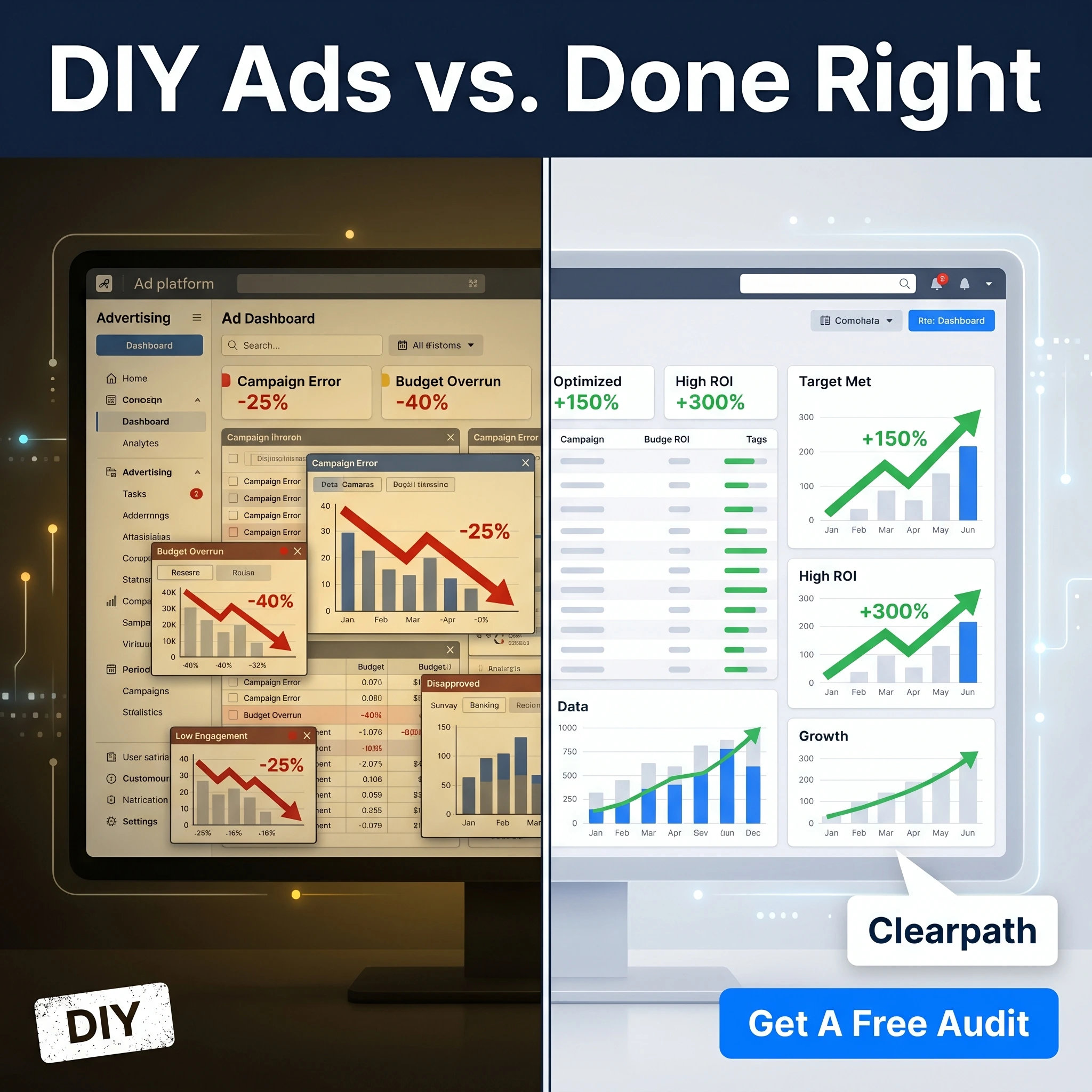
The format & angle. Clearpath Marketing’s split: a chaotic, under-performing ad account on the left; a clean, structured, profitable one on the right. Credibility and value.
Who it targets. Warm prospects currently doing it themselves or with a junior hire — the owner who suspects their account is a mess but isn’t sure.
The hook. “DIY Ads vs. Done Right.” It draws the line between dabbling and expertise without insulting the prospect outright.
Why it works. The comparison format externalizes a fear the DIY marketer already has — that they’re wasting spend they can’t see. Showing a cluttered account beside a clean one makes the gap visceral and positions the agency’s expertise as the difference between burning budget and printing returns. It reframes the retainer as cheaper than the waste, the same value logic that makes ABO vs. CBO testing structure worth getting right.
Steal it. Mock up a believable messy-versus-clean account comparison (anonymized, honest), same crop both sides. Headline the gap between doing it and doing it right, and route the click to a free audit that proves the point on their real account.
4. The booked-solid testimonial ad

The format & angle. Anchorpoint Media pairs a real client with a review card — five stars, a client count, and an outcome quote. Trust and social proof.
Who it targets. Warm prospects comparing agencies — people who like your numbers but need to know other businesses trusted you and won.
The hook. “They Booked Us Solid.” A client’s words describing a concrete business result — a full calendar — not an abstract metric.
Why it works. Prospects discount an agency’s self-promotion but trust another business owner’s account, especially when it names a tangible outcome like a booked calendar. The visible client count turns one quote into a pattern, which is the real decision input at the comparison stage. An outcome-specific testimonial also does double duty: it’s proof and it’s a mini case study the sales team can expand on the call.
Steal it. Pull a client quote that names a business result, not a vanity metric, and pair it with a real client photo and your client count. Specificity — “booked solid,” “doubled our leads” — is what makes it stick.
5. The free growth audit offer ad

The format & angle. Meridian Growth’s lead-capture push: typography-led, the free offer and the scarcity dominant, a confident color block — no stock laptop photo. Low-friction lead generation with urgency.
Who it targets. Cold and warm prospects curious enough to want a look at their own numbers but not ready for a sales call — the audit-curious.
The hook. “Free Growth Audit, 5 Spots.” Zero-risk value plus honest scarcity that makes the prospect act before the spots fill.
Why it works. A free audit delivers value before any commitment and demonstrates expertise in the process — the prospect experiences the agency’s thinking before paying for it. The capped “5 spots” adds real urgency without the fake countdown clichés the category overuses. The typography-only format reads as a genuine offer, and the audit qualifies the lead while handing the sales call a concrete starting point.
Steal it. Make the free offer and the spot count the two biggest elements, cap the slots honestly, and route leads to a calendar. The audit is the hook; the call is where the strategy and the close happen.
Run the portfolio you’d sell a client
An empathy hook, a hard number, a DIY contrast, a client win, and a free audit — five angles for a buyer who’s heard every pitch. The case for variety here is the one you already make to clients: Meta’s Andromeda retrieval engine evaluates and personalizes far more creatives per auction than it used to, so five distinct concepts out-deliver five rewordings of “we drive growth” — and running near-duplicates quietly tells a prospect you don’t believe your own advice.
Prospect cold with the UGC and stat ads, retarget with the comparison and testimonial, and let the free audit capture and qualify the curious. Keep the creative fresh, since an agency whose own ads visibly fatigue undercuts the sales call before it starts.
Producing distinct creative at volume while running client accounts is the squeeze. Zendux generates on-brand static variants with AI and bulk-launches them across ad sets — for your own funnel and every client’s — without eating your team’s hours.