5 Recruitment Agency Ad Examples That Win Clients
Five recruitment agency ad examples that win hiring clients — a fast-fill UGC ad, a shortlist hero, a job-board comparison, a hiring-manager testimonial, and a guarantee offer.
Recruitment agency ads that win clients sell the hiring manager exactly what an overflowing inbox can’t: a short list of vetted, right-fit candidates, fast — not 200 resumes to wade through. “Talent solutions” is noise; “three vetted candidates in a week” books the intro call. The five fictional ads below cover the five angles that convert employers — speed-to-hire, a curated shortlist, the job-board comparison, a hiring manager’s proof, and a no-risk guarantee — each in a visibly different format.
Key takeaways
- Sell quality and speed, not volume — recruitment is direct-hire, so the promise is a vetted shortlist and a lasting hire, never a pile of applicants.
- Quantify the win: “filled in 11 days” or “three candidates, not 200” beats “talent solutions,” because hiring managers buy time and certainty.
- A guarantee removes the risk of trying a new agency — contingency fees and replacement guarantees are the category’s strongest closers.
- Five distinct concepts reach five different employer mindsets; one recycled “winner” caps reach under Meta’s current delivery.
What makes a great recruitment agency ad
The buyer is a hiring manager or owner who’s been trying to fill a role for weeks, drowning in unqualified applicants, and losing productivity to the vacancy. Their pain is the time and risk of hiring, not a shortage of resumes. The trigger is an open req that won’t close. Recruitment is direct-hire, so the promise is quality and permanence — the right person who stays — not bodies.
The proof that matters is concrete and outcome-based — a real time-to-fill, a vetted-shortlist process, a hiring manager who’ll vouch, a guarantee that puts the agency’s fee at risk. Generic “connecting talent” creative reads as every other agency. One specific promise per ad — speed, fit, or risk reduction — is what separates the best static ads from filler. Keep numbers defensible; an inflated fill-time invites a hard question on the first call.
The economics support a higher cost per lead. A single direct-hire placement fee is often a meaningful percentage of salary, so a qualified employer lead can cost real money and still pay off. The benchmark is cost per signed client against average placement fee and repeat-client value — agencies that earn a company’s trust place for it again and again.
| Ad | Format | Angle | Funnel stage | Best for |
|---|---|---|---|---|
| 11-day-fill UGC | UGC | Speed-to-hire | Cold | Generalist & in-demand roles |
| Three-candidate hero | Service hero | Quality / curation | Cold/warm | Specialized direct-hire |
| Job-board comparison | Comparison | Us-vs-the-old-way | Warm | Agencies vs. DIY hiring |
| Best-hire testimonial | Testimonial | Proof / fit | Warm | Firms with client references |
| No-placement-no-fee offer | Offer | Risk reduction | Cold/warm | Winning first-time clients |
1. The 11-day-fill UGC ad

The format & angle. A Keystone Talent recruiter mid-call at her desk, shot like a teammate caught the moment. Speed-to-hire, with a human face on the agency.
Who it targets. Cold hiring managers with a role that’s been open too long and a team feeling the gap.
The hook. “We Filled It In 11 Days.” A concrete, fast time-to-fill — the number a frustrated hiring manager most wants to hear.
Why it works. The candid desk shot reads as a real, working recruiter rather than a faceless agency, which builds the trust an employer needs before handing over a req. A specific fill time implies an active pipeline and a method, not luck — far stronger than “fast placements.” Naming the days makes it checkable and memorable. The human, unpolished frame earns the save and cheaper reach.
Steal it. Photograph a real recruiter at work, phone, headset, screen visible. Headline your most defensible average or standout time-to-fill, and be ready to explain how you hit it. Never quote a number you can’t back up.
2. The three-candidate hero ad

The format & angle. Ascend Search Partners’ hero: a clean, premium layout of three anonymized candidate cards on a bold background — no real people. Quality and curation.
Who it targets. Cold and warm employers exhausted by sorting through unqualified applicants themselves.
The hook. “Three Vetted Candidates. One Week.” It sells curation — a tiny, qualified set — against the chaos of a full inbox.
Why it works. The hiring manager’s real pain is volume without quality, and the image of three clean shortlist cards is the visual antidote — it shows the deliverable as relief from the slog. “Vetted” answers the fit question; “one week” answers the speed question. The minimal, premium composition signals a curated service, not a resume firehose. The deliverable is the pitch.
Steal it. Mock up a clean, anonymized shortlist graphic — three strong, screened profiles. Headline the contrast between a curated few and the hundreds employers wade through alone. Let the tidy shortlist carry the quality message.
3. The job-board comparison ad
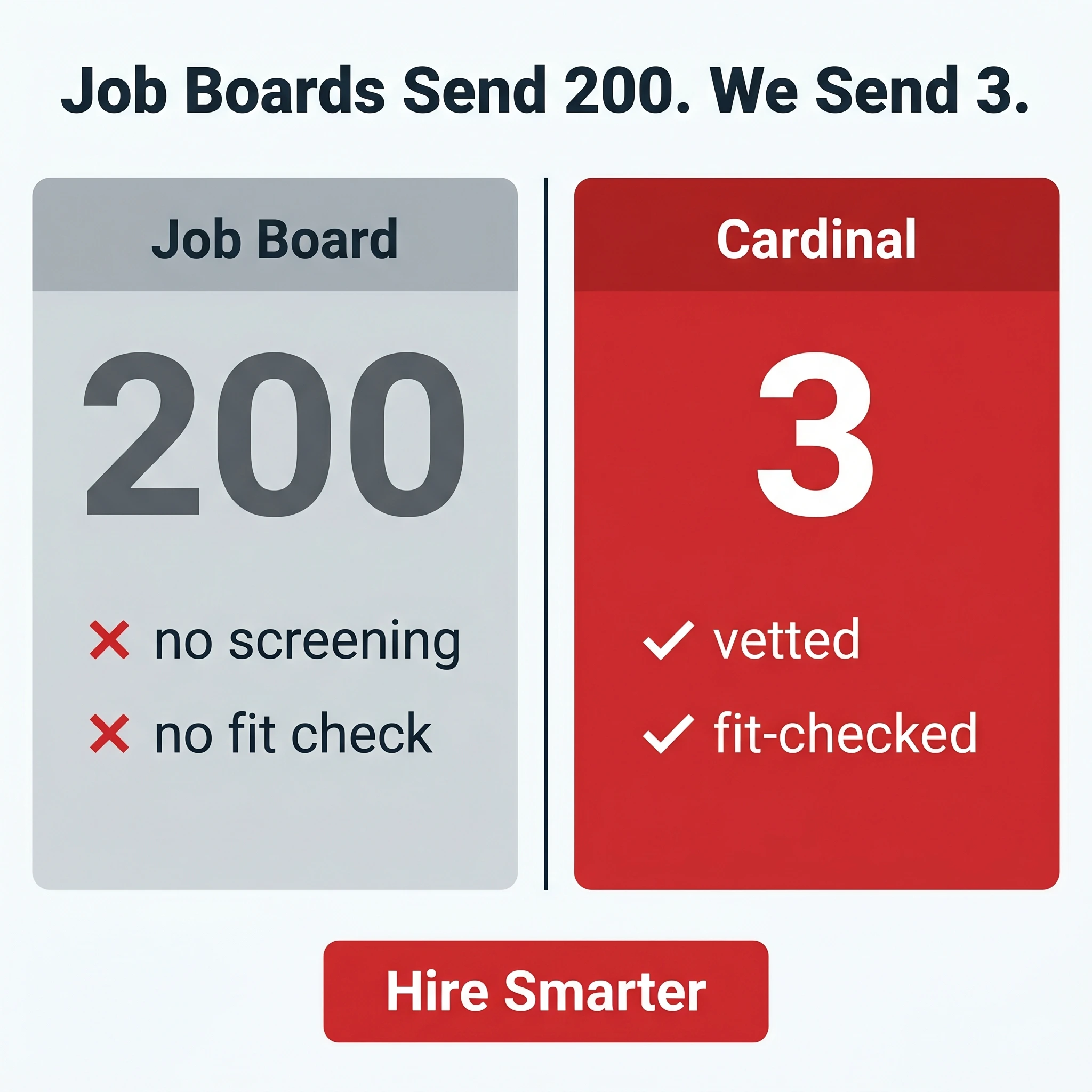
The format & angle. Cardinal Recruiting’s us-versus-the-old-way comparison: two columns contrasting the job-board experience (200 applicants, no screening) with the agency’s (3 vetted, fit-checked) — no people. This replaces the before/after; a side-by-side is the cleaner contrast for a service decision.
Who it targets. Warm employers currently DIY-ing the hire on a job board and feeling the pain of it.
The hook. “Job Boards Send 200. We Send 3.” The arithmetic is the argument — quality over a meaningless flood.
Why it works. The comparison format makes the choice for the viewer by framing it as DIY chaos versus curated calm. Hiring managers know the 200-applicant slog intimately, so naming it validates a frustration they’re living. Contrasting raw volume against a vetted three reframes value around screening and fit, where the agency wins. The two-column layout is instantly legible at a glance.
Steal it. Build a clean two-column graphic contrasting the DIY job-board path with your service on the dimensions that hurt — volume, screening, time, fit. Keep the claims honest; the contrast persuades on its own.
4. The best-hire testimonial ad

The format & angle. Tier One Talent: a hiring manager beside a quote card, five stars, “300+ placements.” Proof and fit, told by the person who made the hire.
Who it targets. Warm employers weighing whether the agency really delivers quality, not just speed.
The hook. “Our Best Hire This Year.” A testimonial fragment about quality and fit — the outcome that matters in direct-hire.
Why it works. Speed is easy to claim; quality needs proof. A hiring manager calling a placement their best hire of the year speaks to fit and longevity, the things that justify a permanent-placement fee. The placement count signals a real track record, and the manager’s photo grounds it in a peer the buyer identifies with. This recycles client references — recruitment’s strongest asset — into reach.
Steal it. Get a client to speak to the quality of a hire, not just the speed, and headline it in their words. Add a real placement count beneath. Secure permission and keep the claim to what the client will confirm on a reference call.
5. The no-placement-no-fee offer ad

The format & angle. Rookwood Recruitment’s risk-reversal push: clean type, the guarantee dominant, a deep green background, no photo. Risk reduction.
Who it targets. Cold and warm employers hesitant to try an unproven agency with a real role.
The hook. “No Placement, No Fee. 90-Day Guarantee.” Contingency plus a replacement guarantee — the two strongest risk-removers in recruiting.
Why it works. The barrier to trying a new agency is the fear of paying for a bad hire, and stacking “no placement, no fee” with a 90-day replacement guarantee removes both the upfront and the downstream risk. It signals confidence — an agency that bets its fee on the outcome believes in its pipeline. The typography-only format reads as a clear professional offer, and the guarantee does the closing that proof set up.
Steal it. Lead with whatever risk reversal you can genuinely stand behind — contingency, a replacement guarantee, a fill-by date. Make the terms clear, and let the guarantee carry the close. Rotate the creative before ad fatigue erodes it.
Place all five concepts
A fast fill, a curated shortlist, a job-board comparison, a best-hire testimonial, and a risk-free guarantee — five recruitment ads aimed at five points in a hiring manager’s frustration. Genuinely different concepts each earn incremental delivery from Meta’s auction, while five versions of one promise just split the same impressions — so range, not repetition, gets each employer the angle that lands. The closest sibling is temporary and contract hiring — the staffing agency ad examples breakdown angles the same channel at shift coverage and volume rather than permanent placements, so link the two instead of overlapping them.
Lead cold traffic with the UGC and comparison concepts, then retarget warm employers with the testimonial and guarantee offer to sign them. The bottleneck is producing five-plus distinct concepts on repeat, and Zendux takes care of it: on-brand static variants generated with AI and bulk-launched across ad sets so your req pipeline stays full.