Staffing Agency Ad Examples: 5 Ads That Win Contracts
Five staffing agency ad examples that win contracts — a crew-ready UGC ad, a staff-up hero, a volume stat, an ops-manager testimonial, and a no-show guarantee offer.
Staffing agency ads that win contracts answer the one thing an operations manager is panicking about: can you put reliable workers on my floor fast, at the volume I need, without a no-show wrecking the shift? “Workforce solutions” is invisible; “crew on site by 6 AM” books the call. The five fictional ads below cover the five angles that convert operations buyers — speed, scale, volume capacity, a peak covered, and a no-show guarantee — each in a visibly different format.
Key takeaways
- Sell speed and coverage, not careers — staffing is temp and contract, so the promise is workers fast and at volume, not a permanent hire.
- Quantify it: “crew by 6 AM,” “20 workers tomorrow,” “fully staffed in 48 hours” beat “flexible workforce solutions” because buyers are losing output now.
- A no-show guarantee removes the risk of trying a new agency — reliability is the single biggest fear in temp labor.
- Five distinct concepts reach five different operations mindsets; one recycled “winner” caps reach under Meta’s current delivery.
What makes a great staffing agency ad
The buyer is an operations or warehouse manager staring at a labor gap that’s throttling output today — a shift short three people, a seasonal peak with no crew, an event next week with no team. Their pain is speed and reliability, not talent quality in the direct-hire sense. The trigger is an immediate, quantifiable shortfall. Staffing is volume and flexibility: get the right number of warm bodies who show up and work.
The proof that matters is operational and concrete — a fast fill time, a real worker count, a no-show guarantee, a client who got covered through a peak. Generic “connecting people with work” creative reads as every other agency. One specific promise per ad — speed, scale, or reliability — is what separates the best static ads from filler. Keep numbers honest; an operations buyer will test “by 6 AM” on the very first order.
The economics reward retention hard. A staffing client that fills shifts with you every week is worth far more than a single placement, so acquiring a recurring account justifies real spend. The benchmark is cost per signed account against weekly fill volume and account lifetime — reliability on the first order is what turns a trial into a standing contract.
| Ad | Format | Angle | Funnel stage | Best for |
|---|---|---|---|---|
| Crew-by-6AM UGC | UGC | Speed | Cold | Light industrial & warehouse |
| Staff-up hero | Service hero | Scale / capacity | Cold/warm | Seasonal & peak staffing |
| 20-workers stat | Stat callout | Volume | Warm | High-volume labor needs |
| Covered-the-peak testimonial | Testimonial | Reliability proof | Warm | Agencies with client references |
| No-show guarantee offer | Offer | Risk reduction | Cold/warm | Winning first-time accounts |
1. The crew-by-6AM UGC ad
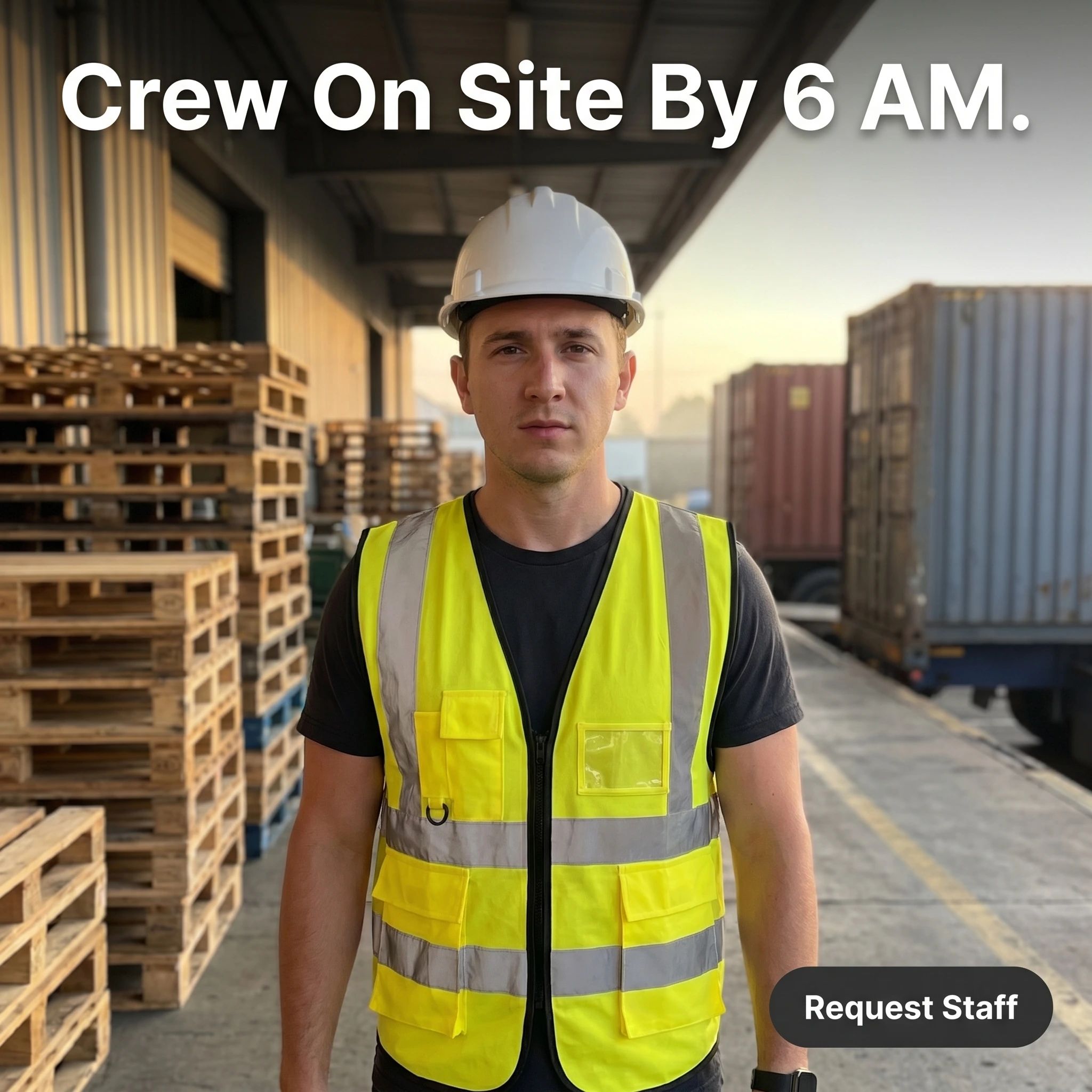
The format & angle. A Shiftline Staffing worker in a hi-vis vest on a loading dock at dawn, shot like a supervisor snapped it on arrival. Speed, with a real worker on a real floor.
Who it targets. Cold operations managers facing a shift that’s short-handed and a clock that’s already running.
The hook. “Crew On Site By 6 AM.” A concrete arrival time — the single thing a manager staring at an understaffed shift needs to hear.
Why it works. The candid dawn-shift frame is proof the agency actually fields workers, not a stock image of a handshake. Naming a specific arrival time speaks to the operational reality — shifts start early, and coverage is binary. The hi-vis, on-the-dock authenticity reads as a firm that knows light-industrial work, which builds trust with a buyer who’s been burned by no-shows. That credibility earns the save and cheaper reach.
Steal it. Photograph a real worker in proper PPE on an actual dock or floor, early light, phone camera. Headline the arrival or fill time you can genuinely hit, and be ready to prove it on the first order — reliability is the whole sale.
2. The staff-up hero ad
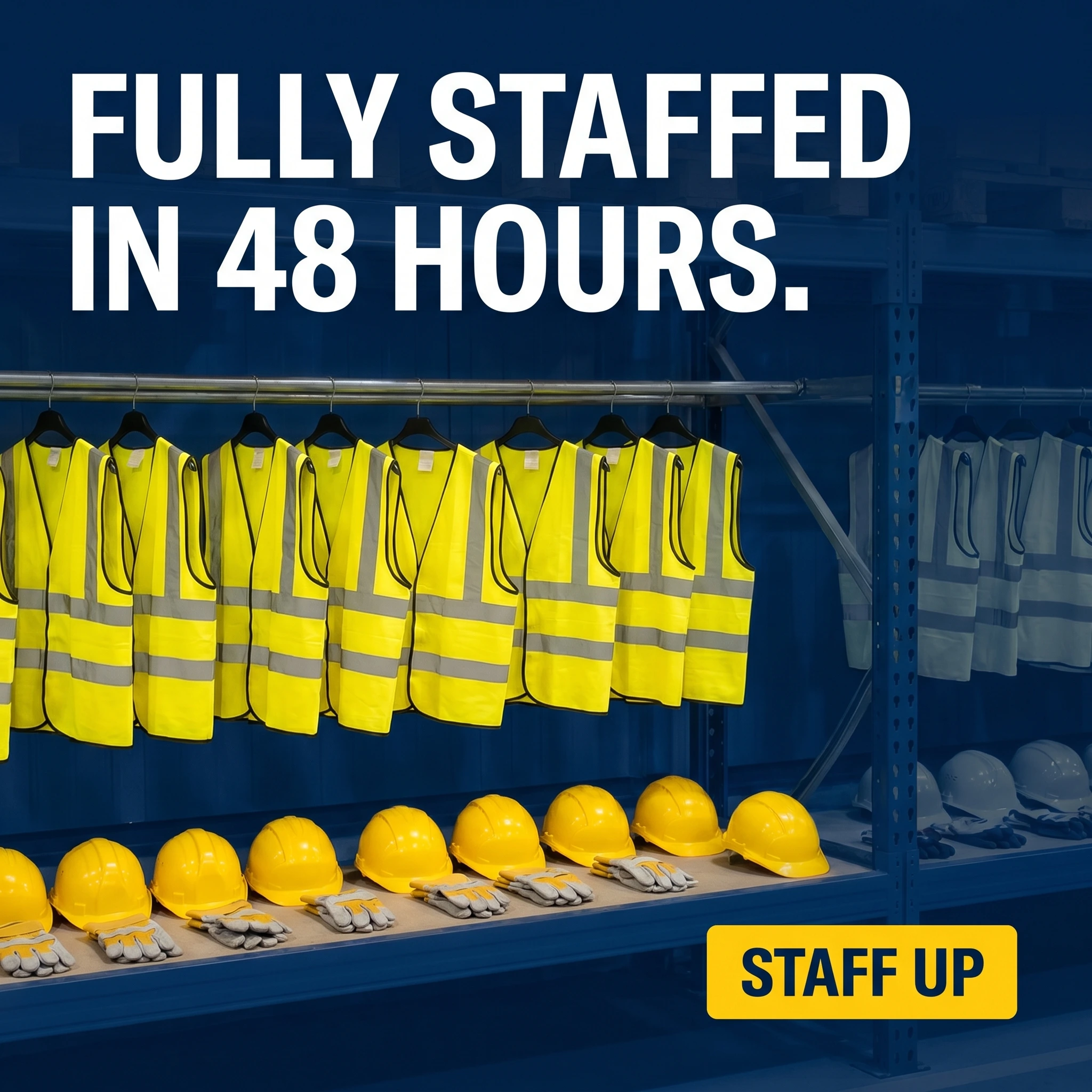
The format & angle. Anchor Workforce’s hero: a clean, bold shot of a rack of ready hi-vis vests, hard hats, and gloves — no people. Scale and capacity, the look of a crew about to deploy.
Who it targets. Cold and warm managers planning a seasonal ramp, a new line, or a big contract that needs bodies fast.
The hook. “Fully Staffed In 48 Hours.” It promises scale on a timeline — the exact worry of anyone facing a ramp with no crew.
Why it works. The image of ready-to-go gear signals capacity at rest — a bench of workers waiting to deploy — which is precisely what a manager planning a ramp wants to see. The headline puts a tight, credible clock on scale, differentiating from agencies that take weeks to staff up. The clean, single-focus composition reads instantly. The gear is the proof of readiness; the timeframe is the promise.
Steal it. Photograph staged crew gear — vests, hard hats, gloves — in clean, bold lighting, no people needed. Headline the scale-and-speed promise your operations matches, and let the ready gear imply a bench that can deploy on demand.
3. The 20-workers stat ad
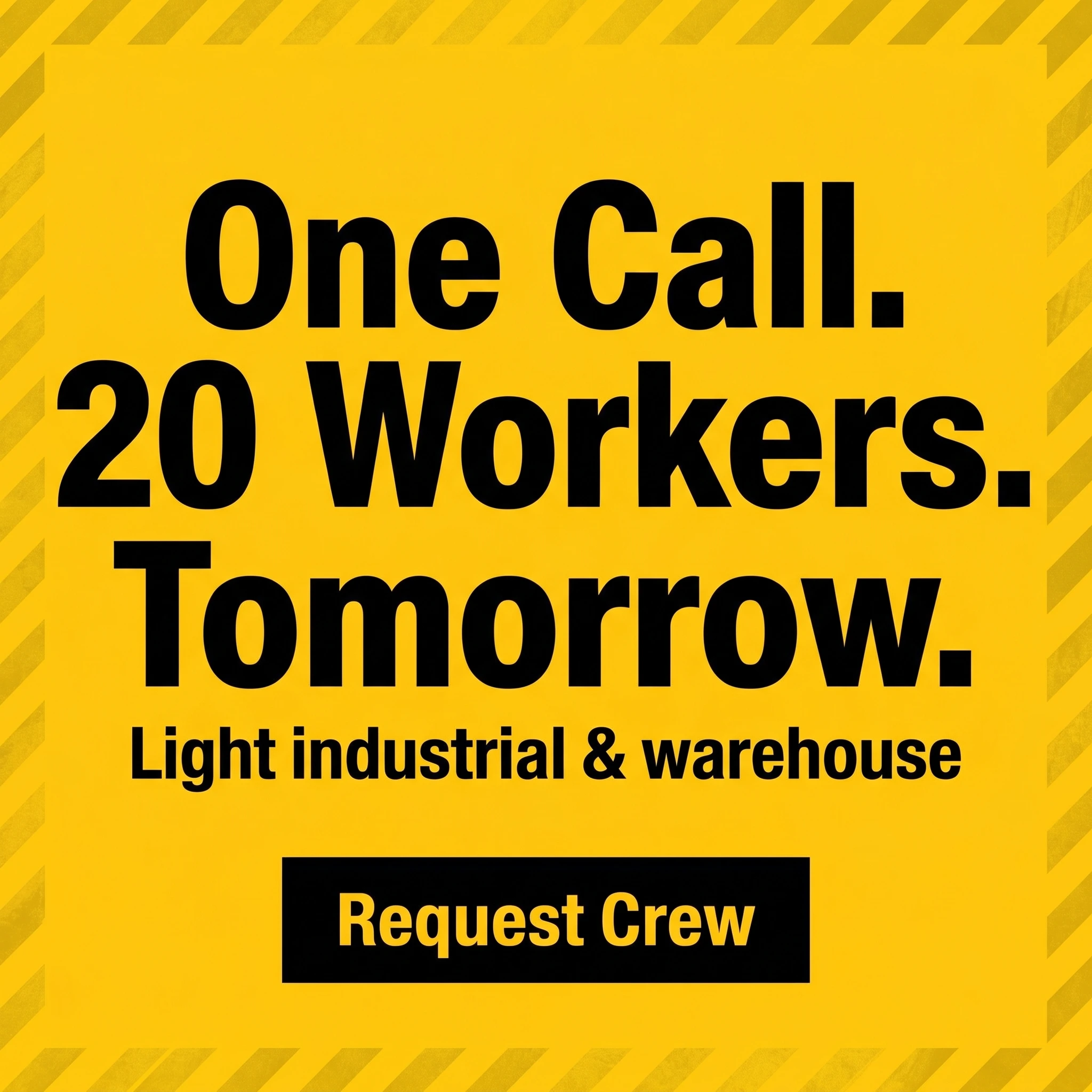
The format & angle. Rapid Crew’s proof point: a bold typographic stat on an industrial-yellow background — no people. This replaces the before/after; for a volume-labor service, a capacity stat is the cleaner proof than any transformation.
Who it targets. Warm operations buyers who need real headcount, fast, and doubt a single agency can deliver it.
The hook. “One Call. 20 Workers. Tomorrow.” Three beats — effort, scale, speed — that map exactly to how a manager thinks about coverage.
Why it works. A volume claim rendered as a big, clean number proves capacity without a wall of copy. “One call” promises low effort, “20 workers” promises scale, “tomorrow” promises speed — the complete value proposition of high-volume staffing in six words. The stat-callout format is built for a service whose value is quantitative, not visual. The number does the convincing.
Steal it. Lead with a real, defensible capacity claim — the headcount you can field on short notice — rendered huge over a bold background. Keep the number honest, because the first big order will test it. Pair it with a simple “request staff” action.
4. The covered-the-peak testimonial ad

The format & angle. Onsite Staffing Co.: an operations manager in a warehouse beside a quote card, five stars, “5,000+ shifts filled.” Reliability proof, told by the person who lived the peak.
Who it targets. Warm buyers wondering whether the agency can actually scale and show up when it counts.
The hook. “Covered Our Whole Peak.” A testimonial fragment about reliability under pressure — the moment that makes or breaks a staffing relationship.
Why it works. The deciding fear in staffing is being left short during the busiest stretch, and a manager confirming the agency covered an entire peak attacks that fear directly. “Shifts filled” as a counter signals proven volume, not a one-off. The warehouse setting and a peer-manager’s face make the proof concrete to the next buyer. This recycles client references — the strongest reliability signal — into reach.
Steal it. Get a client to speak to reliability through a high-pressure period, and headline it in their words. Add a real shifts-filled or fill-rate stat beneath. Secure permission and keep the claim to what the client will confirm.
5. The no-show guarantee offer ad

The format & angle. Bluecollar Bridge’s risk-reversal push: bold type, the guarantee dominant, an industrial charcoal background, no photo. Risk reduction.
Who it targets. Cold and warm managers who’ve been burned by no-shows and are wary of trusting a new agency.
The hook. “No-Show? That Shift’s On Us.” It names the exact nightmare — a worker who doesn’t show — and puts the agency’s money behind preventing it.
Why it works. Reliability is the entire anxiety in temp labor, and a guarantee that the agency eats the cost of a no-show signals total confidence in its bench and accountability systems. It removes the single biggest reason a manager won’t try a new firm. The typography-only format reads as a clear, serious operational offer, and the guarantee does the closing that speed and volume claims set up.
Steal it. Offer a no-show or fill guarantee you can genuinely back — a free replacement shift, a credit, same-day backfill. Make the terms clear, and let the guarantee carry the close on first-time accounts. Rotate the creative before ad fatigue erodes it.
Deploy all five concepts
A fast crew, a 48-hour staff-up, a volume stat, a covered-peak testimonial, and a no-show guarantee — five staffing ads aimed at five points in an operations manager’s labor crunch. Because the Andromeda engine now sifts a far larger pool of ads per auction, a portfolio of distinct concepts out-delivers near-duplicate variants — each finding the operations buyer it was built for. The closest sibling is permanent hiring — the recruitment agency ad examples breakdown angles the same channel at direct-hire quality rather than shift coverage, so link the two instead of overlapping them. To structure the creative tests themselves, the ABO vs. CBO for creative testing guide covers campaign setup.
Lead cold traffic with the UGC and stat concepts, then retarget warm accounts with the testimonial and guarantee offer to sign standing contracts. Standing up five-plus genuinely different concepts on a schedule is the hard part, and Zendux automates it — AI static variants in your brand, bulk-launched across ad sets so your account pipeline stays full.