Pet Store Ad Examples: 5 Ads That Sell
Five pet store ad examples that sell food and supplies — a picky-eater UGC ad, a product hero, a coat before/after, a switcher testimonial, and a first-bag offer.
Pet store ads that sell all do the same thing: show a real animal visibly happier or healthier because of the product, then give one clear reason to try it. Ingredient panels and packaging flat-lays don’t move owners the way a picky eater finally diving into the bowl does. The five fictional ads below cover the five angles that convert pet shoppers — the happy-pet payoff, the product hero, a visible improvement, a switcher’s proof, and a first-bag offer — each in a visibly different format.
Key takeaways
- Show the pet, not the package — owners buy their animal’s joy and health, so a happy or healthier pet outsells a product flat-lay.
- Repeat purchase is the prize: design the first ad for a trial and the experience for a subscription, where pet-retail margins compound.
- One clear claim per ad — real ingredients, lasts longer, picky-eater approved — beats a feature list a scrolling owner won’t read.
- Five distinct concepts reach five different shopper mindsets; one recycled “winner” caps reach under Meta’s current delivery.
What makes a great pet store ad
The buyer shops with their heart and their wallet at once: they want their pet delighted and healthy, and they want value on something they’ll rebuy forever. The trigger moments are a picky eater, a destroyed toy, a dull coat, a vet’s nudge, or simply running low. Creative that pictures the pet in that moment — and the product solving it — converts; abstract claims don’t.
The proof that matters is the animal’s reaction and a believable, specific claim. A real dog mid-chomp beats “premium nutrition.” Stocky catalog shots of a product on white read as a marketplace listing, not a brand worth switching to. One concrete claim per ad, shown through the pet, is what separates the best static ads from filler. Keep health claims modest and honest — “supports a shinier coat,” not a cure.
The economics run on repeat purchase. Ecommerce CPMs swing with season and audience, but the number that matters is first-order ROAS measured against lifetime value: a pet owner reorders for years, so acquiring near break-even on the first bag and profiting on the subscription is a sound trade. Build the funnel — and the offer — around the second order, not the first.
| Ad | Format | Angle | Funnel stage | Best for |
|---|---|---|---|---|
| Picky-eater UGC | UGC | Happy pet / relief | Cold | Premium & fresh food brands |
| Real-food hero | Product hero | Quality / value | Cold/warm | Hero SKU launches |
| Coat split | Before/after | Visible improvement | Warm | Coat, skin & nutrition lines |
| Switcher testimonial | Testimonial | Social proof | Warm | Brands with loyal reorders |
| First-bag offer | Offer | Acquisition / trial | Cold/warm | Subscription acquisition |
1. The picky-eater UGC ad

The format & angle. A Wagworthy shopper crouched by her dog’s bowl as it dives in, shot like she grabbed her phone in delight. The happy-pet payoff, aimed at the picky-eater frustration.
Who it targets. Cold owners battling a fussy eater — a daily, low-grade stress for a huge slice of the market.
The hook. “My Picky Eater Finally Eats.” First-person, specific, and instantly relatable to anyone who’s scraped a full bowl into the trash.
Why it works. The candid kitchen moment is proof of the result, not a claim of it — a real dog, a real bowl, real enthusiasm. Framing the benefit as a problem solved (“finally eats”) reaches owners who’ve tried three other foods and reaches them emotionally. The unpolished phone-photo look reads as a genuine customer recommendation, which earns the save, the share, and the cheaper reach that follows.
Steal it. Film or photograph a real pet enthusiastically eating or playing, phone camera, natural light. Headline the exact frustration the product fixes, in the owner’s own words — “finally eats,” “stopped scratching,” “actually plays with it.”
2. The real-food hero ad

The format & angle. Kibble Lane’s product hero: a clean studio shot of the food bag surrounded by fresh, recognizable ingredients on a bold background — no people. Quality and value.
Who it targets. Cold and warm owners scrutinizing ingredient quality, increasingly the default mindset in pet food.
The hook. “Real Food, Not Filler.” A blunt quality claim that draws the line against the cheap-ingredient competition.
Why it works. Ingredient quality is the dominant anxiety in pet food, and the hero shot answers it visually — real meat and vegetables beside the bag prove the claim better than a panel of percentages. The single bold focal point reads instantly at thumbnail size, and the us-versus-filler framing positions the brand against the bargain shelf without naming a competitor. The product is the hero; the ingredients are the evidence.
Steal it. Shoot your hero SKU in clean, bold lighting with the actual recognizable ingredients staged around it. Headline the single quality claim you can defend, and let the fresh ingredients carry the proof.
3. The coat split ad
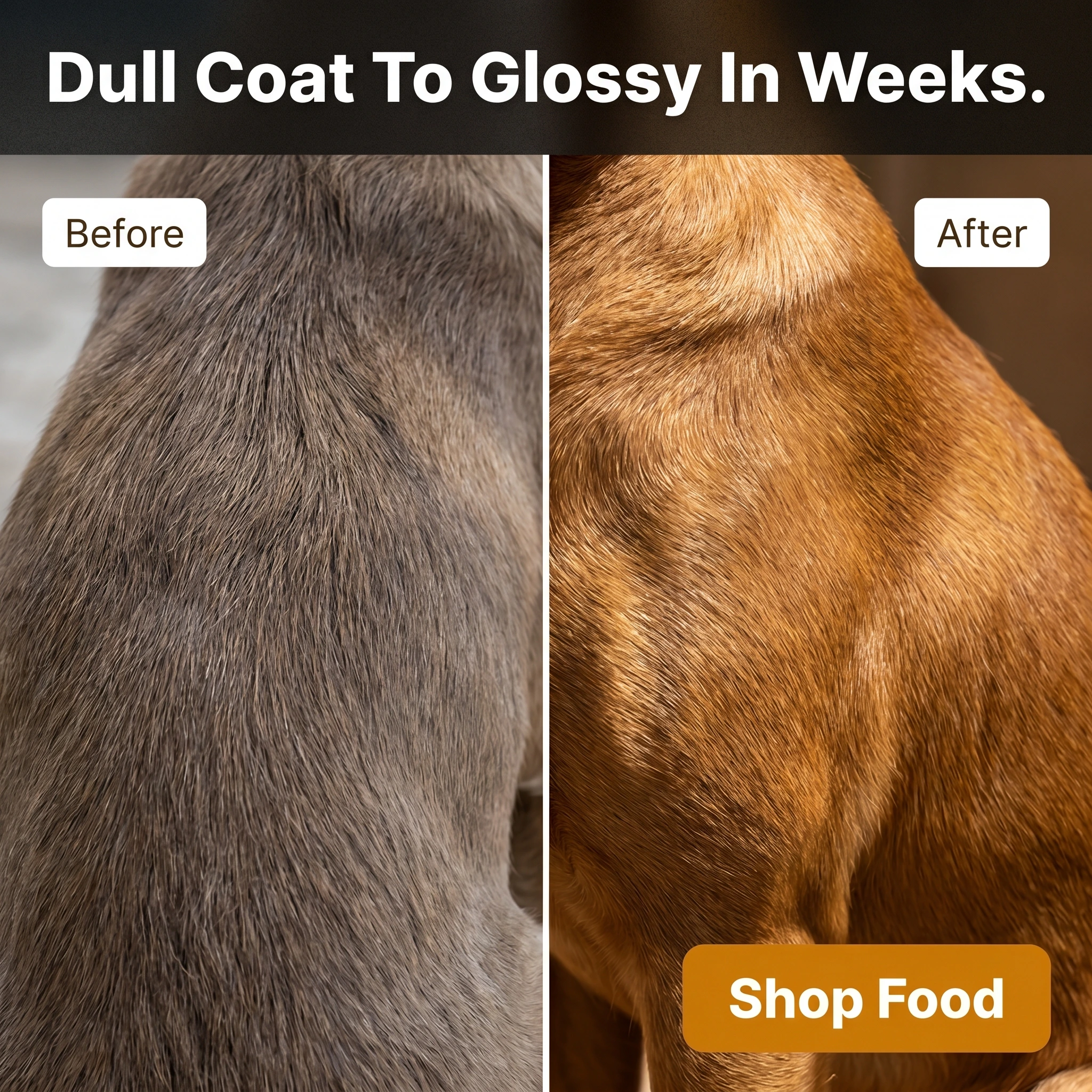
The format & angle. Pawtry’s transformation: a dog’s dull, dry coat on the left; a soft, glossy coat on the right after weeks on the food. A visible improvement — an animal’s coat, not a human body, so it’s clear of Meta’s personal-health rules.
Who it targets. Warm owners who’ve noticed a lackluster coat and are open to a nutrition fix.
The hook. “Dull Coat To Glossy In Weeks.” The contrast sells the outcome; “in weeks” sets an honest, achievable timeframe.
Why it works. Coat condition is a visible, emotionally resonant proxy for pet health, and the before/after makes a nutrition benefit concrete in a category where claims usually stay abstract. Because the subject is an animal’s coat, the transformation format is fair game where a human before/after wouldn’t be. The realistic timeframe keeps the claim credible — overpromising a result invites both skepticism and policy trouble.
Steal it. Document a real coat improvement over a few weeks, same lighting and angle, and keep the claim modest and honest (“supports a shinier coat”). Hedge the timeframe to what you can actually show.
4. The switcher testimonial ad

The format & angle. Snout & About: an owner relaxed with his cat beside a quote card, five stars, “4,000+ five-star bags.” Social proof, framed as a switch that stuck.
Who it targets. Warm audiences weighing whether to abandon their current brand for yours.
The hook. “Switched And Never Looked Back.” A review fragment that signals the switch was easy and the regret was zero.
Why it works. Switching pet food feels risky — owners fear digestive upset or a pet that refuses the new bag. A testimonial about a switch that worked defuses that fear directly, and the huge “bags sold” count turns one voice into a movement. The owner-and-pet photo makes it concrete and warm. This recycles your reviews — pet retail’s most persuasive asset — into paid reach.
Steal it. Pull reviews that mention switching, “no more upset stomach,” or “wish I’d done it sooner.” Build the card around the strongest switch story and display your bags-sold or review count beneath it.
5. The first-bag offer ad

The format & angle. Thicket Pet Supply’s acquisition push: bold type, the discount dominant, a warm background, a small paw motif, no animal. Trial and acquisition.
Who it targets. Cold and warm owners ready to try but hesitant to commit at full price.
The hook. “First Bag 30% Off + Free Delivery.” The discount lowers the bar; free delivery removes the last objection to ordering online.
Why it works. The whole game in pet retail is the second order, and a discounted, free-shipped first bag makes the trial nearly frictionless. Stacking the discount with free delivery kills the two reasons a ready buyer stalls at checkout — price and shipping cost. The typography-only format reads as a clean brand promo, and routing into a subscription option at checkout turns the trial into recurring revenue.
Steal it. Discount the first bag enough to win the trial, cover or waive shipping, and present the subscription as the default at checkout. Track first-order ROAS against lifetime value, and rotate the creative before ad fatigue erodes it.
Put all five in the bowl
A happy-pet payoff, a product hero, a visible improvement, a switcher’s proof, and a trial offer — five pet store ads aimed at five different shopper moments. With the Andromeda engine evaluating far more candidate creative per impression, a feed of genuinely different concepts beats a stack of near-identical variants — each one matched to the owners most likely to buy it. For broader retail patterns, the ecommerce ad examples breakdown covers the cross-category playbook, and if you also handle pet health, the veterinary ad examples post is a natural sibling.
Lean on the offer and UGC concepts to acquire trials, then retarget with the hero and testimonial to convert and reorder, pushing subscription wherever it fits. Generating five-plus genuinely different concepts on a schedule is the bottleneck, and Zendux clears it — AI static variants in your brand, bulk-launched across ad sets so the funnel never runs dry.